
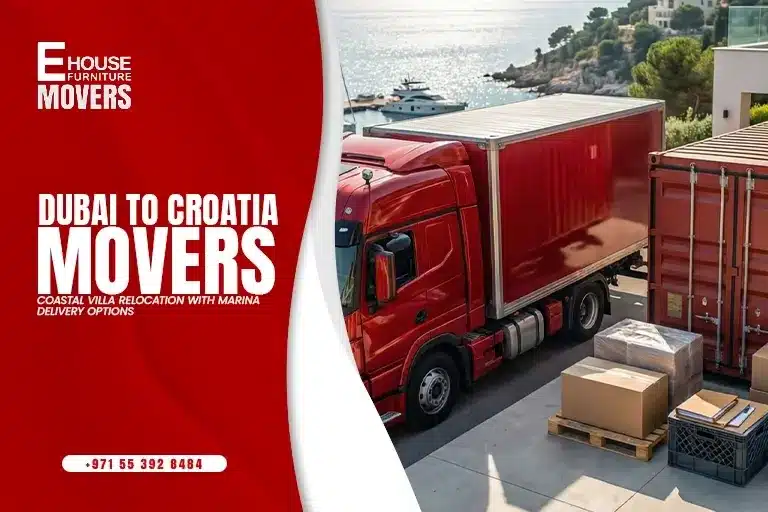
Dubai to Croatia movers often plan for a standard EU household goods shipment, then encounter Croatia-specific clearance proofs, Adriatic port tariffs, and coastal last-mile constraints that change the invoice and the delivery method.
Coastal villa relocation adds two extra variables. First, marinas and island logistics compress delivery windows. Second, salt-laden air and winter condensation elevate corrosion and moisture exposure during discharge and last-mile staging.
What benefits come from reading this guide?
- Lower clearance rework risk by matching Croatia duty and VAT relief conditions to a document list published by Croatia’s Customs Administration and gov.hr.
- Lower destination cost volatility by converting Port of Rijeka container storage and handling tariffs into measurable cost triggers.
What makes Dubai to Croatia movers planning different for coastal villa relocation with marina delivery options?
Dubai to Croatia movers projects become complex because coastal villas add a second delivery layer after port clearance. That second layer often uses marina side access, island logistics, or restricted road corridors. In 2024, the average total occupancy of mooring capacity in nautical ports was 68.0%, of sea moorings it was 76.5%, and of land berths it was 48.7%, which makes berth timing a measurable constraint, not an assumption.
A compliance-first guide starts with customs eligibility and ends with a delivery method statement that fits marina operating rules, port appointment systems, and villa access constraints.
What conditions define duty and VAT relief for household goods when moving from Dubai to Croatia?
Croatia’s Customs Administration ties customs duty relief to EU relief rules for personal property. The published conditions include 12 consecutive months in a third country before moving and 6 months of ownership and household use for the imported personal property.
Personal property of natural persons moving to Croatia from third countries (non-EU Member States) is exempt from payment of customs duties and value-added tax (VAT) if they meet the following conditions:
- The beneficiary of the exemption has spent a minimum of 12 months in a row in a third country before moving;
- They are importing personal property that they owned and used in their household in a third country for a minimum of 6 months before the day of the move;
- Their personal property is intended to be used for the same purpose in their new habitual, temporary, or permanent place of residence.
Compliance check
- Confirm continuous residence abroad for at least 12 months.
- Confirm household ownership and use for at least 6 months.
- Confirm the post-move use purpose remains household or leisure, not professional.
Which documents support smooth customs clearance for Dubai to Croatia movers using the transfer of residence relief?
Croatia’s Customs Administration lists a specific attachment set for the relief request filed with the competent customs office for the new Croatian residence location.
Document set listed by the Croatian Customs Administration
- Certificate from a Croatian diplomatic or consular office abroad, or an equivalent proof, confirming continuous residence abroad for at least 12 months.
- Written statement declaring the moving date to Croatia.
- List of imported personal property in two copies.
- Proof of registered residence or habitual residence in Croatia for a period of at least one year.
- Documents proving the goods had at least 6 months of use before the moving date
VAT relief anchoring
The same Customs Administration page links VAT exemption for imported personal property to Croatia’s VAT provisions for persons who spent at least 12 consecutive months outside the Union, with category exclusions.
What counts as “household goods” for Dubai to Croatia movers, and where do exclusions start?
Shipping household goods into the Republic of Croatia
Household goods include: furniture, household appliances, various electrical appliances, works of art, hobby tools, smaller agricultural tools and devices (various saws, walking tractors, lawnmowers), personal vehicles (cars), trailers, mobile homes, vessels, pets, riding animals, and also reasonable quantities of consumables bought as stock (e.g. as one-month stock of food). The goods have to be intended for use in a household or for leisure and may not be used for the performance of professional business activities.
Croatia’s Customs Administration clarifies exclusions under personal property relief, including alcohol and alcoholic beverages, tobacco products, commercial means of transport, and goods used for business or a job.
Practical classification rule
Treat the inventory as two streams.
- Personal household and leisure goods aligned to relief eligibility.
- Excluded or restricted categories flagged early for separate handling logic.
Can household goods arrive before the mover arrives in Croatia?
Import of household goods before physically moving
Import of household goods before the physical move, but it ties the relief to a relocation within 6 months of release into free circulation, and requires a statement of intent to relocate within six months.
A guarantee issued by an authorised forwarding agent or a cash deposit in the amount of the customs duty and VAT that would otherwise apply supports the procedure when the person imports before arrival.
Timing control
- Record the customs release date.
- Record the physical relocation date within 6 months of release.
- Record the guarantee or cash deposit instrument and reference.
Which Croatian ports matter for coastal villa relocation logistics after Dubai arrival?
Croatia’s Ministry of the Sea, Transport and Infrastructure lists six ports open for public traffic of outstanding international economic importance: Rijeka, Zadar, Šibenik, Split, Ploče, and Dubrovnik.
This matters because coastal villa relocation often routes via these hubs, then converts to road delivery, island feeder delivery, or marina side handling depending on access constraints and berth availability.
What does the marina capacity data say about marina delivery options on Croatia’s coast?
Croatia’s official statistics on nautical tourism ports provide measurable constraints for marina delivery planning.
NAUTICAL TOURISM – Capacity and Turnover of Ports
Croatia’s statistical release reports:
- 226 nautical ports on the Croatian coast, including 85 marinas, 81 anchorages, 16 berths, and 44 boat storage.
- Total water surface area 4,949,829 m² and total moorings 19,073.
- Average total occupancy 68.0%, sea mooring occupancy 76.5%, and land berth occupancy 48.7%.
This distribution supports a practical inference: larger service craft faces tighter mooring availability than mid-size vessels, especially near premium coastal villa zones during high occupancy periods.
Which port tariff numbers convert into cost triggers for Dubai to Croatia movers?
The confirmation of acceptance of an operational order by the contractor represents the conclusion of the contractual obligation in accordance with the
General Terms and Conditions of Port of Rijeka. The Port of Rijeka published tariff provides concrete cost triggers for container handling and storage.
Selected Port of Rijeka container storage and handling tariff items (examples)
| Cost trigger | Tariff item | Unit |
|---|---|---|
| Full container storage, Rijeka terminal | Storage fee for the first 3 days | per TEU per day |
| Full container storage, Rijeka terminal | Storage fee for 4 to 7 days | per TEU per day |
| Empty container storage, Rijeka terminal | Storage fee for 4 to 7 days | per TEU per day |
| Full container storage, Škrljevo terminal | Storage fee from the first day | per TEU per day |
| Full container storage, Škrljevo terminal | Storage fee for 4 to 7 days | per TEU per day |
| Full container storage, Škrljevo terminal | Storage fee from day 8 onward | per TEU per day |
| Transhipment full container | AGCT to Rijeka terminal | per container |
| Positioning a full container | For inspection, sealing, stripping, and weighing | per container |
Port of Rijeka includes the first and last day inside the storage fee calculation language, which turns appointment delays into billed days.
What are the most common landed invoice expansion points in a Dubai to Croatia coastal villa relocation?
Invoice expansion usually comes from measurable triggers, not from hidden intent. The triggers below align with published tariff logic, customs procedure steps, and marina capacity constraints.
Cost triggers to track
- Port storage days after free storage periods.
- Container transhipment between terminals.
- Container positioning for inspection or stripping.
- Incorrect or delayed dispositions billed per container.
- Customs relief rework when residence and use proofs lack sufficiency.
- Guarantee or cash deposit exposure when goods arrive before the importer.
- Marina slot scarcity during high occupancy periods, shown by 68.0% average occupancy and 76.5% sea mooring occupancy.
- Large vessel berth scarcity for over 20 m craft, with 986 moorings recorded.
- Special category exclusions that require separate handling and documentation.
- Motor vehicle taxes even when the move stays inside the EU, per gov.hr guidance on vehicle declarations.
- Demurrage and detention charges when container time exceeds the agreed free time, as described by carriers and regulators.
- Weather-driven moisture damage occurs when condensation forms inside containers under changing conditions.
What compliance-first documentation structure fits the coastal villa relocation and marina delivery options?
A compliance-first evidence pack stays readable for customs, terminals, insurers, and delivery subcontractors.
Evidence pack structure aligned to clearance and delivery
| Pack section | Purpose | Examples |
|---|---|---|
| Residence continuity | Relief eligibility | Consular certificate or equivalent confirming 12-month residence abroad |
| Use and ownership | Relief eligibility | Invoices and authentic documents proving 6-month ownership and use |
| Inventory control | Clearance speed | Two copies of the list of personal property, consistent with the item naming |
| Relocation timing | Early import procedure | Statement of moving date, plus a six-month relocation intent when importing early |
| Port cost control | Invoice predictability | Storage day log tied to Port of Rijeka tariff thresholds |
| Marina and site access | Delivery feasibility | Mooring reservation, access survey, lifting plan, route restrictions supported by occupancy context |
How do Dubai to Croatia movers select the correct last-mile method for a coastal villa?
Method selection depends on access constraints, berth constraints, and damage risk controls.
Three delivery patterns used in coastal villa relocation
- Port to the villa by road
This pattern fits mainland villas with road access and turning radii that accept box trucks or shuttle vehicles.
- Port to marina, marina to villa by small craft
This pattern fits villas with direct quay access, controlled unloading zones, and confirmed mooring or berth windows, which matters under 76.5% sea mooring occupancy. Državni
- Port to island staging point, then feeder leg
This pattern fits island villas where direct heavy truck access lacks feasibility, and delivery timing depends on marina operations.
Decision prompts that reduce rework
- Validate berth type and availability in a marina, anchorage, or berth category, since Croatia records 85 marinas and 81 anchorages as separate facility types.
- Match vessel length to mooring availability bands, since Croatia records separate counts for under 6 m, 10 to 12 m, and over 20 m classes.
- Match delivery month to occupancy patterns, using the 68.0% annual average occupancy as a baseline risk indicator.
What material controls reduce moisture damage during Adriatic coastal delivery?
Moisture damage in containers follows physics, not luck. Condensation forms when internal air reaches its dew point on colder container surfaces, which trade literature describes as container sweat or container rain.
A peer-reviewed navigation study models condensation probability on major Asia to Europe container routes and ties risk to changing outside conditions, and measures correlations between outside and inside air conditions.
Moisture control actions that stay auditable
- Use humidity indicators inside cartons containing corrosion-sensitive items.
- Use sealed vapor barriers for metal fixtures and tools, with a separation layer between metal and corrugated board.
- Use desiccant placement logs with location counts per container and photo evidence.
- Use air gap planning between cargo and container walls to reduce direct contact with cold surfaces.
- Use ventilation logic aligned to dew point concepts described in loss prevention guidance.
Corrosion context for coastal villas
ISO 9223 defines a classification system for atmospheric corrosivity and includes marine and marine industrial environment descriptions, including the CX category concept for severe marine exposure.
This matters for coastal villa relocation because outdoor staging at a marina increases salt aerosol exposure compared to inland unloading.
What evidence reduces claims friction for luxury interiors in coastal villa relocation?
Claims friction drops when evidence aligns with sequence and responsibility boundaries.
Evidence protocol
- Photograph the exterior condition of crates, cartons, and seals before port release.
- Photograph the container interior before the first item removal.
- Record seal number, container number, and time stamp per photo batch.
- Record moisture indicator readings at door opening and at villa unloading.
- Record high-value items with serial numbers in the inventory list.
This evidence protocol supports clear allocation of damage timing between port custody, inland haulage, marina transfer, and villa handling.
What is an end-to-end SOP for Dubai to Croatia movers aiming for smooth clearance and marina delivery options?
A linear SOP keeps customs, port, and delivery contexts separated while maintaining a single evidence trail.
SOP sequence
- Scope: Confirm shipment type as household goods and confirm excluded categories early.
- Eligibility: Confirm 12-month residence abroad and 6-month use and ownership evidence.
- Pack: Build a moisture control plan supported by condensation and ventilation guidance.
- Document: Assemble the customs request attachment set listed by Croatia’s Customs Administration.
- Port plan: Map storage thresholds and handling triggers using Port of Rijeka tariff items.
- Marina plan: Reserve berth windows using occupancy context and match vessel length to mooring bands.
- Deliver: Execute a method statement aligned to villa access constraints, then close with a signed condition confirmation.
Final Thoughts: Closing the File, Customs Proofs, Port Clocks, and Marina Delivery Sign Off
Dubai to Croatia movers planning becomes predictable when customs relief evidence, port tariff triggers, and marina delivery options sit inside one compliance-first workflow. Croatia’s published rules define the relief test through 12-month residence continuity and 6-month ownership and use, plus a specific attachment list that supports the request. The cost side becomes measurable when Port of Rijeka storage and handling tariffs translate into day band thresholds and per container trigger points. The coastal side becomes schedulable when marina capacity data, including 226 nautical ports, 19,073 moorings, and 68.0% average occupancy, informs berth planning and vessel sizing. A single evidence pack, built for customs offices, port operators, and villa delivery teams, reduces rework loops and keeps the handover aligned to luxury finish protection.
FAQs
What is the main customs relief test for household goods from Dubai to Croatia?
It is 12 months of residence abroad plus 6 months of ownership and household use, per Croatia customs guidance.
Which document list supports the relief request in Croatia?
Croatia customs lists residence proof, moving date statement, two copies of the inventory, Croatia residence proof, and use proofs.
Can goods arrive before the mover arrives in Croatia?
Yes, with a six-month relocation commitment after customs release and a guarantee or cash deposit mechanism.
Which Croatian ports matter for international cargo flows relevant to coastal delivery?
The ministry lists Rijeka, Zadar, Šibenik, Split, Ploče, and Dubrovnik as major ports.
How many nautical ports and marinas operate on Croatia’s coast?
The 2024 survey included 226 nautical ports, including 85 marinas.
What is the reported average occupancy of the mooring capacity?
Croatia reports 68.0% average total occupancy and 76.5% sea mooring occupancy in 2024.
What port tariff number shows storage cost exposure in Rijeka?
Port of Rijeka lists EUR 8.50 per TEU per day for full container storage from day 4 to day 7 at the Rijeka terminal.
Why does condensation risk matter in a sealed container?
Research and guidance link condensation to changing conditions and dew point dynamics that cause container sweat and container rain.
What is the standard VAT rate in Croatia, for context, when relief fails?
Croatia’s Tax Administration lists a standard VAT rate of 25%.
Is an EORI number relevant for customs operations in the EU?
The European Commission describes EORI as mandatory for customs clearance in the EU customs territory for customs operations.