
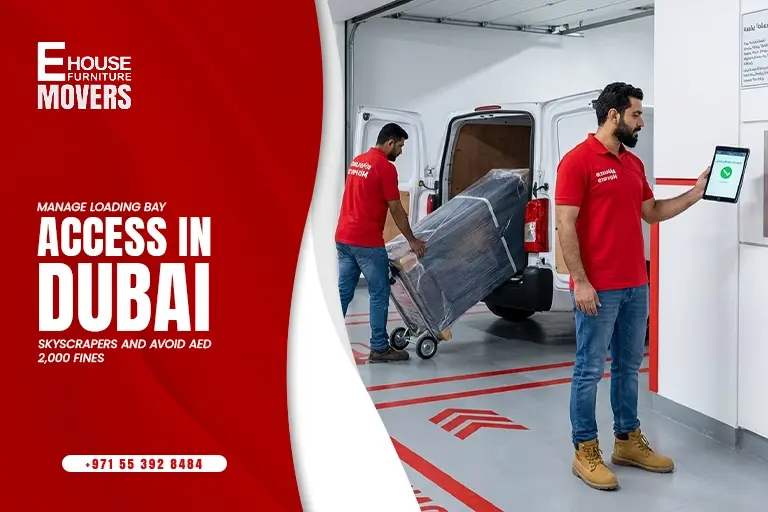
You avoid AED 2,000 fines by preventing unsafe heavy-vehicle loading, using booked loading-bay and service-lift slots, and keeping the bay clear within the approved time window. This page stays inside one macro context: loading bay access in Dubai high-rise towers and the fine-trigger behaviors during loading and unloading.
Why can loading bay mistakes trigger AED 2,000 fines in Dubai?
AED 2,000 fines apply to heavy-vehicle loading violations when the load is handled in a way that creates danger or harms the road surface. A Dubai traffic fine list includes: “Loading a heavy vehicle in a way that poses danger to others” = AED 2,000 + 6 black points and “Loading a heavy vehicle in a way that causes harm to the road” = AED 2,000 + 6 black points.
Skyscraper loading bays create risk because they combine 5 pressure points:
- Tight ramps and turns (basement entry)
- Short time slots (bay is shared)
- Service lift bottleneck (queue risk)
- Active pedestrian paths (lobbies, docks)
- Moving inventory that is bulky and unstable (wardrobes, sofas, glass)
Fine logic: if your loading method creates danger or road/ramp damage, you enter the AED 2,000 enforcement category.
What does “loading bay access” mean in Dubai skyscrapers?
Loading bay access is permission to enter a tower’s designated delivery area, unload/load within a specific slot, and exit without blocking traffic, emergency routes, or other deliveries. In most Dubai towers, access is controlled by 6 gatekeepers:
- Building management / FM (move approval)
- Security (gate pass + ID checks)
- Loading bay schedule (time slot)
- Service lift booking (lift slot)
- Vehicle constraints (height, length, type)
- Protection rules (lift padding, corridor protection)
Which 7 situations commonly cause fines, refusals, or penalties at towers?
Most problems come from unsafe loading behavior, obstruction, or unbooked access. Use this “risk map”:
- Unsafe heavy-vehicle loading (danger to others) → AED 2,000 + 6 black points risk
- Loading that damages road/ramp → AED 2,000 + 6 black points risk
- Falling/leaking load (loose cartons, unstrapped items) → higher severity in heavy-vehicle tables (risk escalation)
- Unbooked service lift → delays, refusal, rebooking, and bay overstay risk
- Unbooked loading bay → forced waiting outside, conflict with traffic/security
- Parking outside designated loading spots → tower enforcement and complaints (some buildings explicitly warn against it)
- Using passenger elevators for moving → many towers prohibit it, and it triggers management action
What is the simplest SOP that prevents AED 2,000 “unsafe loading” violations?
A fine-resistant SOP is a linear process that blocks unsafe loading before it starts. Use 6 checkpoints in the same order every job:
- Confirm tower constraints (vehicle + bay + lift)
- Book bay and service lift (same time logic)
- Arrive only when the slot is live (no lane waiting)
- Load/unload using safety controls (straps, balanced weight, no overhang)
- Exit on time (hard cutoff)
- Close-out proof (timestamps + bay cleared)
What tower information must be confirmed before you dispatch the vehicle?
You must confirm 12 attributes because any one missing attribute creates bay conflict and unsafe rushed loading.
Tower Access Sheet (12 fields):
- Tower name + area (Downtown, Business Bay, Marina, JLT, etc.)
- Loading bay type (basement dock / side ramp / rear lane)
- Bay entry point (gate name or ramp location)
- Allowed vehicle type (van / 3-ton / heavy truck)
- Vehicle height limit (meters)
- Turning radius constraints (tight ramp warning)
- Slot duration (minutes)
- Service lift booking required (yes/no)
- Lift slot time window (start/end)
- Protection requirements (padding, floor covering)
- Security requirements (crew list, Emirates ID check)
- Contact person (security/FM/concierge) + reporting channel
Why this works: It converts “tower rules” into measurable dispatch controls.
Why does service lift booking decide loading bay success in skyscrapers?
Because the service lift is the bottleneck, and a blocked lift forces the vehicle to overstay the bay or unload into unsafe areas. Multiple Dubai building move guides describe service elevator booking as mandatory in high-rises and linked to permit control.
Slot math (non-negotiable):
- If lift slot starts later than bay slot → vehicle waits and blocks
- If lift slot is shorter than unloading volume → crew rushes → unsafe loading risk
- If lift slot is not booked → security refusal → vehicle idles outside → conflict
Operational rule: book lift first, then book bay to match lift.
What does “safe loading” mean when the risk is an AED 2,000 fine?
Safe loading means the load is secured, balanced, and handled without creating danger to people or damaging the road/ramp. That is exactly what the AED 2,000 heavy-vehicle loading violations target.
Safe loading controls (10 controls that directly reduce fine exposure)
- Weight centered (no heavy bias at one side)
- No overhang beyond vehicle edges
- Straps applied to tall furniture and stacked cartons
- Anti-slip base for stacked boxes (prevents shift)
- Edge protection for straps on sharp corners
- Two-person carry rule for long items (wardrobes, glass tops)
- Spotter on ramps (blind turns)
- No dragging on ramps (surface damage risk)
- Clear walking lane (no trip hazards)
- Stop-work rule if instability appears (re-stack, re-strap)
How do you book loading bay access in Dubai towers without creating violations?
You book access by syncing three approvals: management approval, loading bay time slot, and service lift slot. Many building guides describe this as part of move permit / building process.
Booking sequence (5 steps):
- Move approval / permit request (tenant authorization)
- Service lift booking (exact start/end)
- Loading bay slot booking (match lift start; add buffer)
- Submit vehicle + crew list to security
- Confirm protection rules (padding + floor covering)
Best practice buffer: add 15–30 minutes buffer before lift start for positioning and controlled unloading (not for waiting in lanes).
What is a “skyscraper timing plan” that prevents bay overstays?
A timing plan prevents overstays by defining entry, unloading, lift flow, and exit as timed milestones. Use a plan like this (edit minutes to your tower slot):
- T-45 min: Crew at off-site staging point (not at tower gate)
- T-15 min: Security call + confirmation “bay ready + lift ready”
- T-10 min: Vehicle enters only if bay is cleared
- T0: Unloading begins
- T+X: Last item off vehicle (target)
- T+X+5: Vehicle exits bay
- T+X+10: Bay cleared + close-out recorded
Rule: If the bay is blocked, revert to the staging point. Do not double-park.
What vehicle constraints cause the most loading bay failures in Dubai skyscrapers?
Most failures come from vehicle mismatch with basement access. Typical constraint types:
- Height limit (basement clearance)
- Length limit (turning radius)
- Weight limit (ramp load capacity)
- Dock geometry (narrow ramp, sharp angle)
Prevention rule: The tower access sheet must explicitly state vehicle type and clearance before dispatch.
What documentation prevents disputes and repeat penalties with tower management?
Documentation prevents disputes by proving that access was booked, rules were followed, and the bay was cleared on time. Build a “Move Access Pack” with 7 items:
- Move approval / permit reference (if issued)
- Service lift booking confirmation
- Loading bay slot confirmation
- Security access list (vehicle + crew)
- Arrival/departure timestamps (actual)
- Incident log (even if “0 incidents”)
- Bay cleared proof (photos if building requires it)
What should you do if the loading bay is blocked when you arrive?
Do not block lanes; switch to the staging plan and escalate through the tower contact. Building rules commonly require using designated spots and booked access, not informal roadside waiting.
3-step response:
- Hold at staging point
- Call security/FM for bay clearance
- Enter only when bay + lift are confirmed ready
What is the 12-point checklist to avoid AED 2,000 loading violations?
A checklist works because it blocks rushed, unstable, damaging loading—the exact behavior fined at AED 2,000.
Loading Bay Compliance Checklist (12 checks)
- Tower access sheet completed (12 fields)
- Vehicle type and clearance confirmed
- Move approval / permit confirmed
- Service lift booking confirmed
- Loading bay slot confirmed
- Crew/vehicle list submitted to security
- Enter bay only when lift is ready (no lane waiting)
- Load secured: straps + balanced weight
- No overhang; no loose stacks
- No dragging on ramps (surface damage risk)
- Spotter assigned for ramp turns
- Exit before slot ends + close-out recorded
What is the final rule for skyscraper loading bay compliance in Dubai?
Loading bay access in Dubai skyscrapers is a timing-and-control problem, and AED 2,000 fines sit on the “unsafe heavy-vehicle loading” side of the line. The enforcement list explicitly ties AED 2,000 to dangerous loading and road-harm loading, both with 6 black points, so your process must prevent rushed and unstable handling. Loading bay access in Dubai skyscrapers stays compliant when permits, bay slots, and service lift bookings are synchronized, and heavy-vehicle loading is controlled to eliminate danger and road damage.
Sarmast Faiz is a seasoned relocation expert with 10 years of experience in the logistics industry. He holds a degree in Business Administration with a focus on Logistics and Supply Chain Management. He specializes in practical, real-world moving guidance for individuals and families planning local or international relocations. His articles cover efficient packing and decluttering, move planning and timelines, and international relocation complexities such as visa coordination and cultural adjustment. Sarmast’s goal is to help readers navigate the moving process with clarity and confidence.
Idris is a logistics specialist with a focus on residential relocation and supply chain efficiency. With extensive experience in the moving industry, he specializes in transit safety, specialized packing techniques for high-value goods, and fleet management. He is dedicated to streamlining the moving process, ensuring that every relocation is handled with strategic planning and maximum care.