Moving household goods from Dubai to Austria is rarely delayed by “bad luck.” Most clearance problems come from fixable gaps: a residence timeline that does not align, missing proof that goods were owned and used for 6 months, document name mismatches, and packing lists that feel too vague for customs to clear quickly.
This guide treats your move as a controlled compliance and unpacking project, not a single freight booking. You will learn what full-service movers actually handle end-to-end, which item categories most often trigger holds, and how to build a customs-grade inventory with the exact fields Austria expects. It also maps timing rules such as 12 months abroad and the 12-month import window, plus cost levers like storage, demurrage, and detention.
Benefits of reading this guide
- Faster “arrival to release” outcomes through a clearance-ready document and inventory system aligned with Austrian relocation relief criteria.
- Lower delay cost exposure through a practical model for storage, demurrage, and detention, including Vienna Airport customs deposit pricing examples.
The next sections map the Dubai to Austria relocation workflow as a controlled customs and unpacking project, not as a single freight booking.
What does “full service Dubai to Austria relocation” cover in operational terms?
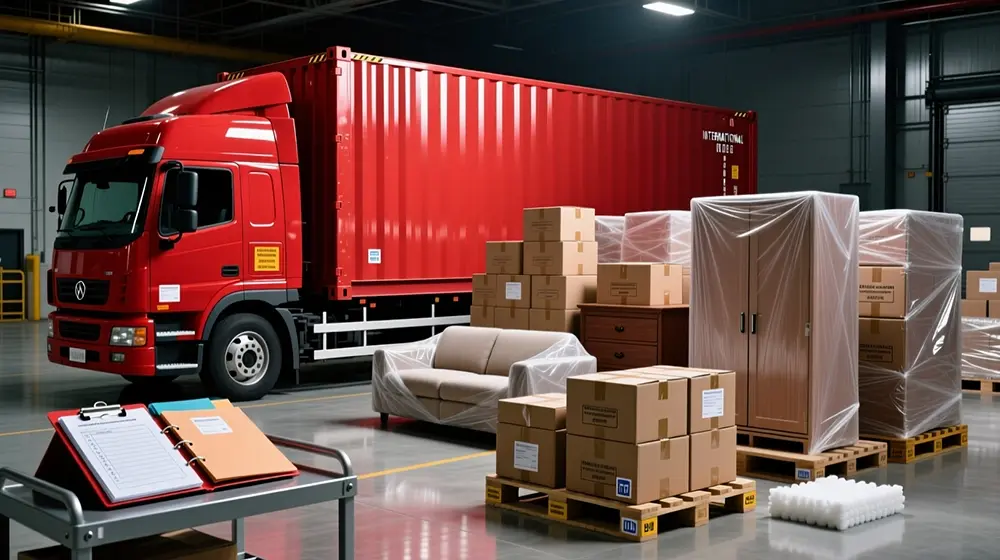
Full-service Dubai to Austria movers typically cover survey, export packing, export documentation, main carriage, Austrian customs filing support, delivery, and unpacking with waste removal, with customs eligibility and inventory quality driving clearance speed.
Full service scope and clearance impact
| Workstream | Deliverable | Clearance risk reduced |
| Pre-move survey | Volume estimate, risk list, routing plan | Misdeclared shipment type, mode mismatch |
| Export packing | Item protection, compliant cartons, and crating | Damage claims, inspection escalation |
| Inventory production | Detailed packing list, identifiers | Documentary holds, valuation disputes |
| Main carriage | Air, sea, or multimodal routing | Storage exposure via transit variability |
| Austria customs support | Forms, proofs, broker data | Relief rejection, inspection triggers |
| Delivery and unpacking | Room placement, debris removal | Post clearance dwell time, detention risk |
What friction points appear most often in customs clarification requests?
- Residence timeline mismatch across lease, deregistration, and travel dates.
- 6-month use proof gap for personal property categories that look newly purchased.
- 12-month import window risk when shipments arrive late or are split into untracked partial consignments.
- Name and address inconsistency across passport, AWB, or B L, and inventory.
- Inventory lines that lack attributes such as material, quantity, and condition.
- New items mixed into relocation goods without invoices and value evidence.
- Plants, soil, or high-risk plant items are included without a phytosanitary pathway.
- Meat products included despite Austria’s warnings and intensified controls.
- Wood packaging without an ISPM 15 stamp for crates and pallets.
- Lithium battery exposure without classification and packing instruction alignment.
- Airport storage days accumulating beyond grace rules and weekend logic.
- Delivery constraints are unplanned, such as building access, lift bookings, and parking permits, which extend terminal dwell time.
Friction point prevention matrix
| Friction point | Customs question | Prevention deliverable |
| 12-month residence rule | “Proof of residence outside the EU?” | Dated residence evidence pack aligned to 12 months |
| 6-month use rule | “Goods used and owned?” | Ownership timeline proof set, invoices for new items |
| Inventory ambiguity | “What exactly arrives?” | Structured inventory with attributes per line |
| Restricted goods | “Any prohibited items?” | Restricted goods register for plants, food, CITES items |
| Wood packaging | “Crate compliance?” | ISPM 15 stamp photo set, debarking confirmation |
| Battery risk | “DG classification?” | Battery register with Wh values and device list |
| Storage cost escalation | “Pickup timing?” | Arrival plan aligned to the grace period and declaration day |
Which items most often trigger Austrian customs holds on Dubai to Austria moves?
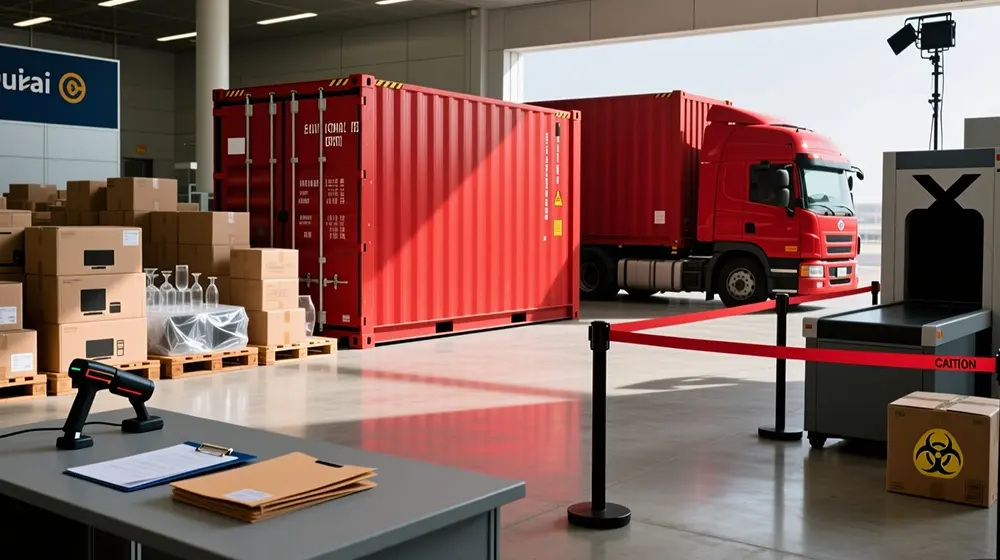
Holds cluster around restricted or excluded categories, evidence gaps on “used household goods,” and items that resemble commercial importation, such as new goods, professional equipment, alcohol, tobacco, and vehicles.
High-risk categories and why they slow clearance
- Alcohol and tobacco: Austria explicitly excludes these from relocation relief in the relocation goods guidance.
- New items and recent purchases: “Used goods owned and used for 6 months” form a core condition; new goods invite VAT and duty assessment.
- Commercial transport or professional equipment: Austrian guidance lists exclusions such as “business equipment” and “commercial means of transport” in relocation contexts.
- Vehicles: Austria applies additional taxes for vehicle imports, including NoVA on registration and import VAT at 20% plus customs duty in relevant cases.
VAT exposure
Austria’s standard VAT rate equals 20% and appears in official business and finance guidance.
Relocation relief can remove import VAT for qualifying goods, but non-qualifying lines often default to standard VAT logic.
How does a customs-grade inventory reduce clearance delays in Austria?
A customs-grade inventory reduces delays by enabling risk assessment and valuation without follow-up requests.
What fields belong in a customs grade inventory line?
IATA guidance on battery marking highlights the importance of explicit technical data fields such as watt hours, which illustrates the same principle for customs inventories: officers act faster when each line contains measurable attributes. Use these fields per line item:
- Item type: Sofa, dining table, laptop.
- Material: Wood, metal, glass, fabric.
- Quantity and unit: 1 piece, 2 cartons, 6 sets.
- Condition qualifier: Used, new.
- Age qualifier: Years in use, purchase month, and year when known.
- Value: Value per unit and total per line.
- Serial numbers: Electronics and high-value items.
Inventory examples for Dubai to Austria movers
Electronics
- Laptop, brand model, 1 piece, used, 2 years, serial recorded, value EUR 600
- Monitor 27 inch, 1 piece, used, 3 years, value EUR 120
Furniture
- Sofa 3-seat fabric, 1 piece, used, 4 years, value EUR 350
- Dining table wood, 1 piece, used, 5 years, value EUR 250
Kitchen
- Stainless cookware set, 8 pieces, used, 5 years, value EUR 120
- Microwave oven, 1 piece, used, 3 years, value EUR 80
Inventory formatting checklist
- Totals: Cartons, pieces, total declared value.
- Terminology: Consistent nouns across sections.
- Granularity: Zero “miscellaneous” lines for controlled categories.
- Segregation: New items listed separately with invoices.
- Battery appendix: Battery-powered devices are listed as a sub-schedule.
How does the packing list format reduce inspection probability?

A packing list reduces inspection triggers when each carton contains item counts, clear descriptions, condition qualifiers, and high-value identifiers, with category separation for regulated items and “new goods” flagged as non-relief lines.
Packing list design rules used by customs brokers
Use a structure that supports fast plausibility checks.
Minimum data fields per carton
- Carton number (sequential, no gaps)
- Room or functional zone (kitchen, master bedroom, office)
- Item description with qualifiers (material, model class, condition)
- Quantity as an integer per line
- Serial numbers for high-value electronics where available
- Explicit flag for regulated classes (batteries, aerosols, chemicals)
Examples that reduce ambiguity
- “Laptop, 1 unit, used, serial recorded.”
- “Cookware, stainless steel, 12 pieces, used.”
- “Power bank, 2 units, lithium ion, declared separately”
How do Dubai to Austria movers calculate the chargeable weight for air freight?
Chargeable weight uses the higher value between actual gross weight and volumetric weight.
How Is Air Freight Cost Calculated?
Air carriers can charge by volumetric weight, which is dimensional weight, or by actual weight. To determine the volumetric rate, the general rule is to divide the volume of the shipment in cubic centimeters by 6000, and pricing uses the higher of volumetric weight and actual weight.
Fast conversion table using the 6000 divisor logic
A 6000 divisor corresponds to about 167 kg per 1 cubic meter in volumetric terms.
- 1.0 CBM equals 167 kg volumetric weight
- 2.0 CBM equals 334 kg volumetric weight
- 5.0 CBM equals 835 kg volumetric weight
This conversion derives directly from the divisor rule described by IATA.
How do Dubai to Austria movers choose air freight versus sea freight using facts?
Mode choice depends on transit time ranges, volume, and cost exposure from storage and free time.
What volume bands help Dubai to Austria movers estimate container needs?
Volume bands reduce quote variance by aligning household size to a CBM planning range and container capacity.
What CBM bands do moving volume calculators publish as estimates?
A Dubai moving volume calculator publishes “Average Moving Volumes in Dubai” estimates:
- Studio apartment: 8 to 12 CBM
- 1-bedroom apartment: 15 to 20 CBM
- 2-bedroom apartment: 25 to 30 CBM
- 3-bedroom villa: 45 to 60 CBM
These bands function as estimation ranges, not as legal thresholds.
CBM to container mapping table using Maersk container volumes
| Property type estimate | CBM band | Container capacity reference | Planning inference |
| Studio apartment | 8 to 12 | 20-foot container 33 m³ | groupage or partial allocation |
| 1-bedroom apartment | 15 to 20 | 20-foot container 33 m³ | 20-foot fit range |
| 2-bedroom apartment | 25 to 30 | 20-foot container 33 m³ | 20-foot high utilization |
| 3-bedroom villa | 45 to 60 | 40-foot container 67 m³ | 40-foot fit range |
Which timing windows control Dubai to Austria customs outcomes?
The clearance pathway depends on a timing matrix with four main numeric controls: 12 months abroad, 6 months of usage, import within 12 months of relocation, and a 12-month post-clearance disposal restriction.
Timing matrix
| Rule | Numeric value | Evidence examples |
| Pre-relocation residence | 12 months | Lease history, employment confirmation |
| Item ownership and use | 6 months | Purchase proofs, warranty start, and device activation logs |
| Import window | 12 months | Move date evidence, shipping dates |
| No disposal | 12 months | Compliance declaration and post-clearance controls, |
What does a clearance delay cost on the Dubai to Austria lane?
Delay cost equals a daily accumulation of storage plus demurrage and detention exposure, and Vienna Airport lists customs deposit charges of EUR 7 per day per item or EUR 12 per day for large items in its passenger customs context, illustrating how daily fees compound.
Delay cost model, auditable and mode-neutral
Total delay cost = (terminal storage per day × days) + (demurrage per day × days beyond free time) + (detention per day × days beyond free time) + (rework costs)
Demurrage relates to holding equipment inside the terminal beyond free time, while detention relates to holding the container outside the terminal beyond free time.
Vienna Airport operational context
Vienna Airport describes cargo handling with bonded storage under customs supervision and 24-hour handling and customs clearance services, supporting the concept that storage under customs control forms a real cost lever.
How does mode choice affect customs support and unpacking schedules?
Mode choice changes the clearance rhythm, the cost basis, and the unpacking timeline, with air freight priced on chargeable weight and sea freight priced on volume, and transit time variance affecting storage exposure.
Air freight chargeable weight, numeric conversion
IATA explains volumetric pricing using a 6000 divisor for cubic centimeters to kilograms, and Maersk provides the same formula framing for air cargo chargeable weight.
Working conversion used in quoting
- 1 cubic meter ≈ 166.67 kg volumetric weight under the 6000 factor convention.
Transit time context for planning buffers
Freightos provides broad estimates: express 1 to 3 days, air freight often 5 to 10 days, sea freight 20 to 45 days or more, with customs complexity influencing time. Route-specific estimators for Dubai to Vienna show sea legs that can extend into multi-week windows depending on routing and port sequence, supporting buffer planning.
Mode decision table
| Decision variable | Air freight from Dubai to Austria | Sea freight from Dubai to Austria |
| Quote basis | Chargeable weight, kg | CBM, container size |
| Best fit profile | Essentials, smaller volumes | Full household volumes |
| Customs scheduling | Fast clearance cadence | Longer dwell risk at destination terminals |
| Unpacking strategy | “first week setup” focus | “full household commissioning” focus |
What unpacking workflow reduces claims and setup time after Austrian clearance?
Unpacking succeeds when movers apply a priority matrix for first night essentials, high value placements, and waste removal sequencing, with carton labeling aligned to room delivery order.
Priority unpacking matrix
| Priority | Carton class | Examples | Placement rule |
| 1 | First night | Bedding, basic kitchen kit, chargers | Same-day access |
| 2 | Compliance critical | Medicine documentation, baby items | Immediate verification |
| 3 | High value | Laptops, cameras, jewelry, documentation | Controlled room placement |
| 4 | Bulk | Books, decor, seasonal items | Deferred unpacking |
Unpacking quality controls
- Photograph high-value items upon unpacking.
- Record carton damage exceptions with carton number references.
- Remove packing waste in staged waves to preserve walking paths and reduce breakage.
How do lithium batteries and power packs change the freight and customs plan?
Lithium batteries change the plan because air transport treats them under dangerous goods frameworks, and carriers apply restrictions and documentation rules.
What does the IATA lithium battery framework cover?
IATA states lithium batteries are classified as dangerous goods and provides shipper guidance, packing instructions, and state and operator variations.
Battery risk screen list for Dubai to Austria household moves
Create a “battery register” that includes:
- Power banks and spare batteries
- Laptops, tablets, phones, cameras
- Cordless tools
- E scooters and e bikes
- Smart home devices with backup batteries
For each item, capture:
- Battery type: lithium ion or lithium metal
- Battery rating: Wh for lithium ion, grams lithium content for lithium metal
- Spare or installed status
- Quantity
What is the most practical Dubai to Austria movers checklist for clearance delay prevention?
A single checklist works when it groups tasks into eligibility, documentation, packing compliance, and destination execution, aligned to Austrian numeric thresholds and EU packaging rules.
Checklist
Phase 1: Eligibility and planning
- Confirm the 12-month residence outside the EU evidence set.
- Identify items under 6 months of ownership and separate them.
- Define the import date window within 12 months of relocation.
Phase 2: Documentation build
- Harmonize identity fields across all documents.
- Produce a quantified packing list with carton numbering.
- Prepare Austrian customs forms referenced in official guidance.
- Execute POA for broker representation where used.
Phase 3: Packing compliance
- Apply ISPM 15-compliant wood packaging rules where crating occurs.
- Compile a lithium battery and device appendix.
- Remove alcohol and tobacco from the shipment scope.
Phase 4: Destination execution
- Coordinate inspection access windows.
- Plan rapid pickup after release to reduce demurrage and detention exposure under carrier “free time” logic.
- Run unpacking by priority matrix for first night commissioning.
How does unpacking support clearance, risk control, and damage control?
Unpacking supports risk control by closing the chain of custody and enabling rapid discrepancy reporting.
What unpacking deliverables matter for insurance and claims?
- Carton count reconciliation against the packing list
- Visible damage log with photo time stamps
- Serial number verification for electronics
- Packaging waste removal record for residence management compliance
Unpacking the workflow map for Dubai to Austria movers
- Verify carton count against manifest.
- Sort cartons by room label and priority category.
- Open fragile cartons first with photo evidence.
- Record damage items and exceptions on a single log.
- Remove packaging waste through the approved disposal route.
What is a clearance delay prevention timeline that fits Dubai to Austria moves?
A clearance delay prevention timeline reduces risk by locking evidence and inventory before freight booking, not after arrival.
21-day operational timeline model
Day 1 to 3: Survey and risk mapping
- Collect the inventory base list
- Classify restricted goods
- Start battery register
Day 4 to 10: Evidence pack build
- Compile residence proof against the 12-month rule
- Compile ownership and use proof against the 6-month rule
- Separate invoices for new items
Day 11 to 16: Packing and compliance capture
- Photograph ISPM 15 stamps on crates
- Finalize inventory line attributes
- Confirm AWB or B L data match
Day 17 to 21: Arrival planning
- Align declaration timing to grace period logic
- Reserve delivery slots and lift bookings
- Prepare an unpacking and debris removal plan
Clearance First, Comfort Fast: Turn Your Dubai to Austria Move Into a Controlled Release Plan
A Dubai to Austria relocation succeeds when customs readiness is built before the first carton is sealed. The fastest releases come from predictable discipline: one identity format across every document, a residence evidence pack that fits the 12-month rule, ownership and use proof that supports the 6-month condition, and an inventory that reads like a measurable dataset, not a vague list. The same logic protects your budget. When pickup timing is planned around terminal processes and carrier free time, storage, demurrage, and detention stop behaving like surprise penalties.
Treat your mover as a compliance partner, not a transport vendor. Ask for a customs support workflow, a restricted goods register, ISPM 15 capture for any wood packaging, and a battery register that makes lithium items easy to classify. Then finish strong after release: priority unpacking, carton reconciliation, and a photo-based exception log. That is how household goods arrive in Austria, ready for living, not stuck in “clarification required.”
FAQs
What usually causes customs delays on Dubai to Austria moves?
What does “full service” cover in operational terms?
How strict is the 6-month owned and used rule for household goods relief?
What is the 12-month import window risk?
Which items most often trigger Austrian holds?
How detailed does a customs-grade inventory need to be?
Can I ship new items with my relocation goods?
Do plants or food items create problems?
Why does ISPM 15 matter for crates and pallets?
How do lithium batteries change the shipping plan?
Idris is a logistics specialist with a focus on residential relocation and supply chain efficiency. With extensive experience in the moving industry, he specializes in transit safety, specialized packing techniques for high-value goods, and fleet management. He is dedicated to streamlining the moving process, ensuring that every relocation is handled with strategic planning and maximum care.