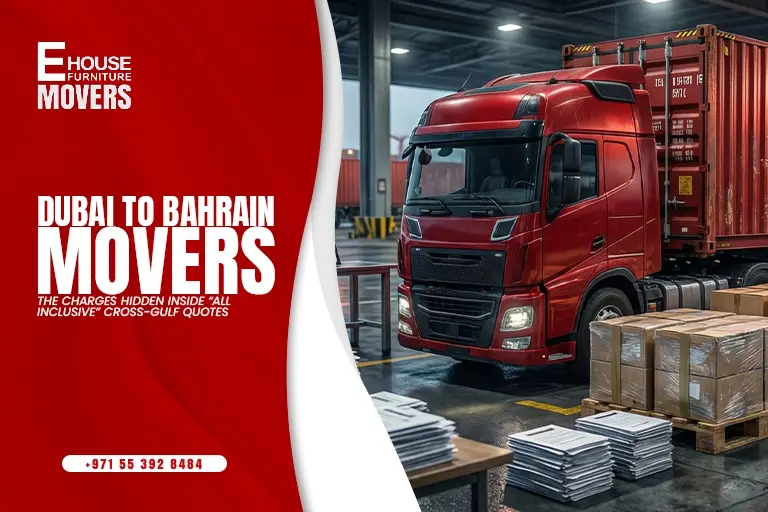
“All inclusive” sounds like peace of mind, until moving day turns your Dubai to Bahrain quote into a stack of surprise invoices. One missed elevator slot, a higher final CBM, or a customs question about “new” items can unlock charges for shuttles, waiting time, storage, and taxes.
This guide explains why similar apartments can receive very different cross-Gulf prices, and where the hidden line items usually sit. Finally, you get a 10-minute quote audit that makes fees, free time, and responsibility lines impossible to hide.
What benefits come from reading this Dubai to Bahrain movers guide?
- Quote clarity: A charge map that separates included services from conditional charges, with verification questions and document checks.
- Delay cost control: A border and delivery workflow that reduces rework events that trigger storage, waiting time, and redelivery fees.
The next section defines “all inclusive” in Dubai to Bahrain movers pricing, then converts hidden charges into a verification checklist.
What does “all inclusive” mean in Dubai to Bahrain movers quotes?
“All inclusive” describes a limited service scope that can exclude conditional charges linked to access, customs decisions, taxes, storage, and exceptions. Many quotes include packing, linehaul transport, and basic labor, then bill exceptions as separate line items.
Which evidence defines “included” versus “excluded” on a movers quotation?
A quote defines inclusion through written scope lines, attached service schedules, and explicit exclusions. A verbal “all-inclusive” line does not equal a customs grade scope.
Inclusion evidence set
- Scope sheet: Services, locations, dates, and mode (road, sea, mixed).
- Rate basis: CBM, container, carton count, or hourly labor.
- Exclusions list: Taxes, permits, storage, special handling, and waiting time.
Why do Dubai to Bahrain movers quotes differ even for similar apartments?
Quotes differ because the total cost depends on measurable variables like volume, access constraints, border handling time, and the tax and duty classification of the goods. Dubai Customs notes that personal-use items can become duty liable if inspectors classify them as brand new in commercial quantities.
Which corridor factors make this route operationally sensitive?
The Bahrain-Saudi causeway carries high traffic volumes, so peak crossing delays translate into driver time, waiting time, and rescheduling exposure. Gulf News reported more than 33 million passengers used the King Fahd Causeway in 2024 and cited peak average crossing time reductions to about 21 minutes after operational improvements.
Which charge categories most often hide inside “all-inclusive” cross-Gulf quotes?
Hidden charges cluster into nine operational buckets: survey and volume variance, packing materials and special handling, building access and shuttles, border documentation and inspections, transit and waiting time, port and terminal charges for sea mode, storage, insurance terms, and taxes and duties. Definitions of demurrage and detention show how delays convert into daily charges when cargo remains inside terminals or equipment exceeds free time. Hidden charges cluster into three groups: statutory, carrier and terminal, and access and handling.
Group 1: Statutory charges
- Tax charge: Import VAT in Bahrain at the standard rate of 10% (with specific zero-rated or exempt categories).
- Duty exposure: Customs duty exposure where authorities classify goods as commercial quantities or new goods rather than personal effects.
Group 2: Carrier and terminal charges
- Storage charge: Terminal storage after free time.
- Demurrage and detention: Charges after agreed free time when containers stay too long.
Group 3: Access and handling charges
- Building access charge: Lift booking, gate pass, and time window penalties.
- Special handling charge: Piano, safe, marble, oversized items.
- Redelivery charge: Failed delivery slot, return to depot, second trip.
Charge bucket 1: Survey and volume variance
How does a survey error create a price jump after packing?
A survey error changes the rating base, so a CBM-based quote expands when the final measured volume exceeds the estimate. Volume variance also triggers larger vehicle selection, extra labor hours, and additional packing materials consumption.
Which numbers define volume risk in a household move?
Volume risk ties to three measurable values: estimated CBM, final CBM, and variance percent.
Variance formula
- Variance percent = (Final CBM minus Estimated CBM) ÷ Estimated CBM × 100
Verification questions
- Which method created CBM: visual estimate, laser measurement, or carton-based conversion?
- Which tolerance threshold applies: 5%, 10%, or another stated value?
- Which remeasurement rule applies at loading: joint measurement or mover-only measurement?
Charge bucket 2: Packing materials, crating, and special handling
Which packing line items commonly appear after “all-inclusive” quotes?
Packing upgrades appear when the shipment includes fragile items, high-value electronics, artwork, stone tops, or items requiring custom crating. Wood packaging compliance matters for cross-border logistics, and inspection teams frequently request clear visibility into packed items.
Which special handling categories create predictable add-ons?
Special handling categories include safes, pianos, large mirrors, chandeliers, gym equipment, and oversized televisions. These categories add labor, padding density, and sometimes separate vehicle allocation.
Evidence requests
- Materials list: Carton types, bubble wrap grade, stretch film, and corner protectors.
- Crating scope: Which items enter crates, crate dimensions, and sealing method.
- Handling method: Lift use, rigging, stair carry count, and manpower count.
Charge bucket 3: Building access, permits, parking, and shuttle trucks
How do building rules translate into invoice line items?
Building rules translate into paid time and equipment. Many towers restrict truck size, restrict move hours, require permits, and reserve freight elevator windows. These constraints add shuttle charges, long carry labor, overtime, and return trip exposure.
Which access constraints create the highest probability of extra charges?
Access constraints cluster into four measurable constraints.
- Restriction: Truck length limit and loading bay height.
- Distance: Long carry meters from the parking to the lift.
- Time: Elevator slot duration and time window.
- Labor: Stair carry floors and manpower.
Verification questions
- Which party books the elevator and obtains security approvals?
- Which waiting time rule applies if security blocks entry?
- Which long carry threshold triggers charges: 25 meters, 50 meters, or another stated value?
Charge bucket 4: Customs decisions and documentation handling
Which customs-related costs can sit outside “all-inclusive” quotes?
Customs costs sit outside quotes when the quote excludes inspection handling, document amendment, and duty or tax outcomes. Dubai Customs lists required documents for personal effects clearance, including a passport or Emirates ID copy, a residency visa copy, and a list of imported goods, and it notes 5% customs duty when inspectors classify goods as brand new in commercial quantities.
Which Bahrain side requirements often influence clearance outcomes?
Bahrain’s personal effects clearance commonly ties to residency evidence and the “used household goods” condition in practice guides used by international moving networks. A FIDI customs guide for Bahrain states that used household goods can clear duty-free, subject to the owner holding a valid Bahrain residence permit, and that customs clearance requires a residence permit copy with official validation details.
Document scope questions
- Which party issues the packing list and inventory format?
- Which identity and residency copies attach to the file?
- Which items receive invoice evidence: electronics, jewelry, or declared valuables?
Charge bucket 5: Taxes, duties, and reclassification risk
Which taxes most often surprise clients moving to Bahrain?
Bahrain applies a 10% standard VAT rate from 1 January 2022, so VAT scope becomes a material variable when quotes exclude taxes or apply VAT to chargeable services.
Which duty rules create confusion in household moves?
Duty confusion often comes from mixing personal effects with commercial quantity items. Dubai Customs notes duty exposure when inspectors classify goods as commercial quantities, and the GCC customs union references a 5% common external tariff for foreign goods imported from outside the customs union, subject to exemptions and member state rules.
Practical classification controls
- Declare condition: Used versus new for each high-value item.
- Separate cartons: Keep new boxed items separate from used household items.
- Attach invoices: Attach invoices for new items and declared valuables.
Charge bucket 6: Waiting time, layover, and exception handling on the road corridor
How does border or checkpoint waiting time convert into a billable cost?
Waiting time converts into billable cost when the quoted rate is transport as time-based, includes limited free waiting, or adds layover fees for night holds. High traffic crossings increase exposure, and the King Fahd Causeway records high annual usage volumes that support a realistic delay model during peaks.
Which line items represent time-based exposure?
Time-based exposure shows up as:
- Waiting time: Per hour after a free threshold.
- Layover: Per night for driver rest and secure parking.
- Rescheduling: Rebooking of the delivery slot and labor.
Verification questions
- Which free waiting threshold applies at the border and delivery: 60 minutes, 120 minutes, or stated otherwise?
- Which evidence proves waiting: timestamped tracking events, border entry logs, GPS pings?
Charge bucket 7: Sea mode charges, terminal handling, demurrage, and detention
When do sea freight charges appear in Dubai to Bahrain movers quotes?
Sea freight charges appear when the move uses Jebel Ali or another UAE port to Bahrain port discharge, or when parts of the shipment consolidate into LCL or FCL. “All-inclusive” road quotes often exclude sea mode charges entirely.
What do “terminal handling, “demurrage,” and “detention” mean in plain operational terms?
Terminal handling charges cover port terminal container handling services. Demurrage relates to container time inside terminals beyond free time, and detention relates to container equipment time outside terminals beyond free time. Maersk and DHL explain these charges as delay-driven fees after free time expiration.
Charge trigger map
- Terminal handling: Charged when port terminals move, stage, load, or discharge containers.
- Demurrage: Charged when the container stays in the terminal beyond free days.
- Detention: Charged when the container stays outside the terminal beyond free days.
Verification questions
- Which free time applies, in calendar days, for demurrage and detention?
- Which party pays terminal storage charges, shipping line charges, and documentation charges?
Charge bucket 8: Storage options and the charges that follow
Why does storage appear mid-move in Dubai to Bahrain relocations?
Storage appears when delivery slots fail, residency documents delay clearance, or handover timing misaligns with move-out and move-in dates. Storage converts timing uncertainty into a managed buffer, but it adds handling and monthly rental costs.
Which storage charges appear most often?
Storage charges cluster into four measurable cost types.
- Handling charge: Inbound receiving and inventory registration.
- Monthly rent: Unit size, climate control, and access frequency.
- Handling charge: Outbound retrieval and loading.
- Insurance: Declared value-based storage cover where applicable.
Storage verification questions
- Which storage duration appears in writing: number of days or months?
- Which access rules apply: appointment access, operating hours, and retrieval fees?
- Which inventory format records stored items: carton IDs, photo log, seal log?
Charge bucket 9: Insurance scope, exclusions, and claims evidence
How do insurance terms change the effective cost of a move?
Insurance terms change cost when the quote includes only limited carrier liability, excludes owner-packed cartons, or applies deductibles that reduce payable claims. Evidence quality, such as inventories and photos, determines claim viability.
Which evidence supports claims in cross-border moves?
Claims evidence ties to four artifacts.
- Inventory: Itemized list with quantities and condition notes.
- Photos: Pre-pack and post-pack images for high-value items.
- Carton IDs: Label to inventory mapping.
- Incident log: Timestamp, location, and handler details.
Charge disclosure matrix for Dubai to Bahrain movers quotes
This table maps each charge bucket to triggers, evidence, and a KPI.
| Charge bucket | Trigger condition | Evidence to request | KPI for control |
| Volume variance | Final CBM exceeds estimate | Survey notes, CBM worksheet | Variance percent stated |
| Packing upgrades | Fragile, high value, oversize | Materials list, crating list | Carton and crate count |
| Access and shuttle | Truck restriction, long carry | Building rules, slot booking | Slot confirmation logged |
| Customs handling | Inspection, classification change | Document pack list | 0 missing documents |
| Waiting and layover | Border queue, missed slot | Timestamped tracking | Waiting threshold defined |
| Taxes and duties | VAT applies, and duty applies on classification | Tax scope statement | VAT line present |
| Sea mode charges | Port use, container use | THC, free time schedule | Free time stated |
| Storage | Handover mismatch | Storage contract terms | Storage duration defined |
| Insurance | Loss, damage, theft | Policy terms, deductible | Declared values recorded |
What does a compliance grade Dubai to Bahrain movers workflow look like?
A compliance grade workflow uses four phases: file build, packing and labeling, border execution, and delivery slot control. Dubai Customs lists personal effects document requirements and applies inspection-based duty decisions, so the workflow treats inventory and condition notes as primary artifacts.
Phase 1: File build
A strong file contains identity copies, residency evidence where relevant, and a detailed list of goods. Dubai Customs lists a passport or Emirates ID copy, a residency visa copy, and a list of imported goods for personal effects clearance.
Phase 2: Packing and labeling
A strong pack uses carton IDs, room tags, and content lists that match the inventory. This structure reduces inspection ambiguity and reduces claim disputes.
Phase 3: Border execution and exception logging
A strong execution logs events with timestamps and evidence, so “waiting time” becomes measurable and contestable.
Phase 4: Delivery slot control and storage contingency
A strong delivery plan confirms access rules and reserves a storage fallback option for timing misalignment.
How do you audit an “all-inclusive” Dubai to Bahrain movers quote in 10 minutes?
A fast audit uses a fixed set of questions that force line item clarity.
Quote Audit Questions
Question: Which costs are payable to customs, ports, or third parties?
Answer: Ask for a written exclusions list with the owner and payable event.
Question: Which taxes appear on imports into Bahrain?
Answer: Ask for a VAT disclosure line referencing the 10% standard rate.
Question: Which free time terms govern demurrage and detention exposure?
Answer: Ask for free time days and the clock start event.
Question: Which document set does the mover build for personal effects?
Answer: Ask for identity, visa, and goods list alignment with Dubai Customs requirements.
Question: Which delivery slot rules govern access in Bahrain?
Answer: Ask for re-delivery pricing and slot booking method.
Final Thoughts: Turn “All Inclusive” Into a Verifiable, Audit-Ready Quote
“All inclusive” only protects you when it is written, measurable, and tied to evidence. Dubai to Bahrain moves fail on the same fault lines: volume variance after packing, access restrictions that force shuttles and long carries, customs decisions that change classification, and time loss at borders or delivery slots that quietly become waiting, layover, storage, and redelivery fees. The fix is not guessing which mover feels safer. The fix is building clarity into the file and into the quotation.
Use the nine bucket charge map to separate what is included from what is conditional. Ask for a scope sheet, a rate basis, and a strict exclusions list that names the payable event and the payer. Treat timestamps like receipts. Log loading time, border arrival, inspection starts, and delivery slot windows, so “waiting time” becomes provable. Keep new boxed items separate, attach invoices for declared valuables, and insist on written free time terms if sea mode or terminals appear in the route. If a mover cannot answer the 10-minute audit questions in writing, the quote is not all-inclusive. It is incomplete.
FAQs
What does “all inclusive” mean in Dubai to Bahrain movers quotes?
Why do two similar apartments get different prices?
How is shipment volume priced in most quotes?
What is the simplest way to spot volume variance risk?
Which access issues most often add extra fees?
Which customs-related costs are often excluded from “all-inclusive”?
What is the most common tax surprise when moving to Bahrain?
What is the difference between demurrage and detention?
When does storage appear during a cross-Gulf move?
What is the fastest way to audit a quote before paying?
Sarmast Faiz is a seasoned relocation expert with 10 years of experience in the logistics industry. He holds a degree in Business Administration with a focus on Logistics and Supply Chain Management. He specializes in practical, real-world moving guidance for individuals and families planning local or international relocations. His articles cover efficient packing and decluttering, move planning and timelines, and international relocation complexities such as visa coordination and cultural adjustment. Sarmast’s goal is to help readers navigate the moving process with clarity and confidence.
Idris is a logistics specialist with a focus on residential relocation and supply chain efficiency. With extensive experience in the moving industry, he specializes in transit safety, specialized packing techniques for high-value goods, and fleet management. He is dedicated to streamlining the moving process, ensuring that every relocation is handled with strategic planning and maximum care.