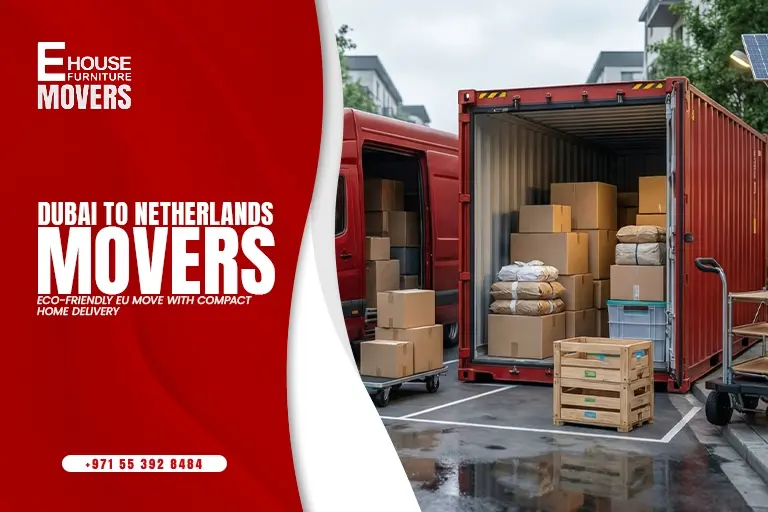
Moving from Dubai to the Netherlands sounds simple until the paperwork, packing waste, and Dutch last-mile reality collide. Too much single-use packaging can add cost and criticism. One oversized truck can fail on narrow streets, strict loading bays, and new zero-emission zones. Dubai to Netherlands movers deliver an eco-friendly EU move when the plan combines Dutch Customs removal goods relief, a carton-level inventory, low waste packing aligned to EU packaging pressure, and a compact home delivery method that fits Dutch streets and building access rules.
This guide delivers how Dutch Customs removal goods relief works, which documents and inventory fields reduce inspections, and how carton-level IDs protect claims. It also breaks down EU packaging waste data, Port of Rotterdam throughput signals, and realistic transport choices that shape CO₂e outcomes.
What benefits come from reading this Dubai to Netherlands movers guide?
This guide gives two measurable benefits: fewer customs delays and fewer last-mile delivery failures, using documented controls rather than marketing claims.
- Faster customs clearance readiness, based on Dutch Customs guidance for household effects from a non-EU country.
- Lower redelivery risk in compact Dutch housing, based on access planning and zero emission zone constraints.
What facts frame an eco-friendly move from Dubai to the Netherlands?
A Dubai to Netherlands move becomes data-driven when the plan uses EU packaging waste metrics, Dutch housing space constraints, Dutch logistics regulation, and port throughput indicators.
What numbers explain why “eco-friendly packing” matters in the EU?
EU packaging waste equals a measurable policy pressure, not a branding concept.
| EU packaging indicator | Latest published value | Why it matters for Dubai to the Netherlands movers |
| Total packaging waste | 79.7 million tonnes in 2023 | Packing material volume and recycling pathway affect compliance and cost narratives. |
| Packaging waste per person | 177.8 kg per inhabitant in 2023 | “Low waste packing” becomes quantifiable per shipment. |
| Year-on-year change | -4.7% in 2023 vs 2022 | Shows active policy pressure and reporting attention. |
| Plastic packaging waste | 35.3 kg per person | Plastic reduction claims need clear evidence. |
| Lightweight plastic carrier bags | 65 bags per person in 2023 | Demonstrates the EU direction toward plastic reduction. |

What numbers explain why compact home delivery matters in the Netherlands?
Compact home delivery becomes predictable when the plan uses verified living space constraints. Statistics Netherlands reports 65 m² per person as the national average floor space available per person, and 49 m² per person in Amsterdam.
Compact delivery implication
- Space constraint: Limited staging area increases carton sequencing complexity.
- Time constraint: Limited curb access increases unloading window sensitivity.
What port throughput numbers matter for route expectations?
Port of Rotterdam container throughput in 2024 equals 13.8 million TEU, with 133.4 million tonnes of container throughput.
Throughput at the Port of Rotterdam, Europe’s largest sea port, was down 4.1% in the first half of 2025, it said on Tuesday, with dry bulk falling 8.9% and wet bulk down by 5.3%. Overall volumes stood at 211 million metric tons in the first six months of 2025 compared with 220 million tons a year ago.
What does “eco-friendly EU moving” mean for Dubai to Netherlands movers?
Eco-friendly EU moving means a move plan that reduces packaging waste, uses lower emissions transport choices where feasible, and documents compliance using named standards and datasets.
What definition keeps eco-friendly claims verifiable?
A verifiable definition uses measurable variables and a source for each variable.
- Emissions factor: UK Government conversion factors for freight transport, expressed as kg CO₂e per tonne km.
- Packaging waste context: Eurostat packaging waste statistics for the EU level baselines.
- Wood packaging compliance: EU plant health requirements based on ISPM 15 and Regulation (EU) 2016/2031.
- City logistics planning: Anticipates low-emission zones and access rules in Dutch municipalities.
Eco-friendly claims that remain verifiable
- Carbon factor disclosure using a named dataset and a declared boundary, for example, UK Government conversion factors.
- Packaging mass disclosure as kilograms of packaging per cubic metre packed.
- Recycling pathway disclosure using the Netherlands packaging and waste reporting context, supported by European Environment Agency (EEA) profiles.
What emissions data show why mode selection dominates eco outcomes?
UK Government factors show a large intensity gap between sea freight and air freight in a standard factor set. Use the factor set as an example boundary, not as a universal constant.
- Cargo ship example factor: 0.00353 kg CO₂e per tonne km.
- Long-haul air freight example factor: 0.5313 kg CO₂e per tonne km without RF.
Intensity ratio example
- Ratio: 0.5313 ÷ 0.00353 = 150.5.
- Interpretation: Air freight intensity can exceed sea freight by roughly 150x in that example.
What does “compact home delivery” mean for Dubai to Netherlands movers?
Compact home delivery means a delivery process designed for limited dwelling space, narrow stair geometry, restricted curb access, and time-boxed unloading conditions in dense neighbourhoods.
Dutch housing constraints show up in measurable floor space per person. Statistics Netherlands corrected figures report about 53 m² per person nationally and about 40 m² per person in Amsterdam, based on a weighted calculation.
What access constraints create the highest failure rate?
Access failures cluster around five constraints.
- Kerb constraint: No legal stopping space for the truck.
- Time constraint: Building unloading windows that reduce labor productivity.
- Vertical constraint: Stair geometry that limits bulky items.
- Equipment constraint: External lift footprint and placement rules.
- Vehicle constraint: City logistics restrictions tied to zero-emission zones.
What regulations affect movers entering Dutch city centres?
Zero-emission zones exist in 15 cities as of 1 January 2025, with another 14 planned between 2025 and 2030.
Operational impact for compact home delivery
- Vehicle selection: Compliant van or compliant truck in the relevant city zone.
- Routing selection: Route planning that avoids restricted corridors.
- Slot planning: Arrival time aligned to permitted access periods.
What customs rules apply when moving household goods from Dubai to the Netherlands?
Dutch Customs states that a person moving from a non-EU country declares household effects and indicates the intent to import without paying import duties under the household effects relief concept.
What EU legal basis controls the removal of goods relief?
Council Regulation (EC) No 1186/2009 states that relief generally applies when personal property enters free circulation within 12 months from the establishment of normal residence, and it includes restrictions for 12 months after entry acceptance.
Two timing rules that shape the move plan
- Entry window: 12 months from the establishment of normal residence for entry for free circulation.
- Disposal restriction: 12 months after entry acceptance before lending, hiring out, or transferring.
What VAT facts matter for budgeting when relief does not apply?
Dutch VAT rates are based on the European Union’s VAT Directive. All EU member states must adhere to the Directive, and the standard VAT rate must be 15% or higher.
Rates: 21%, 9%, or 0%
In the Netherlands, the standard VAT rate is 21%. There are two additional special rates: the 9% rate and the 0% rate (zero rate).
What documents do Dubai to Netherlands movers use for an EU-compliant move?
A Dubai to Netherlands mover relies on a document stack that proves identity, residence transfer facts, ownership and use, and a defensible inventory.
Core document pack for removal goods declarations
- Passport copy and identity pages for declarant consistency.
- Residence evidence showing the establishment of normal residence in the Netherlands and the relevant timeline for relief.
- An inventory list signed by the owner, at a level that supports inspection.
- Transport documents from the carrier or freight forwarder, used for customs declaration and cargo release.
Relief eligibility facts that require documentation
- Import timing within the relief window set out in EU rules.
- Post import restriction on lending, hiring out, or transferring goods inside the defined time period.
What inventory standard reduces customs friction and delivery errors?
A high control inventory uses itemized identifiers, declared condition, and carton mapping so that customs inspection and delivery reconciliation use the same evidence set.
What inventory fields give the highest compliance value?
An inventory produces a higher compliance value when it includes identity, quantity, material category, and value qualifier.
Recommended inventory schema
- Category: Kitchenware, books, clothing, electronics, artwork, and tools.
- Entity signifiers: Brand, model, serial number for electronics.
- Quantity: Exact counts, for example, 12 wine glasses, three monitors.
- Condition: Functional, cosmetic wear, boxed new.
- Value qualifier: Insured value bracket per item line.
What evidence artifacts support insurance and dispute resolution?
Evidence artifacts include pickup photos, packed carton photos, and sealed container seal numbers, aligned to a single inventory reference.
Proof artifacts
- Photo set: Pre-pack condition and post-pack closure.
- Seal log: Seal number at origin and seal verification at destination.
- Handover log: Signatures tied to carton counts, not only truck departure.
What packaging practices align with eco-friendly EU moving without increasing breakage risk?
Eco-friendly packing reduces material mass and increases reusability while maintaining compression resistance for long-haul loads. Eco-friendly packing aligns with EU waste pressure when it reduces material mass per packed cubic metre and increases reuse rates without reducing compression protection.
EU packaging waste data clarifies why packaging reduction sits under scrutiny. Eurostat reports 79.7 million tonnes of packaging waste in the EU in 2023 and 177.8 kg per inhabitant, with plastic, paper, and glass forming major shares.
What packaging decisions reduce waste while protecting goods?
Packaging decisions reduce waste when they replace single-use plastics with reusable systems and optimize void fill.
Low-waste packing controls
Measurable waste reduction uses clear material categories and kilograms. Use a packing materials log tied to the inventory.
- Crate control: Reusable crates for books and kitchenware.
- Blanket control: Reusable moving blankets for furniture.
- Carton control: Right-sized cartons to reduce void fill.
- Fill control: Recycled paper cushioning for low-fragility items.
What wood packaging rules apply to crating and pallets in the EU?
The European Commission states that EU requirements for wood packaging material and dunnage rely on ISPM 15 and Regulation (EU) 2016/2031, and it lists conditions for non-EU imports.
ISPM 15 compliance elements
- Treatment: Heat treatment or approved treatment schedule.
- Marking: Official ISPM 15 stamp and IPPC logo.
- Debarking: Debarked wood requirement in EU rules summaries.
What transport choices shape emissions and service performance for Dubai to the Netherlands movers?
Transport choices shape emissions because aircraft and ships differ by orders of magnitude in emissions intensity per tonne km in standard factor sets.
UK Government conversion factors list an example intensity of 0.00353 kg CO₂e per tonne km for an average cargo ship and 0.5313 kg CO₂e per tonne km for long-haul freight flights without RF, which implies roughly 150 times higher intensity for that air freight example.
What container volume numbers help estimate capacity?
Freightos lists the typical capacity of a 20-foot container at about 33 cubic meters, and it references pallet counts such as 11 Euro pallets.
Capacity guidance for planning
- 20-foot container: Around 33 m³.
- Pallet capacity: About 10 standard pallets or 11 Euro pallets.
What does the EU maritime regulation change for reporting?
The EU extends emissions regulation to maritime transport through EU ETS coverage for shipping, which increases the relevance of emissions accounting in EU logistics narratives.
What eco-friendly move strategy remains realistic for household goods?
A realistic eco-friendly strategy prioritizes sea freight for the line haul and optimizes local delivery routing and vehicle class inside the Netherlands, especially where low-emission zones operate.
What household volume bands map to common move sizes?
Use volume bands as planning anchors, not as price quotes.
| Household profile | Typical packed volume band | Typical shipment type |
| Studio or 1-bedroom compact | 8 to 15 m³ | Groupage LCL or partial container |
| 1 to 2 bedroom apartment | 15 to 30 m³ | LCL or 20-foot FCL boundary |
| 2 to 3 bedroom household | 30 to 45 m³ | 20-foot FCL or shared 40-foot |
| Larger household | 45 to 67 m³ | 40-foot FCL boundary |
What transit time and disruption factors shape expectations?
Transit time for sea freight spans a wide range because schedule design, transshipment, congestion, and security detours change the route duration.
What baseline transit time range does a major carrier publish?
Maersk states that sea freight shipping can range from 20 to 45 days, with peak seasons extending timelines.
What security factor adds weeks to some Asia-Europe services?
Reuters reported that many carriers rerouted around the Cape of Good Hope after Red Sea attacks since December 2023, and Reuters described Maersk’s stepwise approach toward resuming Red Sea transits in December 2025.
Planning implication: Add a time buffer for detours or congestion risk on affected corridors.
What city logistics factors affect compact home delivery in Amsterdam, Rotterdam, and Utrecht?
City logistics factors affect compact home delivery through parking control, temporary traffic measures, and equipment placement rules that influence lift deployment.
Some services reference municipal processes for temporary traffic measures and object placement for moving equipment in Amsterdam, which links directly to lift-based delivery planning.
What access questions define the compact home delivery scope?
The compact home delivery scope becomes clear when the mover answers access questions before packing completion.
Access questions
- Street access: Lane width, turning radius, and stopping tolerance.
- Kerb space: Reservation requirement, enforcement level, time window.
- Vertical path: Lift size, stair width, landing geometry.
- Equipment placement: External lift footprint, object permit, or notification.
- Building controls: Elevator booking, quiet hours, and loading bay slots.
What cost drivers appear in Dubai to Netherlands movers quotes, and which ones tie to compact home delivery?
Cost drivers concentrate around access complexity, packaging scope, and customs handling events, not only base freight.
What quote lines usually correlate with compact home delivery complexity?
Compact home delivery lines correlate with labour hours and equipment hours.
Delivery-linked line items
- Lift service: External lift or internal lift planning time.
- Shuttle service: A smaller vehicle for narrow streets.
- Parking management: Reserved kerb space, time window management.
- Stair carry: Higher labour intensity for vertical paths.
What quote lines correlate with customs compliance?
Customs compliance lines correlate with documentation handling and inspection exposure.
Customs linked line items
- Declaration handling: Preparation and submission support aligned to the Dutch Customs process.
- Inspection handling: Labour and port terminal handling if an inspection occurs.
What risks dominate Dubai for the Netherlands moving projects, and what controls reduce them?
The highest risk categories include customs delay risk, loss and damage risk, moisture and temperature sensitivity, and last-mile access failure.
What controls reduce customs delay risk?
Customs delay risk falls when documentation matches Dutch Customs expectations, and the relief basis matches EU rules on transfer of residence.
Customs risk controls
- Consistency control: identical names across the passport, airway bill, or bill of lading, and declaration.
- Timing control: shipment planning aligned with the 12-month window.
- Restriction control: written acknowledgement of the post-import restriction on disposal.
What controls reduce inventory disputes?
Inventory disputes drop when the mover ties each carton to an identifier and ties signatures to counts.
Carton control system
- Label: Unique carton ID such as NL 001 to NL 120.
- List: Carton list with room origin and content category.
- Photo: Photo of sealed carton with ID visible.
- Count: Pickup and delivery counts matched to the carton list.
What controls reduce moisture and mould risk in containerized moves?
Moisture risk falls when packing uses vapour management materials for sensitive goods and when the load plan allows airflow.
Moisture controls
- Desiccant allocation per container size and load composition.
- Barrier packing for textiles and paper archives.
- Ventilation planning through load gaps and palletization strategy.
What sustainability metrics can Dubai to Netherlands movers report without greenwashing?
Sustainability metrics remain credible when they use a defined method, a named factor dataset, and a declared scope boundary.
Metrics that remain measurable
- Estimated CO₂e per shipment using tonne km factors and declared mode.
- Packaging kilograms per CBM packed, split by paper, plastic, and wood.
- Reuse rate for crates and blankets, expressed as a percentage of packing units reused.
- Recycling pathway for destination waste streams, aligned to the Netherlands packaging waste management context.
What final checklist closes a Dubai to Netherlands eco-friendly move cleanly?
A clean closeout uses a documented count reconciliation, a condition check, and a compliance record for removal goods timing constraints.
Closeout checklist
- Count: Carton count equals inventory count at delivery signature.
- Condition: Photo evidence matches condition notes for high-value items.
- Documents: Customs declaration record archived with inventory and ID.
- Restriction: The removal goods restriction period is recorded as 12 months after entry acceptance.
Final Recap: Eco-Friendly EU Moving That Survives Inspection and Delivery Day
An eco-friendly Dubai to the Netherlands international relocation is not a slogan. It is a controlled process where a document, a measurement, or a photo can back every claim. When your mover understands Dutch Customs removal goods relief, the shipment stops being “a container” and becomes a file that clears. When packing is logged by material type and linked to carton IDs, “low waste” becomes measurable and defensible. When the last mile is planned for tight streets, limited kerb space, building rules, and zero-emission zone access, delivery becomes predictable instead of stressful.
The takeaway is simple. Choose a mover that can show you the evidence pack before pickup. If they can map your inventory to cartons, match names across documents, plan access down to unloading time windows, and explain mode choice with a clear emissions boundary, you are not buying transport. You are buying a compliant outcome.
FAQs
What is removal goods relief in the Netherlands?
What is the main timing rule that affects eligibility?
Which documents usually reduce Customs questions fastest?
Why does a carton-level inventory matter more than a room list?
How do you make “eco-friendly packing” measurable?
Do wooden crates or pallets need special compliance for the EU?
Why does compact home delivery fail in Dutch cities?
How do zero-emission zones affect movers?
Is sea freight always the greener option than air freight?
What is the simplest way to reduce mould risk in a container move?
Sarmast Faiz is a seasoned relocation expert with 10 years of experience in the logistics industry. He holds a degree in Business Administration with a focus on Logistics and Supply Chain Management. He specializes in practical, real-world moving guidance for individuals and families planning local or international relocations. His articles cover efficient packing and decluttering, move planning and timelines, and international relocation complexities such as visa coordination and cultural adjustment. Sarmast’s goal is to help readers navigate the moving process with clarity and confidence.
Idris is a logistics specialist with a focus on residential relocation and supply chain efficiency. With extensive experience in the moving industry, he specializes in transit safety, specialized packing techniques for high-value goods, and fleet management. He is dedicated to streamlining the moving process, ensuring that every relocation is handled with strategic planning and maximum care.