
One wrong description on a packing list can cost more than an extra flight ticket. If you are moving a household between Dubai and the UK, customs is the step that can turn a planned delivery into import VAT, reassessed duty, storage charges, and fines. The risk is real because trade volumes are high, the United Kingdom (UK) and United Arab Emirates (UAE) run different customs rules, and border systems quickly flag anything that looks vague, undervalued, or mixed with restricted items.
This guide explains how International Movers, Dubai to UK Movers, and UK to Dubai Movers can reduce that risk by treating customs compliance as a data job, not a last-minute form. You will see what taxes may apply on both routes, when UK Transfer of Residence relief can remove duty and VAT on personal belongings, and when UAE duty and VAT benchmarks still apply to new or commercial goods.
Why do International Movers and Dubai to UK Movers operate in a high-risk customs corridor?
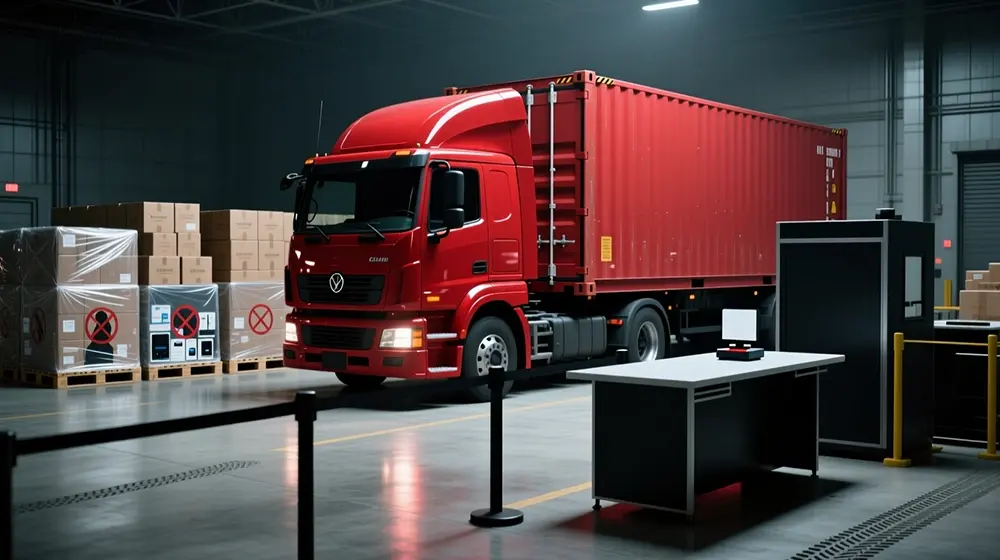
International Movers and Dubai to UK Movers operate in a high-risk customs corridor because trade volumes and mobility between the UK and the UAE are large and growing.
According to the UK government trade and investment factsheet, total trade in goods and services between the UK and the UAE reached about £24.8 billion in the four quarters to Q2 2025, an increase of about 9.8 % from the previous year. Official trade statistics for Q1 2025 report about £14.9 billion in UK exports to the UAE, equal to roughly 1.7 % of total UK exports.
This trade relationship sits on top of a large expatriate base. Recent estimates show that the UAE now records 11.44 million residents in 2025, marking one of the strongest spurts of demographic growth in its recent history. This surge is powered largely by expatriates moving in for work, business, and lifestyle opportunities. High numbers of contracts, international assignments, and study visas translate into a constant stream of household relocations, which keeps International Movers, Dubai to UK Movers, and UK to Dubai Movers under regular customs scrutiny on both borders.
Key structural reasons for customs risk
1. High trade volumes
- Billions of pounds in goods and services each year between the UK and the UAE.
2. Two customs regimes
- UK customs, duty, and VAT rules on one side.
- UAE customs rules and local duty structure on the other side.
3. Frequent relocations
- Families, students, and professionals who move with entire households through International Movers.
4. Tight restrictions
- Lists of banned and restricted goods for both directions, including weapons, controlled drugs, and sensitive food categories.
When these structural factors combine with incomplete documents or vague packing lists, customs systems detect risk, and International Movers experience extra taxes, storage, or fines.
What customs taxes apply to Dubai to UK Movers and UK to Dubai Movers?
Dubai to UK Movers and UK to Dubai Movers face a mix of customs duty, import VAT, and relief schemes that depend on residence status, item type, and declaration accuracy.
Dubai to UK Movers: duty, VAT, and transfer of residence relief
HMRC guidance states that transfer of residence relief (ToR) can remove customs duty and import VAT on personal belongings when a person moves their normal place of residence to the UK. Key conditions include:
- Residence outside the UK for at least 12 consecutive months in many cases.
- Ownership of the goods for at least 6 months before the move.
- Import of goods within 12 months of the date of transfer of residence or graduation for students.
If the transfer of residence relief applies, customs duty and import VAT on eligible household goods are reduced to zero. If relief does not apply, duty follows the tariff for each HS code, and import VAT usually sits at 20 % on the customs value plus duty.
UK to Dubai Movers: duty and VAT for personal effects
The official UAE government portal explains that the general customs duty rate in the UAE is 5 % of the CIF value of imported goods. Alcohol attracts about 50 % duty, and tobacco attracts about 100 % duty.
UAE guidance notes that used household goods and personal effects may qualify for a duty exemption for returning residents or new residents when conditions on ownership and quantity are satisfied. In practice, UK to Dubai Movers often face three patterns:
- Duty exemption for used household effects in normal quantities.
- About 5 % duty and 5 % VAT equivalent on new or commercial goods.
- Higher customs scrutiny for alcohol, tobacco, and media content.
Summary: duty and VAT benchmarks for both routes
| Route | Typical goods | Duty benchmark | VAT or tax benchmark | Main relief scheme |
| Dubai to UK Movers | Used household goods and personal effects | Often 0 % with ToR relief | Often 0 % with ToR relief | UK Transfer of Residence Relief (ToR1) |
| Dubai to UK Movers | New furniture, electronics, and luxury items | Up to several % per HS code | Usually 20 % import VAT | No relief if conditions are not met |
| UK to Dubai Movers | Used household goods for residents | Often exempt when conditions apply | Often exempt | UAE exemption for used personal effects |
| UK to Dubai Movers | New consumer goods, business stock | About 5 % on CIF value | About 5 % equivalent VAT | Normal customs duty structure |
| UK to Dubai Movers | Alcohol and tobacco | Around 50 % for alcohol | Around 100 % for cigarettes | Excise style higher duties |
International Movers that place these benchmarks in front of clients before packing create a realistic expectation of tax exposure for both directions.
Which customs errors create extra taxes and fines for International Movers and Dubai to UK Movers?
Customs errors create extra taxes and fines for International Movers and Dubai to UK Movers when declarations conflict with tariff rules, relief conditions, or risk flags.
Frequent error clusters
1. Incorrect or incomplete transfer of residence applications
- ToR1 not submitted, or submitted after the shipment departs.
- Goods that do not meet the six-month ownership rule are included in the relief claim.
2. Undervaluation and inconsistent values
- Declared values are significantly below second-hand market levels.
- Values on insurance documents are higher than values on customs documents.
3. Generic descriptions instead of item details
- Use of labels such as “miscellaneous items” or “household goods” without item names.
- No distinction between used personal effects and new items.
4. Mixing personal goods with commercial stock
- Business inventory is packed together with household goods in one container.
5. Restricted or prohibited goods included in the load
There are some goods you cannot bring into the UK – customs’ll seize them.
- Meat and dairy products in personal bags after April 2025, restrictions on certain food imports to Great Britain.
- Weapons, self-defence sprays, and controlled drugs in boxes of personal belongings.
When such errors appear, customs officers can reclassify goods, recalculate duty and VAT for the entire category, and consider penalties. Public guidance for travellers confirms that undeclared goods and excess quantities lead to full tax on entire categories when allowances are exceeded.
Example pattern of error escalation
- International Movers submit a generic packing list.
- Border Force queries category descriptions.
- Inspection finds new high-value goods inside boxes marked as used household items.
- Customs revalues the shipment and applies duty and VAT without relief.
- Storage and handling charges accumulate during the investigation.
Dubai to UK Movers and UK to Dubai Movers that avoid these error patterns limit both tax exposure and delays.
Which goods are restricted or banned for Dubai to UK Movers and UK to Dubai Movers?

Restricted and banned goods influence the risk profile for International Movers, Dubai to UK Movers, and UK to Dubai Movers because they trigger seizure, re-export, or prosecution.
Restricted and banned goods for Dubai to the UK Movers
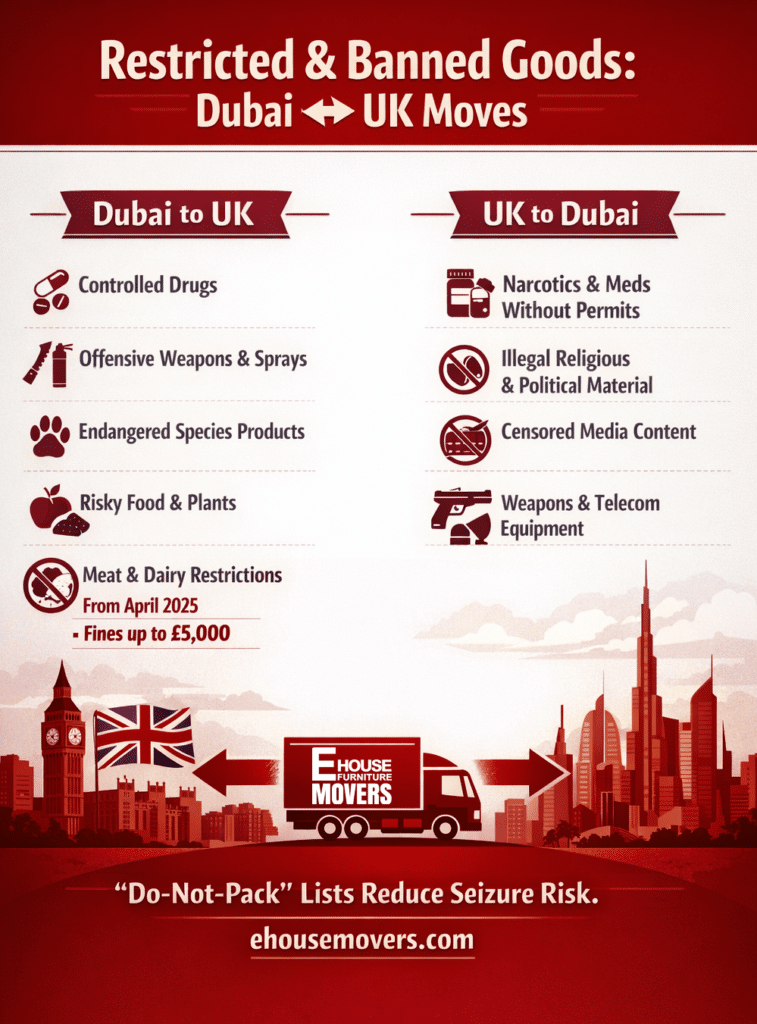
UK government guidance on banned and restricted goods lists several key categories.
- Controlled drugs.
- Offensive weapons and some self-defence sprays.
- Endangered species products.
- Certain food and plant products may carry pests or diseases.
In April 2025, new restrictions on meat and dairy imports into Great Britain from Europe and some other areas introduced bans on many meat and dairy products for personal use, with fines up to £5,000 mentioned in media reports for serious breaches. These rules influence risk assessment across personal shipments, even from non-European origins, because customs systems monitor food categories closely.
Restricted and banned goods for the UK to Dubai Movers
UAE and Dubai Customs sources confirm that the general duty rate is about 5 %, but many goods fall into restricted or prohibited categories. Broad categories include:
- Narcotics and certain medicines without permits.
- Religious or political material that violates local law.
- Media content that fails local censorship rules.
- Weapons and some telecommunications equipment.
International Movers that maintain explicit “do not pack” lists for both directions reduce the probability of seizure and protect clients in both legal systems.
How can International Movers, Dubai to UK Movers, and UK to Dubai Movers build compliant inventories?
International Movers, Dubai to UK Movers, and UK to Dubai Movers build compliant inventories by combining detailed descriptions, realistic values, and clear separation between used personal effects and new goods.
Core characteristics of a compliant inventory
1. Structured categories
- Living room, bedroom, kitchen, office, outdoor, and storage.
2. Item level descriptions
- “Three-seat fabric sofa”, “double bed frame with mattress”, “refrigerator 400 litre capacity”, “four laptop computers”.
3. Quantities and values
- Quantities in units for each line.
- Estimated current value for used items and purchase value for new items, in local currency.
4. Cross-reference to boxes or liftvans
- Box numbers for tracing during inspections.
5. Segregation of new and commercial goods
- Clear section for new items, business stock, or high-value goods.
Relocation specialists and customs agents regularly indicate that transfer of residence applications with detailed inventories receive smoother processing. Dubai Customs and the UAE government guidance confirm that used personal and household items for new or returning residents qualify for favourable treatment when documented clearly.
Example inventory extract for Dubai to UK Movers
| Box | Room | Item description | Quantity | Status | Estimated value (local currency) |
| 1 | Living room | Three-seat fabric sofa | 1 | Used | 1,200 |
| 2 | Living room | Flat screen television 55-inch | 1 | Used | 1,500 |
| 3 | Kitchen | Stainless steel cookware set | 10 | Used | 600 |
| 4 | Bedroom | Double bed frame with mattress | 1 | Used | 1,000 |
| 5 | Mixed | New laptop computer in sealed box | 1 | New | 3,800 |
A list in this format gives customs officers enough detail to apply relief where suitable and to tax new items transparently.
How large can the financial impact of customs errors become for International Movers and their clients?
The financial impact of customs errors for International Movers and their clients can reach tens of % of shipment value when relief fails, and storage accumulates.
Assume a household shipment with a replacement value of 120,000 AED (about £26,000 at an example rate). Figures below serve as an illustration based on duty and VAT benchmarks.
| Scenario type | Duty rate | VAT rate | Direct taxes on shipment value | Extra storage and handling estimate |
| ToR1 approved, all conditions satisfied | 0 % | 0 % | 0 AED | Minor terminal fees only |
| ToR1 rejected, normal duty and VAT applied | 3 % average duty rate | 20 % VAT on the value plus duty | Around 27,000 AED | Several days of storage are possible |
| Misdeclaration with inspection and revaluation | 3 % duty after review | 20 % VAT plus penalty | Above 27,000 AED plus penalty amount | Extended storage and agent fees |
Source values reflect UK duty and VAT examples rather than exact tariff lines. Similar calculations in the UAE use 5 % duty and local VAT, with higher rates for alcohol and tobacco.
Dubai to UK Movers and UK to Dubai Movers gain a clearer sense of risk when they see numbers in these ranges before booking.
What customs documents do International Movers and Dubai to UK Movers rely on most?
International Movers and Dubai to UK Movers rely on a small group of core customs documents that anchor every decision on duty and VAT.
HMRC and relocation industry sources highlight five documents for Dubai to UK Movers.
- Passport copy and UK visa or residence evidence.
- Completed ToR1 application and approval reference where the transfer of residence relief applies.
- Detailed packing list and inventory with values.
- Bill of lading or air waybill with accurate shipper and consignee data.
- Any purchase invoices for new or high-value items.
For UK to Dubai Movers, local customs regulations list parallel items, including passport or Emirates ID, residence visa copy or entry permit, bill of lading, air waybill, and a detailed packing list in English. Shipment clearance becomes more complex if residence visas are not ready, if ownership of goods is unclear, or if quantities exceed what customs considers appropriate for household use.
International Movers that structure their internal workflows around these documents, with pre-checks and audit trails, create a verifiable compliance file that supports clients in any later review.
What practical checklist can International Movers, Dubai to UK Movers, and UK to Dubai Movers apply before packing?
A short checklist supports International Movers, Dubai to UK Movers, and UK to Dubai Movers in reducing customs errors before the first box closes.
Residence and eligibility checklist
- Has the main shipper lived outside the UK for at least 12 months if claiming ToR relief?
- Are goods for personal and household use rather than resale?
- Did ownership of the main items start more than six months ago?
Inventory and valuation checklist
- Does each box number appear on the packing list?
- Do item descriptions use clear nouns rather than generic labels?
- Do declared values reflect realistic second-hand values for used items?
- Are new goods listed in a separate section?
Restricted goods checklist
- Have controlled drugs, weapons, and self-defence sprays been excluded from the load?
- Do any meat and dairy products fall under recent UK restrictions?
- Are religious, political, or media materials checked against UAE rules for UK to Dubai Movers?
A person who answers “yes” to each eligibility and inventory question, and “no” to each restricted goods question, stands in a more predictable position at the border.
How can International Movers and Dubai to UK Movers turn customs risk into a predictable plan?
International Movers and Dubai to UK Movers convert customs risk into a predictable plan when they treat customs compliance as a structured information process supported by accurate data.
Key public sources from HMRC, UAE authorities, and logistics providers clearly describe duty rates, relief schemes, and restricted goods lists. International Movers that embed this guidance into surveys, packing lists, and documentation workflows help Dubai to UK Movers and UK to Dubai Movers:
- Protect the transfer of residence relief where eligibility exists.
- Avoid mixing restricted goods with standard household items.
- Detect undervaluation before customs discovers inconsistencies.
- Quantify likely duty and VAT exposure before booking.
When these elements function together, customs checks become a series of documented steps rather than unpredictable crises, and extra taxes or fines appear only in exceptional situations.
Paperwork First, Taxes Later: Keep Customs Predictable
Customs delays rarely happen because a shipment is “unlucky.” They happen because the shipment looks unclear. A vague packing list, missing ToR1 approval, mixed new and used goods, or values that do not match insurance paperwork all tell the same story to border systems: inspect this load. The good news is that most of this risk is controllable. When you treat customs as a structured information process, everything improves. Your inventory becomes specific, your values become defensible, your restricted items stay out, and your documents line up the first time.
For Dubai to UK Movers, the biggest win is protecting eligibility for Transfer of Residence relief by getting the ToR1 right and proving ownership and timing. For UK to Dubai Movers, the biggest win is separating genuine personal effects from anything that looks commercial, brand new, or high risk. When International Movers builds a clean audit trail before packing starts, customs checks turn into a routine step instead of a financial shock. If you want predictability, insist on a pre-packing document review and an inventory that can survive inspection line by line.
FAQs
What is the fastest way to reduce customs risk on a Dubai to UK move?
Does ToR relief remove both duty and import VAT in the UK?
What is the most common reason ToR claims fail?
Why do “household goods” and “miscellaneous items” cause problems?
Can different values on insurance and customs documents create a penalty risk?
What happens if new electronics are packed with used personal effects?
What is the UAE’s typical customs duty benchmark for many imports?
Do used household goods entering the UAE always get a duty exemption?
Which items are most likely to trigger a seizure or a serious delay?
What should be ready before the first box is sealed?
Idris is a logistics specialist with a focus on residential relocation and supply chain efficiency. With extensive experience in the moving industry, he specializes in transit safety, specialized packing techniques for high-value goods, and fleet management. He is dedicated to streamlining the moving process, ensuring that every relocation is handled with strategic planning and maximum care.