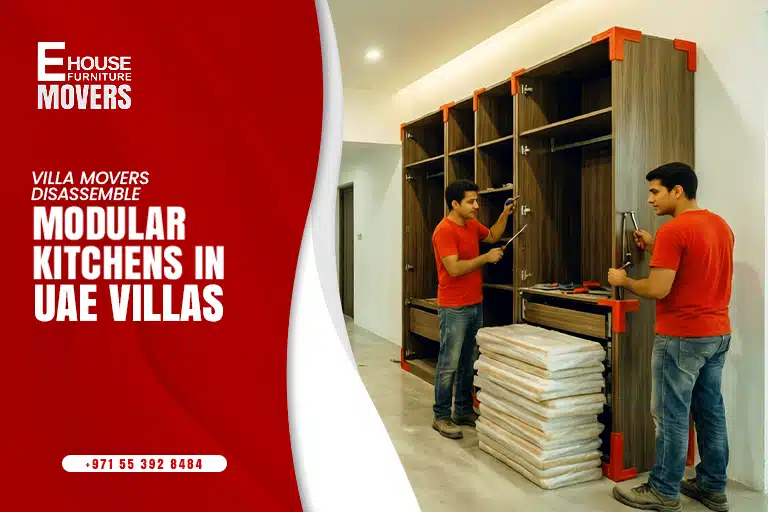
Built-ins in UAE villas create a higher damage-risk profile than loose furniture because panels anchor to walls, floors, and service points. Villa movers reduce damage through a controlled sequence: site survey, condition evidence, hardware identification, staged disassembly, protected packing, and reassembly with alignment checks. Hardware systems such as clip-on hinges and drawer runners support tool-light removal when crews use the correct release points.
Benefits of reading this article
- A step-by-step disassembly workflow that maps wardrobe and kitchen components to the correct removal sequence and packaging method.
- A damage-control checklist and evidence pack that reduces disputes about chipping, misalignment, and missing hardware during villa moves.
The next section defines built-in wardrobes and modular kitchens as technical assemblies so each step stays consistent.
What counts as a built-in wardrobe in a UAE villa move?
A built-in wardrobe is a fixed storage assembly that integrates with the villa envelope, commonly through wall anchoring, skirting integration, filler panels, and scribed joints. A crew treats it as a component system: doors, hinges, carcass panels, shelves, drawer boxes, rails, toe-kicks, fillers, and fixings.
What counts as a modular kitchen in a UAE villa move?
A modular kitchen is a cabinet system assembled from base units, wall units, tall units, doors, drawer fronts, worktop, plinths, fillers, and hardware sets such as hinges, runners, and lift mechanisms. Many systems follow manufacturer-defined installation logic, including cabinet rails, hinge adjustment points, and drawer runner attachment methods.
Why do villa clients fear damage during built-in disassembly?
Clients fear damage because built-ins include visible finishes and edge-banded panels, plus alignment-dependent hardware. A small error can produce door sag, uneven reveals, chipped laminate, or torn wall paint around fillers. The risk rises when crews remove panels without mapping fixings and without surface protection.
What is the standard workflow villa movers use to reduce built-in damage?
Villa movers use a five-stage workflow:
- Site survey and access plan
- Condition evidence and sign-off gates
- Hardware identification and removal sequencing
- Component packing with hardware control
- Reassembly and adjustment to restore alignment
This structure keeps the information graph linear from assessment to closure.
What happens in the site survey for wardrobes and kitchens?
A site survey records constraints and assembly type.
Which fields appear in a mover survey sheet?
- Built-in type: wardrobe, kitchen, pantry, utility units
- Finish type: laminate, veneer, acrylic, lacquer, glass, mirror
- Hardware brand cues: hinge type, runner type, lift mechanism type
- Fixing exposure: visible screws, rail systems, concealed brackets
- Wall condition: paint, wallpaper, tiles, stone cladding
- Service points near kitchens: sink, dishwasher, hob, hood, water line, drain line
A survey converts fear into measurable risk drivers.
What evidence pack reduces disputes about damage?
An evidence pack records condition and component inventory before disassembly.
Which items appear in an evidence pack?
- Timestamped photos of each elevation and door reveal lines
- Close-ups of chips, swelling, scratches, hinge cups, runner clips
- Video sweep of full run for kitchens and full wardrobe elevation
- Hardware count sheet per cabinet bank
- Signature line for client confirmation of pre-existing defects
The evidence pack creates a consistent baseline for claims review.
What tools do villa movers use for disassembling built-ins?
Villa movers use a controlled tool set:
- Manual screwdrivers and bits for confirm-fit removal
- Allen keys for adjustable hinges and runners
- Label tape and marker for component indexing
- Zip bags and compartment boxes for hardware segregation
- Corner guards, foam sheets, bubble wrap, and moving blankets
- Stretch film for bundled panels and safe edge retention
- Dust sheets for floor and pathway protection
A tool list stays smaller when hardware uses clip-on and tool-less release points.
How do villa movers identify hinge and drawer hardware before removing doors and drawers?
Movers identify hardware because removal points differ by system.
How do clip-on hinges change removal?
Clip-on hinge systems include a release lever that detaches the hinge from its mounting plate without unscrewing the hinge cup from the door. Blum documentation for CLIP hinges describes locating the clip release lever and pressing it to release the hinge from the plate.
How do drawer systems change removal?
Many modern drawers detach from runners using clips or release points. Hettich provides technical assistant content for InnoTech Atira assembly and removal workflows and highlights easy removal characteristics in its product literature.
IKEA support documentation also describes drawer front removal steps for specific systems such as MAXIMERA using a screw-release method.
Hardware identification avoids prying damage and cracked fronts.
What is the safest disassembly sequence for built-in wardrobes?
The safest sequence removes weight-bearing and moving parts first, then fixed panels, then anchoring fillers.
Step 1: How do movers clear and de-load a wardrobe?
Movers remove loose content, shelves, baskets, and hanging rails. Movers keep shelf pin sets in labeled bags per cabinet.
Step 2: How do movers remove wardrobe doors without chipping edges?
Movers detach doors at the hinge plate when the hinge type supports clip release. Blum CLIP hinge guidance describes a release lever that detaches the hinge from the mounting plate.
Movers protect door edges with foam wrap before stacking.
Step 3: How do movers remove drawers without stressing the runners?
Movers remove drawer boxes using the runner release method defined by the hardware family. Hettich provides system-specific references for InnoTech Atira assembly and handling.
Step 4: How do movers detach internal panels and carcass fasteners?
Movers remove interior fasteners, then detach side panels and mid-panels only after doors and drawers leave the carcass. This reduces torsion and corner splitting.
Step 5: How do movers remove filler panels and scribes?
Movers score caulk lines, then release filler fixings from inside the cabinet where possible. Movers protect wall paint lines with low-tack tape at the cut line.
Step 6: How do movers label wardrobe components?
Movers label by bank and position:
- Bank code: W1, W2, W3
- Component: D for door, S for shelf, P for panel
- Position: L, C, R, plus floor level
Labels reduce reassembly time and alignment drift.
What is the safest disassembly sequence for modular kitchens?
Kitchen disassembly adds service risk. Movers split the workflow into mechanical parts and service-adjacent parts.
Step 1: How do movers remove doors and drawer fronts first?
Movers remove doors at hinge release points and detach drawer fronts using the manufacturer-defined mechanism. IKEA guidance shows defined steps for changing doors and drawer fronts, and IKEA knowledge content describes drawer front release steps for specific systems.
Step 2: How do movers remove drawer boxes?
Movers detach drawer boxes from runners using the runner release system. Hettich system guidance supports this approach for InnoTech Atira.
Step 3: How do movers remove plinths and toe-kicks?
Movers remove plinth clips and toe-kicks to expose leg sets and base frames. Movers store clips in labeled bags.
Step 4: How do movers approach worktops?
Movers treat worktops as high-risk items because stone, quartz, and compact laminate crack under bending. Movers keep the worktop step separate from cabinet removal and include a dedicated packing plan and carry route.
Step 5: How do movers remove base and wall cabinets?
Movers detach cabinets from rails or anchor points after doors and drawers come off. IKEA METOD installation guidance describes rail and cabinet logic, which informs reverse-sequence removal in practice.
Step 6: How do movers manage service-adjacent components?
Movers isolate dishwasher panels, sink cabinet doors, and hob cabinet components with extra evidence photos because service lines and cut-outs increase risk.
How do villa movers control hardware and fasteners so parts do not go missing?
Movers control hardware using a closed-loop method:
- One labeled bag per cabinet box
- One master kit box per room
- Photo of the bag label and component before sealing
- Counts for hinges, mounting plates, screws, shelf pins, drawer clips
This method reduces the most common built-in failure mode: missing hinge plates and mixed screw lengths.
How do villa movers pack doors, panels, and drawer fronts to prevent scratches?
Villa movers pack by surface sensitivity and edge exposure.
What packing method fits doors and panels?
- Foam sheet on finish face
- Edge protectors on all corners
- Blanket wrap, then stretch film as an outer retention layer
- Vertical stacking in a rigid panel crate when available
What packing method fits drawers and fronts?
- Front face foam wrap
- Clip protection on runner interfaces
- Bundle by cabinet bank to preserve sequence
Finish protection reduces micro-scratches that appear only under villa lighting.
What damage control checks happen during reassembly?
Reassembly uses alignment metrics.
Which checks define acceptable reassembly?
- Door reveal lines consistent across a bank
- Hinge adjustments set for height, side, and depth
- Drawer fronts aligned with consistent gaps
- Plinth lines straight with no wave pattern
- Handles aligned on a shared axis
Hinge and drawer systems provide adjustment features that support alignment. IKEA guidance describes hinge adjustment as part of door installation and alignment.
What are the most common damage points in wardrobes and kitchens?
Damage concentrates at edges, corners, and filler interfaces.
Which wardrobe damage points appear most often?
- Door edge chips near hinges
- Panel corner swelling from moisture exposure
- Scratches on mirror or acrylic faces
- Misaligned doors from swapped hinge plates
Which kitchen damage points appear most often?
- Drawer front cracks at release points
- Worktop edge chips at cut-outs
- Wall tile chipping near filler removal
- Cabinet rail distortion from uneven load
A pre-removal evidence sweep makes these points visible and attributable.
What questions do villa clients ask before approving built-in disassembly?
Clients ask four practical questions.
- What evidence records current condition
- What labeling system keeps parts in order
- What packing method protects finishes
- What alignment checks confirm correct reassembly
These questions map directly to the workflow in this guide.
What is the built-in disassembly checklist that clients can copy and paste?
Built-in wardrobe checklist
- Photos of full elevation and close-ups of defects
- Door removal method confirmed by hinge type
- Drawer removal method confirmed by runner system
- Hardware bag labels per cabinet
- Panel packing plan with corner protection
- Reassembly alignment checks recorded
Modular kitchen checklist
- Door and drawer front removal method confirmed by system
- Drawer box removal confirmed by runner family
- Worktop plan recorded as a separate high-risk item
- Plinth and filler removal plan with caulk scoring
- Final alignment photos and sign-off page
What is the conclusion on built-in disassembly for villa movers?
Villa movers reduce built-in damage by treating wardrobes and modular kitchens as hardware-defined component systems, not as loose furniture. Clip-on hinges and defined drawer release mechanisms support clean removal when crews use the correct release points documented by hardware makers and cabinet system guides. Evidence gates, labeled hardware control, protected panel packing, and alignment checks form the practical controls that match UAE villa client expectations for zero visible finish damage.
Idris is a logistics specialist with a focus on residential relocation and supply chain efficiency. With extensive experience in the moving industry, he specializes in transit safety, specialized packing techniques for high-value goods, and fleet management. He is dedicated to streamlining the moving process, ensuring that every relocation is handled with strategic planning and maximum care.