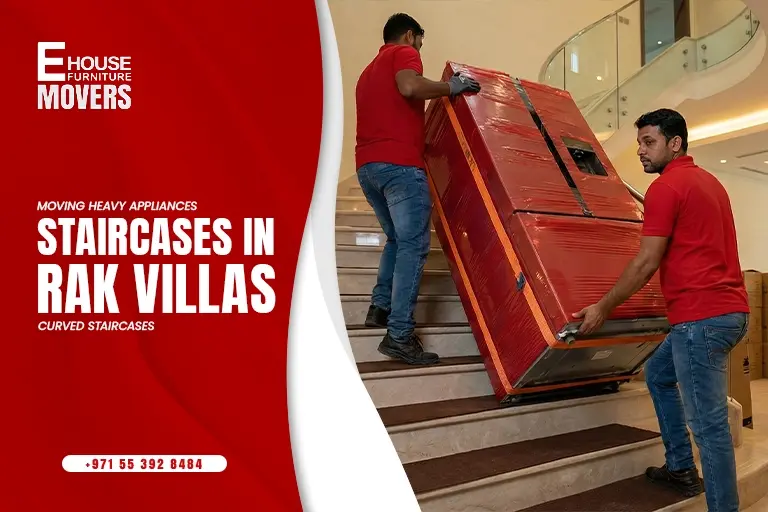
Curved staircases make appliance moves risky because rotation happens mid descent and the team loses straight line control at the bend. This guide explains how RAK villa moves stay safe and predictable using spotter guidance, a three person lift, and anti slip mats, with one core rule repeated through the page: curved stairs require pivot and turn.
Why Do Curved Staircases In RAK Villas Increase Risk For Heavy Appliances?
Curved staircases increase risk because the load must rotate at the bend while footing and grip change across smooth steps like marble or tile.
A straight staircase is a single axis problem. A curved staircase is an axis plus rotation problem.
What changes on curved stairs
- Line of sight breaks: carriers cannot see the next two steps at the bend
- Handrail geometry changes: rail to wall distance narrows at the turn
- Step contact points shift: feet land closer to the nosing edge
- Clearance becomes dynamic: corners and handles collide during rotation
Common RAK villa features that amplify risk
- Polished marble treads with low friction when dusty
- Tight landings built for foot traffic, not appliances
- Decorative handrails that reduce usable width
- Tall stair wells that create echo and communication errors
Decision rule: If the appliance must rotate to clear the bend, treat the move as a controlled pivot task, not a basic carry.
Why Do Curved Stairs Require Pivot And Turn For Appliances?
Curved stairs require pivot and turn because the appliance cannot stay aligned to one straight axis across a bend without clipping walls, rails, or step edges.
Pivot and turn is not a style choice. Pivot and turn is a geometry requirement.
What pivot and turn means in practice
- The appliance moves to a landing or bend zone
- The team pauses at a stable stance
- The appliance rotates around a controlled pivot point
- The descent continues with the new alignment
Why rotation is unavoidable
- Stair width changes at the inner curve
- Handrail posts reduce turning envelope
- Wall corners reduce safe swing space
- Appliances have protrusions like handles, hinges, and compressor covers
Appliance examples
- Refrigerator: Tall profile increases tip risk during rotation
- Washing machine: Dense mass increases momentum during step transitions
- Oven or dishwasher: Sharp edges and panels dent easily during a tight pivot
What Measurements Prevent Clearance Failure On Curved Staircases?
Clearance failure is prevented by measuring appliance dimensions against stair width, landing depth, and the bend’s turning radius before the carry begins.
What Stair Measurements Matter Most On Curved Stairs?
Stair width, landing depth, rail to wall distance, and headroom matter most because they define the turning envelope.
Measure these points:
- Stair width at the inner curve and outer curve
- Rail to wall distance at the bend
- Landing depth where rotation must occur
- Headroom at the bend where tilt increases height demand
What Appliance Measurements Matter Most For Stair Rotation?
Height, depth, and handle protrusion matter most because they determine how much rotation space is needed at the bend.
Measure these points:
- Appliance depth including handle
- Appliance height including top hinge cover
- Protrusions such as water line fittings and rear vents
- Door swing risk if doors are not secured
Quick measurement grid you can use
| Measurement Item | Why It Matters On Curved Stairs | Failure If Ignored |
|---|---|---|
| Inner curve stair width | Inner curve is the pinch point | rail strike or wall scrape |
| Landing depth | Rotation needs space | stuck at bend |
| Rail to wall gap | Defines turning envelope | knuckle crush risk |
| Appliance depth with handle | Defines pivot clearance | handle tears wrap or hits wall |
| Headroom at bend | Tilt increases height | ceiling or light fixture contact |
What Is Spotter Guidance During Curved Stair Appliance Moves?
Spotter guidance is the control role that calls step timing and clearance at blind bends to prevent rail strikes, wall scrapes, and foot slips.
Spotter guidance reduces errors because it centralizes decision making at the point where carriers lose visibility.
Where Should The Spotter Stand On Curved Stairs?
The spotter stands where the carriers lose sight of the lower path, usually at the bend or landing line of sight break.
Spotter placement zones:
- Bend line: Where the lower steps disappear
- Base line: Where the appliance must clear the final turn
- Rail hazard line: Where the inner rail tightens the envelope
What Spotter Calls Prevent Common Failures?
Calls that prevent failures are “step”, “hold”, “pivot”, and “clear” because they control timing and rotation.
Simple call set
- Step: Move one step only
- Hold: Stop and stabilize
- Pivot: Rotate on the planned point
- Clear: Safe to continue, no contact risk
Spotter guidance rule: One caller, one command set, one timing rhythm.
Why Does A Three Person Lift Reduce Risk On Curved Staircases?
A three person lift reduces risk because it stabilizes the load during pivot and turn and keeps the center of mass controlled at the bend.
A two person carry is stable on straight stairs when clearance is generous. Curved stairs reduce clearance and demand more micro adjustments.
What Roles Should A Three Person Team Use On Curved Stairs?
Roles are lead carrier, tail carrier, and spotter stabilizer because each role controls a different failure mode.
- Lead carrier: Controls direction and step placement
- Tail carrier: Controls tilt, braking, and load stability
- Spotter stabilizer: Controls clearance and pivot timing
When Is A Two Person Carry Not Enough?
Two person carry is not enough when the appliance is tall, top heavy, or must pivot tightly at a curved landing.
High risk triggers:
- Narrow rail to wall gap
- Short landing depth
- Polished steps
- Long carry distance before the stair begins
- Tight door exit into the staircase corridor
How Do Anti Slip Mats And Step Protection Control Slip Risk On Marble Or Tile Stairs?
Anti slip mats control slip risk by increasing traction at the contact points where feet and load transitions occur on smooth stair finishes.
Anti slip mats reduce slide risk in two places:
- Foot contact zone: Where carriers place weight during a controlled descent
- Load contact zone: Where the appliance base comes close to step edges during pivot
Which Stair Surfaces In Villas Need Extra Grip Control?
Polished marble, glossy tile, and worn nosing edges need extra grip control because friction drops under dust and humidity.
Surface risk checklist
- Marble treads with fine dust
- Tile steps with cleaning residue
- Rounded nosing edges that reduce grip area
- Steps with decorative inlays that create micro unevenness
Protection items commonly used
- Anti slip mats placed on high risk steps
- Step edge protection to reduce chipping
- Rail padding to prevent scratches
- Wall guard sheets at the pivot zone
What Appliance Specific Risks Change The Plan On Curved Staircases?
Appliance risk changes by center of mass and fragile parts, so refrigerators, washers, and ovens require different handling priorities.
What Makes Refrigerators Risky On Curved Stairs?
Refrigerators are risky because they are tall and can shift balance during rotation at the landing.
Risk factors:
- Tall center of mass
- Door swing if unsecured
- Rear compressor zone sensitivity during impact
Controls:
- Secure doors before descent
- Define a pivot zone with clear walls
- Keep rotation slow and timed
What Makes Washing Machines Risky On Curved Stairs?
Washing machines are risky because their mass is dense and can jerk during step transitions.
Risk factors:
- Dense weight increases momentum
- Sudden step changes increase slip risk
- Tight bends force awkward grip angles
Controls:
- Maintain stable tilt angle
- Prevent sudden step drops
- Keep the three person lift rhythm
What Makes Ovens And Dishwashers Risky On Curved Stairs?
Built in appliances are risky because edges and panels dent easily when the pivot path is tight.
Risk factors:
- Sharp corners that hit rails and walls
- Delicate panels that deform under pressure
- Narrow form factor that tempts fast handling
Controls:
- Add corner guards
- Protect wall contact zones
- Use slow pivot and turn timing
What Packing And Surface Protection Prevents Scratches And Wall Damage During Pivot And Turn?
Damage is reduced when corners, edges, and wall contact zones are protected before the pivot begins.
Packing and protection is a control system, not decoration.
Protection sequence
- Corner protection on appliance edges
- Wrap layers to prevent scuffs
- Rail padding at inner curve hazard points
- Wall guards at the pivot zone
- Floor protection at entry and base landing
Minimum protection set
- Moving blankets
- Stretch wrap
- Corner guards
- Rail padding
- Anti slip mats
- Wall guard sheets
Key principle: protect the pivot zone first because pivot and turn is where contact risk peaks.
Which RAK Villa Access Rules And Community Controls Affect Heavy Appliance Moves?
Access rules affect heavy appliance moves because time slots, gate checks, and parking distance control how safely teams can stage the descent.
RAK villa moves often depend on:
- Security gate access for moving crew and transport vehicles
- Time slot windows for moving activity
- Parking distance from truck to villa entrance
- Community rules on noise, working hours, and loading areas
Why parking distance matters
- Longer carry distance increases fatigue
- Fatigue reduces grip stability
- Grip stability errors rise at the curved bend
Operational rule: If the carry distance is long, increase control time and reduce rushed descent attempts.
How Do Tight Staircase Techniques Apply When Curved Stairs Are Also Narrow?
Tight staircase techniques apply by reducing rotation space demands and controlling the pivot path at the landing.
A curved staircase can also be narrow. That combination creates a double constraint: reduced width plus forced rotation.
Tight staircase techniques that fit curved stairs
- Pre plan the pivot point on the landing
- Protect the inner rail hazard zone
- Keep the appliance alignment consistent before rotation
- Reduce unnecessary tilt changes
How Should RAK To Dubai Appliance Transfers Be Sequenced After A Curved Stair Descent?
RAK to Dubai sequencing works when loading order matches unloading order, so the appliance does not get re handled during delivery.
After a curved stair descent, the biggest preventable cost is re handling. Re handling increases scratch probability and schedule variance.
Sequence controls
- Load the appliance into a stable position in the vehicle
- Lock the delivery order based on destination access windows
- Prevent mid route rearrangement that forces extra lifting
What Questions Should You Ask A Moving And Packing Company Before A Curved Stair Appliance Move?
The right questions confirm manpower, spotter control, traction protection, and clearance planning before the move starts.
- Do you use spotter guidance at blind bends and landings
- When do you require a three person lift on stairs
- Do you use anti slip mats on marble and tile steps
- How do you measure landing clearance for pivot and turn
- What protections do you apply to rails, walls, and step edges
- How do you prevent door swing on refrigerators during descent
- How do you plan staging when parking distance is long
Conclusion
Curved staircases create appliance risk because rotation must happen at the bend under reduced visibility and reduced clearance. The safest method stays consistent: spotter guidance controls timing, a three person lift stabilizes the load, and anti slip mats increase traction on marble and tile steps. The same operational rule connects every section of this page from the first sentence to the last: curved stairs require pivot and turn.
FAQS
Yes, curved stairs require pivot and turn because the bend forces rotation to clear rails, walls, and step edges.
Spotter guidance is a control role that calls timing and clearance at blind bends to prevent contact and slips.
A three person lift is needed when the appliance is tall, heavy, top heavy, or must rotate tightly at a landing.
Anti slip mats increase traction on marble and tile steps where friction drops under dust or humidity.
The most common failure is clearance loss at the bend, which causes wall scrapes, rail strikes, or forced resets.
Measure inner curve width, landing depth, rail to wall gap, and fridge depth with handle to confirm pivot space.
RAK villa moves often include longer carry distances, gated access controls, and curved stairs with decorative rails.
Tight staircase techniques help by controlling the pivot point and minimizing rotation space demands at the landing.
Sarmast Faiz is a seasoned relocation expert with 10 years of experience in the logistics industry. He holds a degree in Business Administration with a focus on Logistics and Supply Chain Management. He specializes in practical, real-world moving guidance for individuals and families planning local or international relocations. His articles cover efficient packing and decluttering, move planning and timelines, and international relocation complexities such as visa coordination and cultural adjustment. Sarmast’s goal is to help readers navigate the moving process with clarity and confidence.
Idris is a logistics specialist with a focus on residential relocation and supply chain efficiency. With extensive experience in the moving industry, he specializes in transit safety, specialized packing techniques for high-value goods, and fleet management. He is dedicated to streamlining the moving process, ensuring that every relocation is handled with strategic planning and maximum care.