
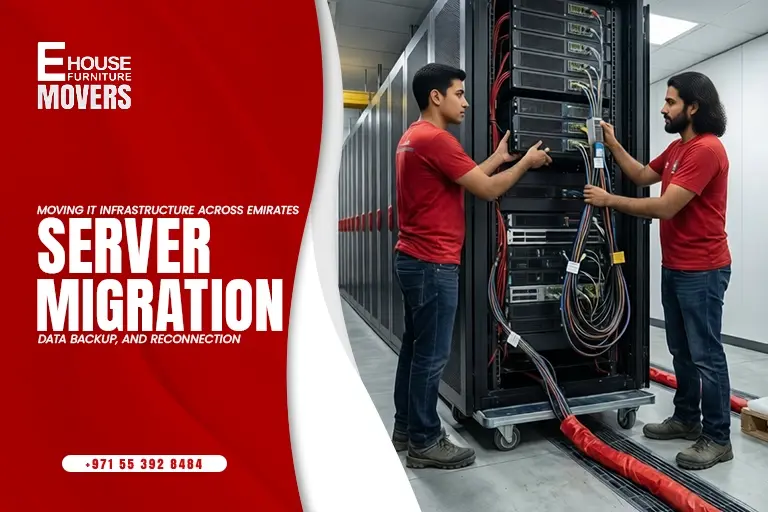
Moving IT infrastructure across Emirates is a sequence of risk events. The largest risks are downtime, data loss, and reconnection failure. A widely cited Gartner estimate places average downtime at $5,600 per minute. Data exposure also carries measurable impact. IBM reports a $4.88 million global average cost of a data breach (2024).
This guide covers inter Emirate moves across Dubai, Abu Dhabi, Sharjah, Ajman, Ras Al Khaimah, Fujairah, and Umm Al Quwain. It focuses on three workstreams:
- Server migration: physical relocation, rebuild, or hybrid cutover.
- Data backup: verified restore points, immutability, and evidence logs.
- Reconnection: power, network, security, identity, applications, user access.
The compliance layer matters. The UAE government portal summarizes the national Personal Data Protection Law framework. The official legislation portal provides the Federal Decree Law text. Building readiness also matters. TDRA publishes Telecommunications Infrastructure Guidelines initiatives for building telecom integration.
What does “moving IT infrastructure across Emirates” include?
It includes asset movement plus service continuity controls.
Physical and logical scope
- Compute: Rack servers, tower servers, hyperconverged nodes
- Storage: NAS, SAN, backup appliances, tape libraries
- Network: Firewalls, switches, routers, Wi Fi controllers
- Identity: Active Directory, DNS, DHCP, NTP, MFA systems
- Applications: databases, ERP, file services, VoIP, line of business apps
- Connectivity: ISP circuits, MPLS, SD WAN, site to site VPN, public IP blocks
Typical inter Emirate constraints
- Circuit activation windows and in building handover timings
- Elevator access and loading bay restrictions in commercial towers
- Cutover window coordination with business peak hours and payroll cycles
What are the top risks in server migration across Emirates?
The top risks are downtime, recovery failure, and security gaps.
Risk facts with accredited sources
- Downtime cost benchmark: Gartner estimate of $5,600 per minute appears in Atlassian’s downtime cost explainer.
- Breach cost benchmark: IBM reports $4.88M average global breach cost (2024).
- Outage cost distribution: Uptime Institute executive summary reports 54% of respondents said their most recent significant outage cost more than $100,000, and 16% reported more than $1 million.
Risk register table
| Risk | Observable trigger | Primary control | Evidence artifact |
|---|---|---|---|
| Extended downtime | missed cutover checkpoint | rollback plan + staged cutover | signed cutover log |
| Data corruption | checksum mismatch | restore tests + hashes | hash report + restore report |
| Circuit not live | link fails acceptance test | parallel link or LTE failover | carrier handover record |
| Firewall drift | blocked app flows | pre validated ruleset | export + diff report |
| Identity failure | login errors, DNS break | identity first sequence | DNS test sheet |
| Compliance breach | unclear data transfer basis | processing record | transfer log |
Uptime Institute highlights outage causes and cost patterns in its annual outage analysis materials.
What data governance rules apply when relocating across Emirates?
The applicable framework depends on jurisdiction and data type.
UAE PDPL baseline
- UAE official portal: national data protection laws overview.
- Federal Decree Law No. 45 of 2021: official legislation text download.
Governance outputs for a move
- System inventory: system name, owner, data categories, retention window
- Access map: admin accounts, MFA coverage, break glass accounts
- Transfer record: who moved data, when, where it landed, integrity evidence
Evidence pack checklist
- Processing record: Controller and processor details where relevant (as documented in law text and official portal guidance context).
- Chain of custody: Asset tags, sealed transport IDs, sign off times
- Integrity proofs: Hashes, restore logs, database consistency checks
What migration model fits inter Emirate relocation?
Three models dominate. Each model maps to downtime tolerance and complexity.
Model comparison table
| Model | Definition | Best fit | Primary risk |
|---|---|---|---|
| Lift and shift | move hardware, reconnect, boot | small racks, stable workloads | physical shock, config drift |
| Rebuild and restore | build new site, restore data | refresh cycle, modernization | restore time, licensing gaps |
| Hybrid cutover | temporary parallel site or cloud | low downtime tolerance | network and identity complexity |
Uptime Institute outage research emphasizes preventing failures through resilience design and operational discipline.
What backup standard reduces data loss risk before a move?
A practical baseline is multi copy backups plus verification.
Backup control set
- Multiple copies: At least two independent backup copies plus production copy
- Separation: One copy stored separately from the primary site
- Verification: Restore tests for critical systems
- Immutability: Tamper resistant retention where available
IBM breach cost research highlights the financial impact of security failures, which increases the value of strong recovery posture.
Restore test ladder (ordered)
- File restore test: Single file integrity
- VM restore test: Boot level validation
- Application restore test: App service start and login
- Database consistency test: Integrity checks and query validation
- Full business workflow test: End user transaction path
Backup evidence table
| Evidence item | Purpose | Example |
|---|---|---|
| Restore log | proves recovery works | app restore report |
| Hash list | proves integrity | SHA256 list for exports |
| Snapshot map | proves timing | cutover aligned snapshots |
| Retention record | proves lifecycle | immutable bucket policy |
What reconnection sequence prevents “site up, services down”?
A stepwise sequence reduces cascading failures.
Reconnection order (numbered, test driven)
- Power and environment
- UPS runtime check
- PDU mapping validation
- Rack airflow clearance
- Core network
- Switch stack health
- VLAN database verification
- Trunk port validation
- Edge security
- Firewall HA status
- VPN tunnels up
- NAT and policy review
- Identity services
- DNS authoritative response
- DHCP scope active
- NTP sync stable
- Application tier
- Database service status
- Middleware service status
- Application service status
- User access
- Wi Fi auth
- endpoint VPN test
- Remote access test
Why building telecom readiness matters in the UAE
TDRA’s Telecommunications Infrastructure Guidelines initiative describes technical requirements and standards for building telecom integration and related areas. TDRA also reported building telecom specification updates with quantified impacts in a press release, including a preparatory study estimate of AED 13.5 million annually in savings for developers and service providers tied to standardization.
What is a practical cutover plan for a multi Emirate move?
A cutover plan is a timeboxed sequence with rollback checkpoints.
Cutover runbook structure
- Scope: Systems and apps inside the window
- Freeze list: Change freeze boundaries
- Roles: names, phone numbers, escalation chain
- Checkpoints: Pass fail tests with timestamps
- Rollback: Exact return path per system
Cutover checklist
- Inventory confirmed. Serial numbers recorded.
- Config exports completed. Stored offsite.
- Backups verified. Restore tests recorded.
- Circuits tested. Latency and packet loss recorded.
- DNS plan finalized. TTL reduced in advance where feasible.
- Firewall rules validated in staging.
- Identity validation plan ready. DNS and AD checks listed.
- Business sign off recorded. Window approved.
Downtime cost references support the business case for disciplined cutovers.
What timeline fits a typical UAE office relocation with IT?
Timelines vary by circuit lead times and building approvals.
Example timeline table
| Phase | Duration range | Deliverables |
|---|---|---|
| Discovery and inventory | 3 to 10 days | asset list, dependency map |
| Backup hardening | 2 to 7 days | restore logs, snapshot map |
| New site readiness | 2 to 6 weeks | racks, power, access control |
| Circuit activation | 2 to 8 weeks | carrier handover test |
| Cutover window | 6 to 24 hours | runbook log, sign offs |
| Stabilization | 3 to 14 days | monitoring baseline, audit |
Telecom infrastructure readiness guidance sits under TDRA initiatives and related documents.
How does a team track dependencies during server migration?
Dependency mapping prevents silent failures.
Dependency map fields
- Application name
- Database dependency
- DNS records
- Static IPs
- Firewall ports
- Certificate stores
- External APIs
- Authentication method
Fast dependency capture list
- Identity: AD, SSO, MFA
- Network: VLAN, subnet, routes
- Storage: mount points, LUN IDs
- Apps: services, ports, job schedules
- Monitoring: agents, syslog targets
Uptime Institute notes preventability themes in outage analysis.
How does a business calculate downtime exposure for the move?
A simple exposure model uses minutes of outage times cost per minute.
Downtime exposure formula
- Exposure = outage minutes × cost per minute
Atlassian’s incident management explainer cites the Gartner benchmark of $5,600 per minute and notes variance by company and industry.
Example calculation table
| Scenario | Planned outage | Cost basis | Exposure |
|---|---|---|---|
| Weekend cutover | 120 minutes | $5,600 per minute | $672,000 |
| Overnight cutover | 45 minutes | $5,600 per minute | $252,000 |
These are benchmark illustrations, not a universal rate. Source context flags this as an average.
What controls reduce physical risk during inter Emirate transport?
Physical handling impacts hardware reliability and chain of custody.
Transport and handling checklist
- Labeling: Asset tag and rack unit position
- Packing: Anti static packing for components
- Shock control: Foam inserts, rack transport frames
- Seal control: Tamper evident seals on crates
- Escort: Handoff signatures at each step
- Climate: Avoid heat soak for sensitive gear
Chain of custody log fields
- Date and time
- Handler name
- Vehicle ID
- Seal ID
- Origin and destination
- Condition notes
What is the fastest reconnection test plan after relocation?
A test matrix reduces random troubleshooting.
Reconnection test matrix table
| Layer | Test | Pass criteria |
|---|---|---|
| Power | UPS status | stable load, no alarms |
| Switching | VLAN reachability | correct L2 adjacency |
| Routing | gateway ping | stable latency |
| Firewall | policy test | app ports open as expected |
| DNS | forward and reverse lookup | correct responses |
| Identity | login test | auth success |
| Apps | health endpoint | green checks |
| Users | Wi Fi plus VPN | stable access |
Interactive section: 12 question move readiness quiz
Score one point per Yes.
- Inventory exists for servers, storage, and network devices.
- Dependency map exists for tier 1 apps.
- Backup copy exists offsite.
- Restore test exists for one full app workflow.
- Firewall export exists with version stamping.
- DNS plan exists with record list.
- ISP circuit handover test exists.
- VLAN and IP plan exists for new site.
- Cutover runbook exists with checkpoints.
- Rollback steps exist per tier 1 system.
- Chain of custody log template exists.
- Stabilization plan exists with monitoring baselines.
If outage costs exceed six figures in a large share of incidents, readiness checks carry high value.
Conclusion
Moving IT infrastructure across Emirates works best as a checklist governed by evidence. The data layer starts with verified backups and restore logs. The reconnection layer starts with power and networking, then security, identity, applications, and user access. The governance layer stays aligned with the UAE’s national data protection framework and official legislation text.
Cost data frames the priority. Gartner’s widely cited downtime benchmark of $5,600 per minute shows how fast a cutover overruns budget. Outage research adds another anchor. Uptime Institute reports 54% of respondents said their most recent significant outage exceeded $100,000, and 16% exceeded $1 million. The practical takeaway is simple. The best migration plan looks boring on paper. It contains inventories, dependency maps, restore evidence, circuit handover results, and a test driven reconnection sequence. That structure converts an inter Emirate relocation from a crisis risk into an auditable operational change.
FAQs
What is server migration in an inter Emirate move?
What backup evidence matters most before moving servers?
What statistic frames outage cost severity?
What is the fastest safe migration model for low downtime tolerance?
What is the first reconnection dependency after a move?
Which UAE sources describe data protection context?
What TDRA resource connects to building telecom readiness?
What cost figure frames breach impact for risk planning?
What causes “site up, services down” after relocation?
What is the simplest way to size the cutover window?
Idris is a logistics specialist with a focus on residential relocation and supply chain efficiency. With extensive experience in the moving industry, he specializes in transit safety, specialized packing techniques for high-value goods, and fleet management. He is dedicated to streamlining the moving process, ensuring that every relocation is handled with strategic planning and maximum care.