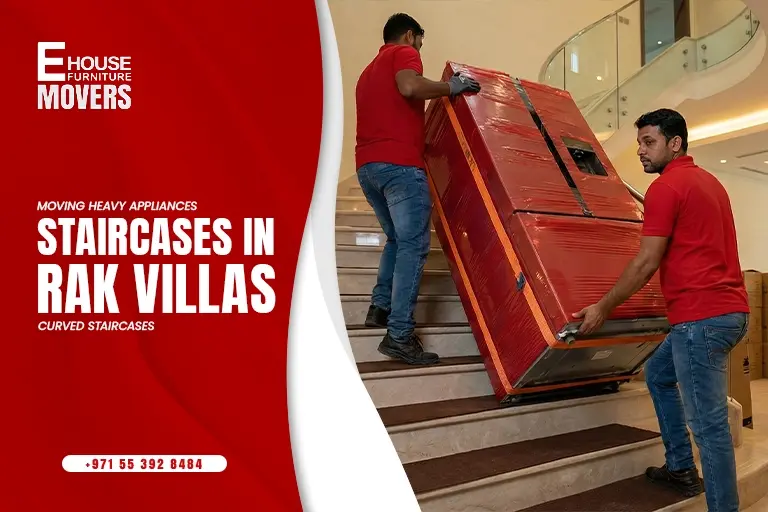
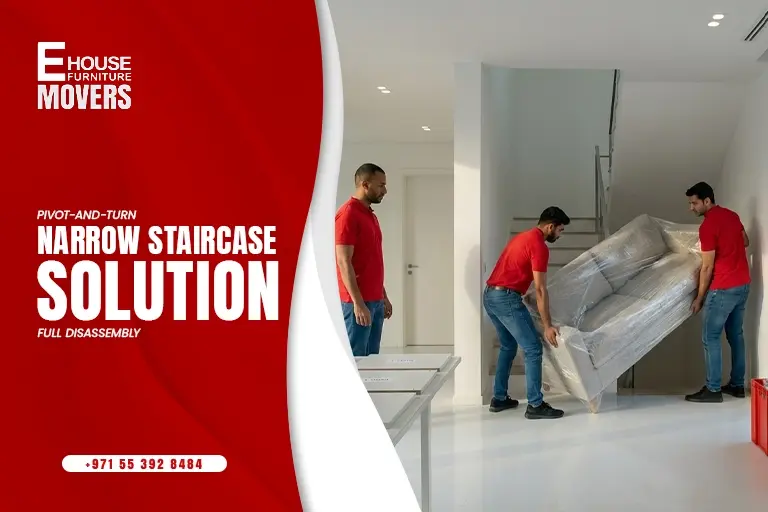
Narrow staircases create a measurable clearance limit that determines whether furniture and appliances can move intact using pivot-and-turn or require full disassembly. This decision depends on numeric comparison between effective stair clearance and the item’s minimum structural width. When clearance becomes smaller than item width, rotation fails and disassembly becomes the only safe method.
Staircase clearance in villas and low-rise buildings typically ranges between 85 cm and 100 cm, while large appliances such as refrigerators often measure 90 cm to 100 cm wide, and assembled wardrobes can exceed 180 cm in total width. Even a small difference matters. For example, a 90 cm staircase and a 95 cm fridge create a −5 cm clearance deficit, which prevents intact movement regardless of lifting strength or angle. The constraint is geometric, not physical effort.
The solution is a structured decision process based on 3 measurable factors: stair width, landing depth, and ceiling height. These measurements determine whether pivot-and-turn rotation is feasible or whether full disassembly is required to reduce item dimensions. This guide explains the clearance formulas, rotation thresholds, and disassembly triggers using real numeric examples such as 90 cm staircases, 95 cm appliances, landing depth limits, and tilt height constraints, so the correct method can be selected before the move begins.
What Makes Narrow Staircases Fail During Moves?
Narrow staircases fail moves because they create a fixed clearance limit and a rotation limit at the landing.
A move becomes unsafe when the team tries to “force” rotation under a negative clearance result.
The 6 Most Common Stair Pinch Points
- Handrail Projection (2–6 cm reduction in usable width)
- Wall Skirting / Trim (1–3 cm reduction per side in older villas)
- Landing Corner Radius (hard corner blocks rotation for rigid items)
- Ceiling Soffit / Low Beam (reduces tilt angle for tall appliances)
- Door Frame At Stair Entry (often 80–90 cm internal clear width)
- Top Landing Narrowing (tightest zone in many villas)
A stair route needs measurements, not guesses.
What Is Staircase Clearance And How Do You Calculate It?
Staircase clearance is the smallest usable width (and height) available at any point on the route. Use effective clearance formula instead of “stair width.”
Clearance Formula (Width)
Effective Clearance (cm) = Measured Stair Width − Obstruction Offsets
Example 1: “90 cm stairs” with offsets
- Measured Stair Width: 90 cm
- Handrail Projection: 4 cm
- Wall Trim Offset: 2 cm
- Effective Clearance: 90 − (4 + 2) = 84 cm
84 cm is the usable width, not 90 cm.
Clearance Formula (Height)
Effective Headroom (cm) = Ceiling Height − Beam/Soffit Drop
Example 2: Low ceiling zone
- Ceiling Height: 205 cm
- Soffit Drop: 15 cm
- Effective Headroom: 190 cm
A tall item that needs tilt may fail even if width looks acceptable.
When Does Pivot-and-Turn Work On Narrow Stairs?
Pivot-and-turn works when the item’s minimum rotation width fits inside effective clearance and the landing depth supports rotation.
The Pivot-and-Turn Feasibility Test (2 Checks)
- Width Test
Effective Clearance ≥ Item Minimum Width - Landing Test
Landing Depth ≥ Item Width + Rotation Buffer
A practical buffer is 10–15 cm for controlled rotation.
Numeric Example: Sofa Passes With Pivot-and-Turn
- Sofa Narrow-Side Width: 85 cm
- Effective Stair Clearance: 92 cm
- Clearance Surplus: +7 cm
- Landing Depth: 105 cm
- Buffer: 105 − 85 = 20 cm
Pivot-and-turn feasible
Pivot-and-Turn Execution (5-Step Method)
- Tilt Item onto a stable edge to reduce footprint
- Advance To Landing with one lifter controlling the high end
- Rotate Gradually in 10–20° increments, not a single swing
- Pivot On Corner using a controlled pivot point (blanket + corner guard)
- Align And Lower into the next stair flight with a spotter calling clearance
Rule: Rotation happens on the landing, not on the steps.
When Is Full Disassembly Required?
Full disassembly is required when effective clearance is smaller than item width (negative clearance). This is the only decision rule that stays consistent on every staircase.
The Clearance Rule (Non-Negotiable)
If Clearance < Item Size → Disassemble
Numeric Example: 90 cm Stairs vs 95 cm Fridge
- Measured Stair Width: 90 cm
- Fridge Width: 95 cm
- Clearance Result: 90 − 95 = −5 cm
Intact carry fails → Disassembly required
Now apply offsets (realistic case):
- Handrail Projection: 4 cm
- Effective Clearance: 86 cm
- Deficit vs 95 cm fridge: −9 cm
This strengthens the disassembly decision.
How Much Width Can Fridge Disassembly Recover?
Fridge disassembly reduces width by removing doors, handles, and protrusions that set the maximum width.
Fridge Disassembly Parts (Common 6)
- Remove Doors
- Remove Handles
- Remove Shelves
- Remove Drawers
- Remove Hinge Covers
- Secure Power Cord And Back Panel
Width Reduction Example (Measured)
- Original Width: 95 cm
- Handle Protrusion: 2 cm
- Door Thickness + Swing Hardware Allowance: 6 cm
- New Operational Width: 95 − (2 + 6) = 87 cm
If effective clearance is 86–90 cm, the fridge becomes feasible only after disassembly.
Control Note: Doors removal also reduces swing risk at the landing.
How Does Stair Geometry Change The Method?
Stair geometry determines whether an item can rotate on the landing without collision.
3 Stair Types And Their Rotation Difficulty
- Straight Staircase (Lowest rotation complexity)
- L-Shaped Staircase (1 × 90° turn at landing)
- U-Shaped Staircase (1 × 180° sequence, highest collision risk)
Landing Depth Threshold (Practical)
- < 90 cm landing depth: rotation becomes high-risk for rigid items
- 90–105 cm landing depth: limited pivot possible for sofas
- > 105 cm landing depth: pivot-and-turn becomes predictable
Example:
- Landing Depth: 95 cm
- Item Width: 95 cm
- Buffer: 0 cm
Rotation becomes uncontrolled → disassembly recommended
How Do You Measure Stairs Correctly Before Moving?
Measure the stair route at multiple points and use the smallest value as the decision value.
6 Measurement Points (Minimum Standard)
- Bottom Entry Width
- Mid-Flight Width
- Handrail Projection
- Landing Width
- Landing Depth
- Top Exit Width
Example Measurement Set
- Bottom Width: 92 cm
- Mid Width: 90 cm
- Landing Width: 88 cm
- Top Width: 91 cm
Decision clearance = 88 cm (smallest)
Decision Flowchart Logic (Clearance → Geometry → Ceiling)
Use this sequence every time.
Step 1: Clearance Math
- Clearance Result = Effective Clearance − Item Width
- If Result < 0 → Disassemble
- If Result ≥ 0 → Go to Step 2
Step 2: Landing Geometry
- If Landing Buffer < 10 cm → Disassemble
- If Landing Buffer ≥ 10 cm → Go to Step 3
Step 3: Ceiling / Tilt Check
- If tilt envelope exceeds headroom → disassemble
- If tilt is possible → pivot-and-turn
Wardrobes: Why Disassembly Becomes The Default
Wardrobes typically exceed stair clearance when intact and have poor rotation characteristics.
Typical Wardrobe Numbers
- Typical assembled width: 150–240 cm
- Typical panel width after breakdown: 35–60 cm
Wardrobe Breakdown Checklist (8)
- Remove Doors
- Remove Shelves
- Remove Drawers
- Remove Back Panel
- Separate Side Panels
- Label Hardware Bags (1 bag per panel set)
- Mark Panel Orientation (Top/Bottom arrows)
- Protect Edges (Corner guards + wrap)
Sofas: When Intact Carry Works With Pivot-and-Turn
Sofas can pass intact when narrow-side width and landing depth support controlled rotation.
Sofa Fit Numbers (Practical Bands)
- Sofa narrow-side width range: 70–90 cm
- Effective clearance that supports intact carry: ≥ sofa width + 5 cm
- Recommended landing depth buffer: 10–15 cm
Sofa Pivot Checklist (6)
- Wrap Arms And Corners
- Use Anti-Slip Mats At Landing
- Assign A Spotter (calls wall distance)
- Rotate In Steps (10–20° increments)
- Hold The High End (reduces swing)
- Stop If Fabric Snags (snag indicates pinch point)
Low Ceilings: The Hidden Reason Pivot Fails
Low ceilings reduce allowable tilt angle, forcing disassembly even when width is sufficient.
Tilt Envelope Example
- Ceiling Height: 205 cm
- Soffit Drop: 20 cm
- Effective Headroom: 185 cm
- Fridge Height: 190 cm
Tilt becomes impossible → disassembly required
Low Ceiling Controls (5)
- Measure Headroom At Landing
- Avoid Vertical Tilt Attempts
- Remove Doors To Reduce Handling Risk
- Use Strap Control (reduces sudden shifts)
- Plan Alternate Path (service stairs or balcony lift if allowed)
Safety Roles: Why Three People Beats Two
Three-person coordination increases stability and reduces collision probability on narrow stairs.
Three-Person Role Split
- Lead Lifter (controls direction at upper end)
- Base Lifter (supports load and step transitions)
- Spotter (calls clearance and pivot timing)
Spotter Callouts (Examples)
- “Clear Left 5 cm”
- “Stop Rotation”
- “Lift 3 cm”
- “Pivot Now”
Numbers matter because they translate movement into controlled increments.
Photo Examples To Include In The Blog (Client-Decision Style)
Photo Set A: Wardrobe (Disassembly Proof)
- Photo 1: Intact wardrobe at stair entry with width label (e.g., 180 cm)
- Photo 2: Panels stacked, hardware bags labeled (Bag 1/4, 2/4, 3/4, 4/4)
- Photo 3: Panel passing landing showing clearance margin
Photo Set B: Sofa (Pivot Proof)
- Photo 1: Sofa wrapped, tilted on side at landing entry
- Photo 2: Pivot point at landing corner with protection pads
- Photo 3: Sofa aligned with next flight, spotter showing wall distance
Conclusion
Full disassembly is required when staircase clearance is smaller than item width, while pivot-and-turn works only when clearance equals or exceeds the item’s minimum rotation width and landing depth supports controlled rotation. This decision depends on measurable values, not assumptions. A staircase labeled 90 cm wide often provides only 84–88 cm effective clearance after subtracting handrail projection and wall offsets. When moving a 95 cm refrigerator, this creates a −7 to −11 cm clearance deficit, which makes intact movement mechanically impossible and increases collision risk. Disassembly reduces structural width by removing doors, panels, and protruding components, allowing safe passage through restricted zones. Pivot-and-turn remains effective for items such as sofas with 70–90 cm narrow-side widths, provided landing depth offers at least 10–15 cm rotation buffer. The safest method always follows clearance math: Measure staircase clearance, compare it with item width, and select pivot-and-turn only when positive clearance exists.
FAQS
No, a 95 cm fridge does not fit through a 90 cm staircase because the clearance deficit is 5 cm, so disassembly is required.
Pivot-and-turn is a controlled landing rotation method where an item is tilted and rotated in steps to align with the next stair flight.
Full disassembly is required when effective clearance is smaller than the item width, producing a negative clearance result.
Clearance Result = Effective Stair Clearance − Item Width, and a negative result means disassembly is required.
A clearance surplus of 5–10 cm improves control, and a landing buffer of 10–15 cm improves rotation stability.
A handrail reduces usable width by 2–6 cm, which can convert a marginal fit into a deficit fit.
Wardrobes typically exceed stair clearance when assembled (often 150–240 cm wide), so panel disassembly is the safe method.
Sofas often have narrow-side widths in the 70–90 cm range and can rotate on landings using pivot-and-turn.
Low ceilings reduce allowable tilt angle, so tall items cannot change orientation safely even when width is sufficient.
A three-person team reduces risk using a lead lifter, base lifter, and spotter to control weight and clearance timing.
Sarmast Faiz is a seasoned relocation expert with 10 years of experience in the logistics industry. He holds a degree in Business Administration with a focus on Logistics and Supply Chain Management. He specializes in practical, real-world moving guidance for individuals and families planning local or international relocations. His articles cover efficient packing and decluttering, move planning and timelines, and international relocation complexities such as visa coordination and cultural adjustment. Sarmast’s goal is to help readers navigate the moving process with clarity and confidence.
Idris is a logistics specialist with a focus on residential relocation and supply chain efficiency. With extensive experience in the moving industry, he specializes in transit safety, specialized packing techniques for high-value goods, and fleet management. He is dedicated to streamlining the moving process, ensuring that every relocation is handled with strategic planning and maximum care.