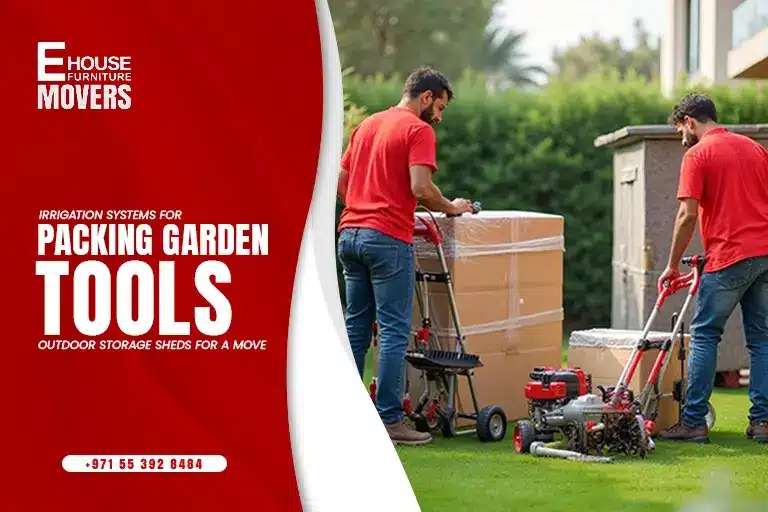
Garden tools, irrigation controls, and outdoor storage sheds get overlooked because they sit outside the main packing workflow. That omission creates predictable failures on moving days: exposed blades, leaking hoses, lost fasteners, broken sprinkler heads, and sheds that cannot be safely lifted or reassembled. A controlled packing plan treats outdoor assets as three systems with different risk profiles: sharp tools, water lines and controllers, and panel-based structures.
Benefits of reading this guide
- A field-ready packing sequence that reduces damage, leaks, and missing parts during a move.
- A copy-paste checklist for movers and facility teams that converts outdoor items into labeled, auditable kits.
The next section separates the topic into three clean modules so each section stays semantically consistent.
What is the correct packing order for outdoor assets?
The correct order is tools first, then irrigation, then shed structure. Tools contain injury risk. Irrigation contains water damage risk. Sheds contain missing hardware and panel distortion risk.
Packing garden tools
What is the safest way to pack garden tools for a move?
The safest way is to remove soil, immobilize sharp edges, bundle by tool type, and pack heavy items low. Safety guidance for sharp tools emphasizes secure storage in holders or sheaths and not leaving exposed sharp edges.
What tool categories require different packing rules?
Use three categories because each category has a different containment requirement.
- Sharp edge tools
Examples: pruning shears, hedge trimmers, hand saws, utility knives, loppers. - Long handled tools
Examples: shovels, rakes, hoes, pickaxes, cultivators. - Power and motor tools
Examples: trimmers, leaf blowers, hedge trimmers, lawnmowers, pressure washers.
How do you pack sharp edge garden tools without injury or box punctures?
Pack sharp tools using a sheath or edge guard, then place them into a rigid container.
Practical method:
- Close and lock pruners and shears.
- Cover blades with a blade cover, cardboard wrap, or a dedicated sheath.
- Place the tool in a rigid bin or a tool case, not a soft carton.
- Label the container “sharp tools” on two sides.
Workplace safety references emphasize securing sharp tools and storing them in designated holders, plus retracting blades after use.
How do you pack long handled tools so they do not damage walls and vehicles?
Use a bundle and clamp method.
- Group similar lengths together.
- Protect ends with foam, cardboard, or cloth.
- Strap into a tight bundle with two straps, one near the head and one near the handle end.
- Transport bundles flat or in a dedicated long-item lane in the truck.
Operational rule: do not mix long tools with cartons. The handles become levers that crush boxes.
How do you pack heavy metal tools to prevent carton collapse?
Heavy tools belong in small boxes or plastic bins with reinforced bottoms.
- Use a small box size.
- Place a rigid base board at the bottom.
- Keep the load dense and low.
- Mark “heavy” clearly.
This follows standard hand and power tool storage guidance that emphasizes storing tools safely and reducing trip hazards from poor handling.
How do you handle fertilizers, pesticides, and garden chemicals during a move?
Many moving companies refuse to transport hazardous chemicals, and risk increases with heat exposure in UAE conditions. The most reliable approach is to:
- Keep chemicals in original containers with intact labels.
- Separate them from household cartons.
- Ask your mover what they accept, and follow local disposal rules for anything not allowed.
Do not decant chemicals into unmarked bottles. Do not pack chemicals with textiles or food items.
Packing irrigation systems
What is the fastest way to prepare an irrigation system for moving day?
The fastest method is to isolate water, relieve pressure, drain accessible lines, and pack controllers and sensors as labeled electronics. Irrigation manufacturers describe draining steps as core protection, including draining pipes and protecting valves and backflow components.
What parts of an irrigation system are usually moved, and what parts stay?
Use a component map to avoid pulling the wrong items.
Common movable items:
- Irrigation controller or timer unit
- Remotes, WiFi modules, and transformer power supplies
- Flow sensors and detachable accessories
- Spare sprinkler heads, nozzles, fittings, and drip emitters
- Hose-end timers and above-ground manifolds
Common fixed items that usually stay with the property:
- Buried mainlines and laterals
- In-ground valve boxes
- Fixed backflow assemblies, depending on property scope and landlord rules
If you are relocating between villas, confirm with the property owner whether controllers and above-ground components are part of the lease fixtures.
How do you shut down and drain irrigation safely?
Use a four-step shutdown pack.
- Turn off irrigation schedule
- Set the controller to off or rain mode.
- Shut off the water supply
- Close the irrigation isolation valve.
- Relieve pressure and drain
- Drain lines using the system’s drain method.
- Rain Bird describes draining pipes and protecting valves and backflow preventers as a core winterization step set.
- Protect vulnerable components
- Protect valves and any above-ground parts as specified by manufacturer guidance.
If your system uses compressed air blowout, manufacturer guidance includes safety warnings such as not standing over pressurized components and not leaving compressors unattended.
If you do not have the correct equipment and training, assign this step to a qualified irrigation technician.
How do you pack an irrigation controller for a move?
Treat the controller as a labeled electronics asset.
Controller packing checklist:
- Photograph the wiring terminals before disconnecting.
- Label each wire with a zone number tag.
- Remove the controller faceplate or module if the system design allows.
- Pack the controller in an anti-static bag or bubble wrap.
- Place in a small carton with foam padding.
- Add a document sleeve with the wiring photo and zone map.
This prevents the most common post-move failure: zones swapped or not recognized.
How do you pack sprinklers, drip parts, and small fittings so they do not disappear?
Use a parts kit method.
- One compartment box for nozzles and emitters.
- One zip bag for each valve box set of screws and covers.
- One labeled bag for spare fittings.
- One small bin labeled “Irrigation spares, Zone map inside”.
Add an inventory card listing counts of:
- Nozzles by type
- Drip emitters by flow rate
- Couplings and tees by size
Packing outdoor storage sheds
What is the safest way to move an outdoor storage shed?
The safest method is to empty the shed, document the structure, disassemble panels in a reverse-build order, and pack fasteners as indexed hardware kits. Attempting to lift a loaded shed or a fully assembled shed typically increases panel distortion, door misalignment, and anchor damage.
What types of sheds require different disassembly plans?
Use three shed categories.
- Resin or plastic panel sheds
Risk: cracked panels and stripped fasteners. - Metal sheds
Risk: sharp edges and bent frames. - Wood sheds
Risk: warped panels, splitting, and fastener pullout.
For metal sheds, sharpened edges can cut cartons and hands. Safety references on sharp edges emphasize secure handling and storage methods to reduce cuts.
What is the correct shed disassembly sequence?
Use a repeatable sequence.
- Empty and clean
- Remove everything.
- Sweep dust and debris.
- Document
- Take photos of each wall, roof seam, and door track.
- Photograph anchors and base layout.
- Remove doors
- Detach doors and tracks first to reduce torque and binding.
- Remove roof panels
- Roof first reduces load on walls.
- Remove wall panels
- Remove panels one side at a time.
- Remove base and anchors
- Store anchor hardware separately and label.
This reverse-order approach protects panels and keeps the frame square
How do you pack shed hardware so reassembly stays accurate?
Use a hardware index system.
Hardware pack format:
- Bag A: Door hardware
- Bag B: Roof fasteners
- Bag C: Wall panel fasteners, left side
- Bag D: Wall panel fasteners, right side
- Bag E: Base anchors
Each bag includes:
- A label with shed ID and bag letter
- A small card showing which panels the fasteners belong to
- A photo print or QR link to the reference photo set
This is the fastest control for missing screws and mismatched bolt lengths.
How do you protect shed panels during transport?
Panel protection rules:
- Stack panels flat with a rigid board at the bottom.
- Place foam sheets between panels.
- Protect corners with corner guards.
- Strap the stack, then wrap with stretch film to stop rubbing.
- Keep panels away from heavy tools.
For metal panels, add edge protection to prevent cuts and carton punctures.
Copy-paste checklist for movers and supervisors
Outdoor move pack list
- Rigid bin for sharp tools, labeled
- Long-item straps and end guards
- Small heavy-duty cartons for dense metal tools
- Compartment box for irrigation parts
- Anti-static or padded pack for controller
- Labeled zip bags and markers for zone wires and shed hardware
- Foam sheets and corner guards for panels
Evidence pack
- Photos of tool condition and counts
- Irrigation wiring photo and zone map
- Shed panel photos and anchor layout
Common failure points and the fix
Failure: Sharp tools packed loose in cartons
Fix: sheath and rigid bin packing, with clear labels.
Failure: Irrigation controller disconnected without wire labels
Fix: wire tags plus wiring photo set and a zone map.
Failure: Shed screws mixed into one bag
Fix: indexed bag method per assembly section.
Failure: Outdoor items staged late and block the loading bay
Fix: stage outdoor modules as separate “load lanes” early, then load them as controlled batches.
Conclusion
Garden tools, irrigation systems, and outdoor storage sheds create moving-day delays because they are multi-part assemblies with hidden risks. A practical packing plan separates sharp tools, water system components, and shed panels into dedicated kits, then locks the process with labeling, photos, and indexed hardware control. Manufacturer guidance treats draining and protecting irrigation components as a core shutdown requirement, and safety references emphasize secure handling and storage of sharp edges.
Idris is a logistics specialist with a focus on residential relocation and supply chain efficiency. With extensive experience in the moving industry, he specializes in transit safety, specialized packing techniques for high-value goods, and fleet management. He is dedicated to streamlining the moving process, ensuring that every relocation is handled with strategic planning and maximum care.