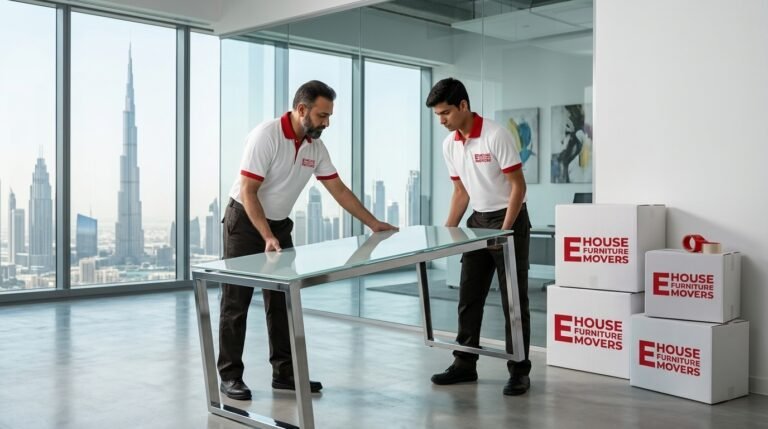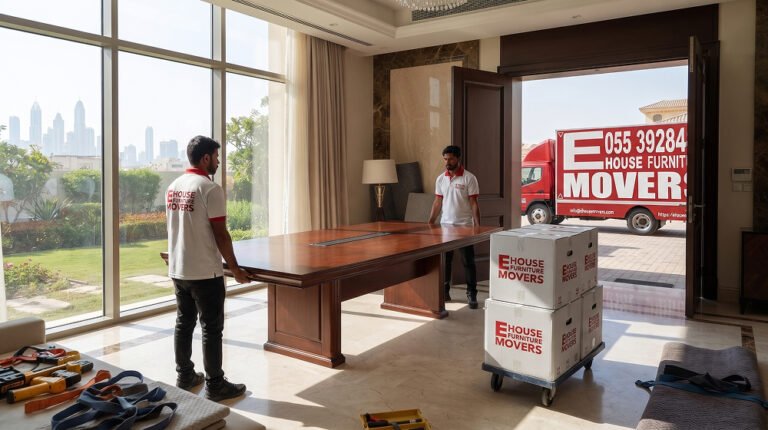



A boardroom table can fit perfectly inside a new Dubai office and still fail at the lift door. Executive desks create the same problem when long tops, structural bases, polished finishes, integrated power modules, marble, or glass turn a routine office move into a high-value handling job.
When choosing office movers in Dubai, confirm how they will handle executive desks and boardroom tables. These pieces need accurate measurements, condition records, access checks, controlled dismantling, and the right protection method for each material. Marble and glass tops may require padded vertical transport, while oversized pieces can depend on goods-lift clearance, stair access, or crane planning.
This guide covers the full process behind boardroom table moving in Dubai, including specialist handling, marble and glass transport, oversized-item access, custom crating, and precise reassembly. It also includes a practical high-value furniture checklist for planning the move before packing begins.
Why Executive/Boardroom Pieces Need Special Handling
Executive desks and boardroom tables require specialist handling because their structural connections, long spans, finished surfaces, and heavy top materials create concentrated damage risks.
The International Organization for Standardization (ISO) publishes ISO 19682:2023 for testing the stability, strength, and durability of tables and desks. The standard covers tables regardless of material or construction method. It contains 45 pages of structural test methodology.
The Business and Institutional Furniture Manufacturers Association (BIFMA) also addresses commercial desks and tables through ANSI/BIFMA X5.5-2021. Its scope covers safety, durability, and structural performance in commercial offices and institutional environments. The 2021 revision added an unattached-top retention test.
Neither standard provides a furniture-moving procedure. Both establish an important distinction for executive desk movers: a desk or table is an assembled structural product. The mover first identifies which parts are designed for removal.
What makes an executive desk difficult to move?
An executive desk becomes difficult to move when its assembled dimensions, structural joints, finish, weight, or integrated components restrict ordinary handling.
A pre-move survey records the following:
- Overall length, width, and height
- Top thickness and material
- Pedestal and leg configuration
- Modesty panels and structural rails
- Drawers, keys, and removable inserts
- Power sockets and cable-management modules
- Fixing points beneath the top
- Existing scratches, chips, cracks, and repairs
Photograph the underside as well as the visible surface. The underside often carries brackets, joining plates, cable trays, levelling feet, and hardware needed during reinstallation.
This detail matters with high-value furniture. A loose pedestal and a structural pedestal can look similar. Removing a structural element without identifying its function can leave the remaining desk unsupported.
Why does a boardroom table require a separate moving plan?
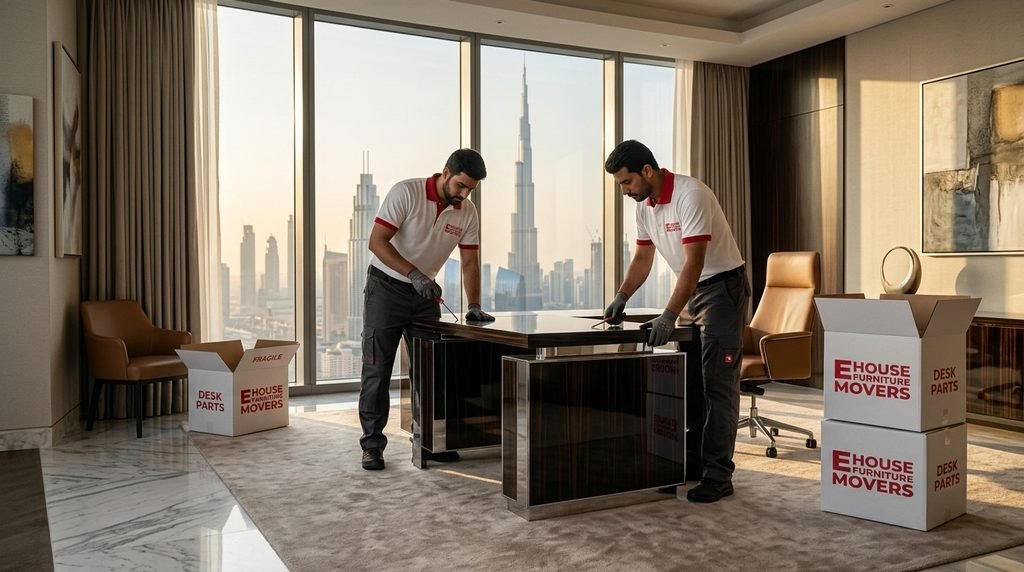
A boardroom table requires a separate plan because long tops increase clearance problems and place more importance on support position.
Large conference tables also contain more interfaces than simple desks. Common examples include sectional tops, central cable wells, power boxes, decorative inlays, stone inserts, and multiple bases.
The handling decision changes with each attribute.
| Furniture attribute | Issue | Handling response |
|---|---|---|
| 3 m or longer top | Turning radius | Measure the corridor and lift approach |
| Removable glass top | Edge and bending risk | Use padded edge support |
| Marble top | High mass and brittle defects | Verify weight and inspect veins |
| Sectional table | Reassembly alignment | Number sections and connectors |
| Integrated power box | Connector damage | Isolate and label connections |
| Lacquered executive desk | Surface marking | Add non-abrasive wrap and corner guards |
| Single-piece base | Door clearance | Measure packed dimensions before loading |
The table gives the survey a purpose. Size alone does not determine the moving method. Material, connections, route geometry, and support position complete the decision.
What belongs in a high-value furniture condition record?
A high-value furniture record contains dimensions, material identification, condition photographs, hardware references, disassembly points, access measurements, and final room position.
Use close photographs for vulnerable edges. Record existing repairs separately. Number multi-section boardroom tables before separating them.
That record creates a before-and-after reference. It also reduces guesswork during reassembly.
Marble & Glass Table-Top Protocol (vertical transport)
Marble and glass table tops generally require edge-supported or near-vertical handling, with cushioning and restraints designed for the specific panel.
The glass industry provides strong support for this orientation. Guardian Glass states that glass generally travels standing on its edge. Pilkington specifies storage racks that hold glass about 5 to 7 degrees from vertical, with cushioning where the rack contacts the glass.
The National Glass Association also shows vertical loading onto racks or A-frames. Its guidance calls for separators, restraint, compatible packing materials, and securement against movement during transport.
A boardroom top is not an architectural glazing shipment. The same load-control principle still applies. Avoid unsupported flat spans, protect exposed edges, prevent glass-to-metal contact, and stop the panel moving inside the vehicle.
Weight changes the handling plan quickly. The National Glass Association uses 2,500 kg/m³ as the assumed density of flat glass in its 2025 technical resource on architectural glass weight.
Using that density, movers can estimate the glass mass before selecting a dolly, A-frame, lifting device, or crate.
| Example glass top | Calculation | Approximate glass mass |
|---|---|---|
| 2.0 m × 1.0 m × 10 mm | 2.0 × 1.0 × 0.010 × 2,500 | 50 kg |
| 2.4 m × 1.2 m × 12 mm | 2.4 × 1.2 × 0.012 × 2,500 | 86.4 kg |
| 3.0 m × 1.2 m × 15 mm | 3.0 × 1.2 × 0.015 × 2,500 | 135 kg |
These figures cover the glass only. Frames, bonded fittings, sockets, decorative layers, or laminated interlayers can increase actual moving weight. Use manufacturer specifications or measured weight for final equipment selection.
Oversized-Item Access (lift/stair/crane)
Oversized executive desks and boardroom tables require a measured access route because the smallest doorway, lift opening, landing, or corridor turn controls whether the planned route works.
Measure the protected item, not the bare furniture. Blankets, corner guards, A-frames, and crates add centimeters to the moving envelope.
What measurements matter before using a goods lift?
Goods-lift planning requires the lift-door opening, internal car dimensions, load rating, approach clearance, and turning space at both floors.
Record at least:
- Lift-door clear width
- Lift-door clear height
- Internal lift depth
- Internal lift width
- Internal lift height
- Rated lift capacity
- Corridor width
- Tightest corner
- Loading-bay clearance
- Distance between vehicle and lift
Compare those measurements with the packed asset.
A 2.4 m table component may fit inside a 2.5 m lift diagonally but fail at the entrance because the landing lacks rotation space. This is why the route gets measured as a sequence, not as one doorway.
Building management rules remain property-specific. Confirm goods-lift bookings, loading windows, floor protection, security access, and insurance documentation with the relevant building before the move.
When does stair access stop being practical?
Stair access stops being practical when the packed furniture cannot maintain controlled clearance through landings, handrails, ceilings, and turns.
Measure the diagonal movement path. Long desks often fail at the landing rather than on the stair flight.
Dismantling can remove that restriction when the manufacturer designed the table for sectional assembly. Avoid dismantling glued joints, bonded stone, or concealed structural elements without technical confirmation.
What Dubai permit costs can affect crane access?
Road access can add official AED charges when the lift affects Dubai’s Right-of-Way.
The Dubai Roads and Transport Authority (RTA) lists a heavy construction vehicle mobility permit at AED 70 per vehicle per month. The total contains AED 50 for the permit and AED 20 for Knowledge and Innovation fees. RTA lists a one-working-day service time.
RTA also requires a technical inspection certificate issued within the past 30 days ago or less for the relevant crane permit application.
A road closure is a separate matter. The RTA minor roads diversion service lists AED 120, comprising AED 100 plus the AED 20 Knowledge and Innovation fee. RTA gives a standard processing time of 7 working days, subject to approvals.
These AED figures are government permit charges. They are not crane-hire prices, moving rates, or custom-crating prices. The applicable permit also depends on the specific road occupation and lifting plan.
Custom Crating & Reassembly
For furniture movers in Dubai, the decision to use custom crating depends on the item’s material, weight, vulnerable edges, and handling route. High-value executive desks and boardroom table components may need a rigid crate when ordinary wrapping cannot provide enough edge support, separation, or movement control.
A crate works as a transport structure. Its design follows the furniture dimensions, verified weight, support points, material, and loading orientation.
When does a boardroom table require custom crating?
Custom crating becomes useful for detachable glass, marble tops, valuable finished panels, and components facing repeated handling stages.
A Dubai office move can involve several transfers:
- Boardroom to corridor
- Corridor to lift
- Lift to loading bay
- Loading bay to vehicle
- Vehicle to destination loading area
- Destination lift to boardroom
Every transfer adds another handling event. A rigid crate reduces direct contact with the finished component during those transfers.
For glass, the crate or A-frame provides cushioned lower support and lateral restraint. Pilkington’s 5- to 7-degree rack guidance gives a useful reference for controlled near-vertical glass positioning.
For marble, the crate design also accounts for veins, openings, repairs, and unsupported spans.
How are executive desks and boardroom tables reinstalled?
Reinstallation reverses the documented dismantling sequence, then checks alignment, stability, hardware, surface condition, and integrated components.
Use photographs and labels rather than memory. Match section A with its original base, bracket, and connector. Refit manufacturer-designed hardware in the same location.
Check:
- Table-section alignment
- Top seating
- Base stability
- Levelling feet
- Drawer operation
- Power-module position
- Cable trays
- Joint gaps
- Visible chips or scratches
- Hardware count
BIFMA’s commercial desk and table standard includes structural-performance testing and an unattached-top retention test. That does not create a moving rule, but it explains why top-to-base connections deserve attention during reassembly.
What belongs on a high-value handling checklist?
A high-value handling checklist records the furniture, fragile materials, route, equipment, protection method, and final condition before the move starts.
Use this checklist for executive desk movers and boardroom table moving in Dubai:
- Record exact desk and table dimensions.
- Identify glass, marble, veneer, lacquer, metal, and electrical components.
- Photograph surfaces, edges, joints, and existing defects.
- Calculate approximate glass weight using 2,500 kg/m³.
- Verify natural-stone weight using supplier data or measured information.
- Measure lift doors, lift cars, corridors, stairs, and loading access.
- Label removable hardware by furniture section.
- Protect exposed corners and polished surfaces.
- Support glass and marble tops with rated handling equipment.
- Transport large glass panels vertically near padded supports.
- Confirm crane certification and safe working load where external lifting applies.
- Check applicable RTA access requirements before occupying public right-of-way.
- Crate fragile components when soft wrapping cannot control movement.
- Reinstall each structural component in its documented position.
- Inspect the finished executive desk or boardroom table before handover.
The sequence keeps the specialist service connected to office furniture moving in Dubai without treating high-value furniture like ordinary desks. Survey first. Protect the finish. Control marble and glass vertically. Solve lift, stair, or crane access before loading. Then reinstall the furniture against the original record.
Frequently Asked Questions
Large marble and glass tops require padded, controlled support, with glass commonly transported near vertical on suitable racks or A-frames rather than across unsupported flat spans.
Measure the protected sections, lift opening, car dimensions, landing space, and turning radius first, then use planned dismantling, stair handling, or approved crane access where the internal route cannot accommodate the piece.
Confirm the building’s insurance-document requirements and obtain written details of the mover’s applicable liability or transit coverage before the executive desk, marble top, or boardroom table is moved.
Sarmast Baloch is a distinguished content strategist and industry writer with multiple years of specialized expertise in the self storage and residential relocation sector. His work reflects a deep command of moving logistics, storage optimization, and consumer-facing relocation strategies, consistently delivering authoritative and insight-driven content that bridges the gap between industry knowledge and everyday decision-making. Over the years, Sarmast has built a strong reputation for crafting meticulously researched, data-informed narratives that empower homeowners, renters, and businesses to approach relocation with clarity and confidence. His editorial contributions span a broad spectrum of moving and storage subjects, from cost analysis and vendor evaluation to long-distance logistics and space management solutions. A trusted voice in the moving and storage landscape, Sarmast brings a rare combination of analytical rigor and accessible storytelling to every piece he produces, making him an invaluable authority at eHouseMovers.com.
Idris is a logistics specialist with a focus on residential relocation and supply chain efficiency. With extensive experience in the moving industry, he specializes in transit safety, specialized packing techniques for high-value goods, and fleet management. He is dedicated to streamlining the moving process, ensuring that every relocation is handled with strategic planning and maximum care.