


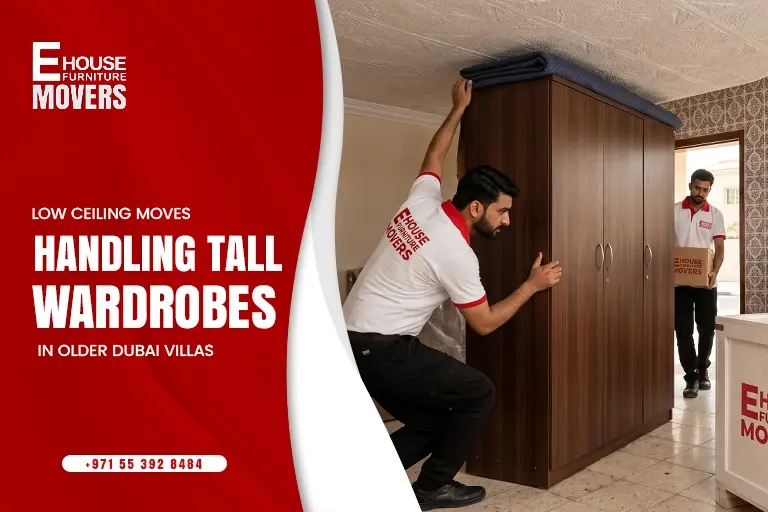
Low ceiling moves for tall wardrobes in older Dubai villas use a clearance map to prevent door-lintel contact, landing-turn jams, and stair-soffit scrapes. The safety rule stays never forced first.
What is a low-ceiling move for a tall wardrobe?
A low-ceiling move is a wardrobe relocation where upright clearance fails at one or more choke points, so the move shifts to tilt, pivot, or disassembly based on measured dimensions. Low ceiling moves depend on geometry, not strength.
Choke points (examples)
- Door lintel (example: 2100 mm door opening height)
- Landing turn (example: 90° rotation on a mid-landing)
- Stair soffit (example: low headroom above stair run)
- Ceiling drop (example: corridor bulkhead edge)
Why do Bur Dubai and Deira villas create more choke points?
Older villa circulation in Bur Dubai and Deira contains tighter turns and lower headroom zones, so diagonal clearance becomes the limiting variable for tall wardrobes. Bur Dubai and Deira villa moves typically include at least one tight choke point—door lintel, landing turn, or stair soffit—so relocations booked under Movers in Bur Dubai usually start with a clearance map for tall wardrobes.
What measurements define a clearance map for tall wardrobes?
A clearance map is a segment-by-segment list of the smallest height and width values on the route, recorded before lifting starts. The map converts “looks tight” into pass/fail numbers.
Clearance map measurements (instruction list)
- Measure door clear opening height (mm) and width (mm).
- Measure corridor width at narrowest point (mm).
- Measure landing turning rectangle (length × width, mm).
- Measure stair headroom at lowest point (mm).
- Measure ceiling drop height at bulkheads (mm).
- Measure threshold steps and level changes (mm).
- Measure wardrobe height × width × depth (mm).
- Measure protrusions (handles, hinge barrels, crown trims) (mm).
- Measure rotation zone width at corner turns (mm).
Table definition
The table below shows a sample clearance map that highlights where low ceiling moves fail.
| Route segment | Minimum height (mm) | Minimum width (mm) | Typical failure type |
|---|---|---|---|
| Bedroom door | 2100 | 820 | Lintel contact |
| Corridor | 2350 | 950 | Corner scrape |
| Landing | 2250 | 1100 | Rotation jam |
| Stair under soffit | 2200 | 900 | Tilt arc contact |
| Main door | 2150 | 900 | Lintel contact |
What is diagonal clearance, and why does it decide “tilt at angle”?
Diagonal clearance is the minimum opening height a wardrobe occupies while tilted, not upright. Diagonal clearance predicts whether “tilt at angle” fits through a door opening or under a stair soffit.
Diagonal clearance (approx.) = √(height² + depth²)
Numeric examples using common tall-wardrobe sizes
IKEA PAX frame sizes commonly include 201 cm and 236 cm heights and 58 cm depth options, which makes diagonal clearance a real constraint in older villa paths.
| Wardrobe size (H × D) | Diagonal clearance (approx.) | What the number means |
|---|---|---|
| 236 cm × 58 cm | 243.0 cm | Tilt arc requires a tall opening |
| 201 cm × 58 cm | 209.2 cm | Tilt arc fits more door heights |
Assembly ceiling signal: IKEA PAX guidance references ceiling height limits for assembling taller frames, which aligns with the same clearance problem that appears during moves.
What are the 4 solutions for low ceiling moves with tall wardrobes?
Low ceiling moves use four methods: tilt at angle, remove doors, use low-profile handling, or dismantle the wardrobe into panels. Each method matches a different clearance failure.
Solution set (unordered list)
- Tilt at angle to convert height into a diagonal, if diagonal clearance passes every choke point.
- Remove doors to reduce snag points and reduce effective rotation width at corners.
- Use low-profile trolleys and sliders to reduce lift height and stabilize movement on tight turns.
- Disassemble into panels to bypass stair headroom and landing-turn limitations.
How does door removal improve tall wardrobe handling?
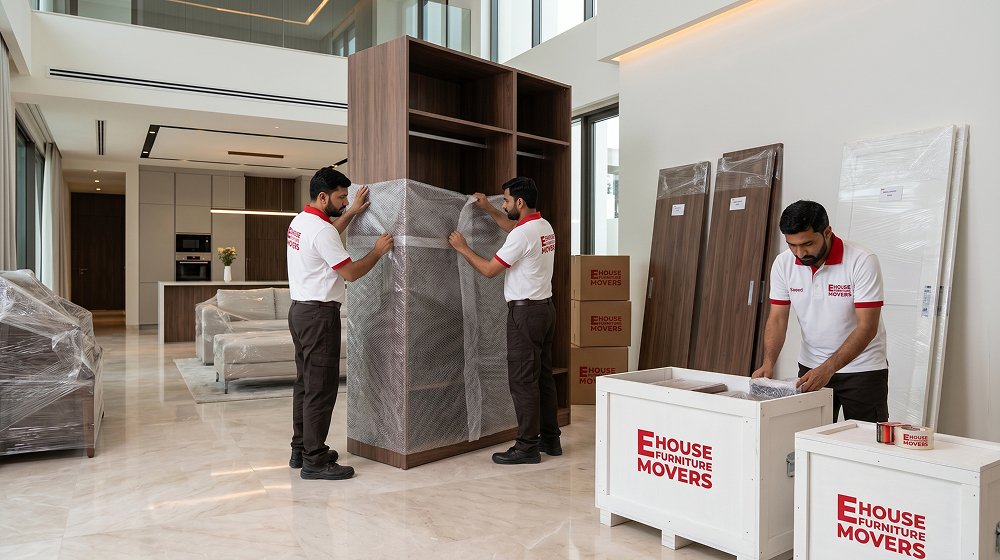
Door removal reduces rotation width and removes hinge/handle snag points that scrape door frames and corridor corners. Door removal also reduces swing instability during pivot turns.
Door-removal steps (instruction list)
- Photograph hinge positions and door alignment before removal.
- Label doors “Left/Right” and hinges “Top/Middle/Bottom.”
- Bag screws and fasteners in a sealed labeled pouch.
- Wrap door edges and mirror surfaces with padding.
- Store doors flat, if transport space allows.
A full hardware-control workflow fits the disassembly structure shown in Furniture Assembly & Disassembly UAE: Complete Guide.
Why do low-profile trolleys matter in low ceiling moves?
Low-profile handling reduces lift height and increases control during turns, which reduces manual-handling risk and surface damage risk. Mechanical aids are a primary control category in UK HSE manual-handling risk reduction guidance.
Low ceiling handling kit (unordered list)
- Low-profile trolley for stable rolling movement in corridors
- Furniture sliders for short pushes under tight headroom
- Lifting straps for controlled tilt arcs
- Corner protectors for door frames and wall edges
- Moving blankets for wardrobe corners and ceiling-drop edges
- Tape measure / laser meter for repeatable clearance checks
How does a tilt-and-pivot move work without scraping ceilings and lintels?
Tilt-and-pivot works by rotating only in the widest zone and advancing in short controlled arcs with a spotter watching the top edge. Movement control reduces contact events more than force increases success.
Tilt-and-pivot protocol (instruction list)
- Select the widest rotation zone (largest landing or widest corridor segment).
- Pad lintels and ceiling-drop edges before movement.
- Pivot on a protected base edge to control the rotation arc.
- Turn using step-turn footwork to reduce twisting.
- Advance in short moves and stop on first scrape contact.
HSE handling technique guidance supports controlled posture and reduced twisting during manual handling tasks.
What safety rules match “never force measure first”?
Safety in low ceiling moves is a measurement-first control system that prevents clearance failure and reduces manual-handling injury exposure. HSE frames manual handling as an injury risk domain and lists mechanical aids as controls.
Safety rules (listing)
- Measure first; move second.
- Stop movement, if scrape contact begins.
- Assign one spotter to track the top edge near lintels and soffits.
- Use trolleys or sliders to reduce carrying distance.
- Split the task into stages: door removal → padding → pivot → advance → set-down.
Risk model reference: OSHA interpretations discuss the NIOSH lifting equation baseline of 51 lb (23 kg) under ideal conditions before task multipliers reduce limits for real tasks, which matches how wardrobes become higher-risk loads due to poor coupling and awkward posture.
What are the most common failure points in older Dubai villa wardrobe moves?
Failure points cluster where clearance reaches the minimum value, especially at lintels and stair soffits. The visible signals help identify which method fits.
Table definition
The table below maps each failure point to its constraint type and visible signal.
| Failure point | Constraint type | Visible signal | Matching method |
|---|---|---|---|
| Door lintel | Opening height | Top edge scrape | Tilt / disassemble |
| Corridor corner | Turning width | Side panel gouge | Remove doors / pivot zone change |
| Stair soffit | Headroom | Ceiling contact | Full disassembly |
| Landing turn | Turning rectangle | Rotation jam | Pivot-and-turn / disassemble |
| Ceiling drop edge | Bulkhead height | Paint peel / chip | Padding + arc control |
A method comparison for stairs fits the decision framing in Narrow Staircase Moving Solutions: Pivot vs Full Disassembly.
What workflow fits older villa moves from survey to setup?
A linear workflow moves from survey measurements to method selection to controlled execution, then ends with reassembly QA.
End-to-end workflow
- Survey the path and record the clearance map.
- Select method using diagonal clearance pass/fail.
- Remove doors and loose internal components.
- Protect lintels, corners, and bulkhead edges.
- Move using low-profile handling and short pivot arcs.
- Reassemble panels and doors with labeled hardware.
- Verify alignment and stability.
Reassembly QA checks
- Hinge alignment and door closing symmetry
- Panel fastener tightness and bracket seating
- Base leveling and anti-tip stability
- Shelf pin seating and rail alignment
Summary rule
Low ceiling moves for tall wardrobes in older Dubai villas use a clearance map to prevent door-lintel contact, landing-turn jams, and stair-soffit scrapes. The safety rule stays never force—measure first.
FAQs
Stop on first scrape contact because scrape contact equals clearance failure and force increases surface damage.
Full disassembly fits stair soffit failure because a tall wardrobe tilt arc expands under headroom constraints and panels pass through tighter geometry.
Door removal reduces snag points because hinges and handles catch at corners and lintels during rotation.
Sarmast Baloch is a distinguished content strategist and industry writer with multiple years of specialized expertise in the self storage and residential relocation sector. His work reflects a deep command of moving logistics, storage optimization, and consumer-facing relocation strategies, consistently delivering authoritative and insight-driven content that bridges the gap between industry knowledge and everyday decision-making. Over the years, Sarmast has built a strong reputation for crafting meticulously researched, data-informed narratives that empower homeowners, renters, and businesses to approach relocation with clarity and confidence. His editorial contributions span a broad spectrum of moving and storage subjects, from cost analysis and vendor evaluation to long-distance logistics and space management solutions. A trusted voice in the moving and storage landscape, Sarmast brings a rare combination of analytical rigor and accessible storytelling to every piece he produces, making him an invaluable authority at eHouseMovers.com.
Idris is a logistics specialist with a focus on residential relocation and supply chain efficiency. With extensive experience in the moving industry, he specializes in transit safety, specialized packing techniques for high-value goods, and fleet management. He is dedicated to streamlining the moving process, ensuring that every relocation is handled with strategic planning and maximum care.