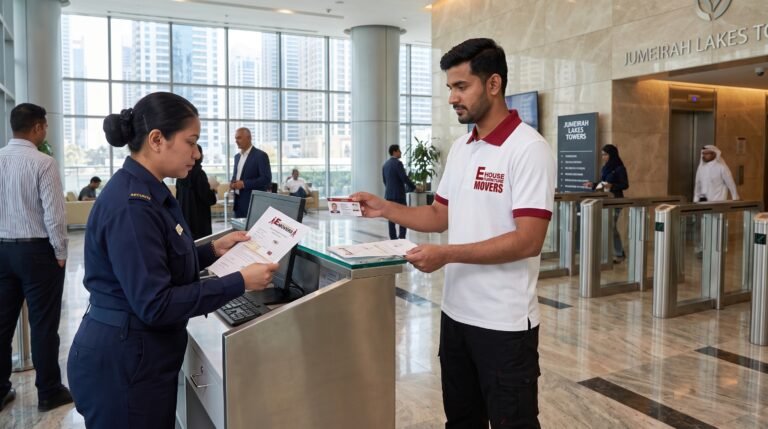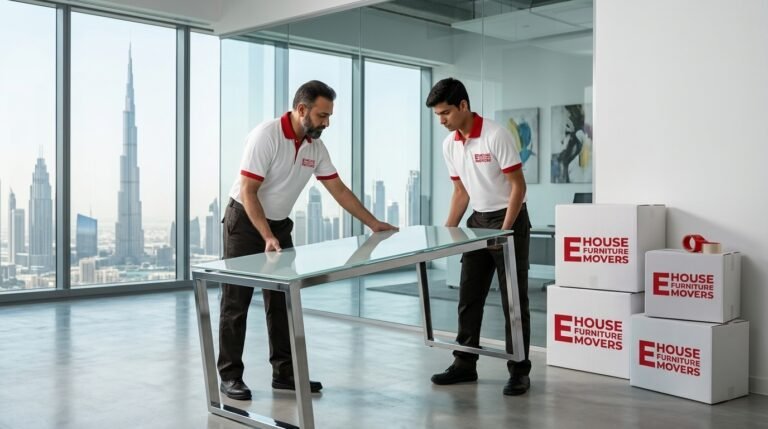



Choosing office movers in JLT/DMCC is not only about finding a crew to pack desks and transport equipment. JLT office relocations depend on tower access, facilities management approval, service-lift bookings, loading routes, permits, and DMCC tenancy handover requirements.
That matters in a district with dense commercial activity. DMCC recorded 2,300 new businesses in 2025, taking membership above 26,000 companies, while more than 100,000 people live and work across JLT and Uptown Dubai. A move that looks simple on paper can slow down quickly if the origin or destination tower has different FM rules, security procedures, or access windows.
The right JLT/DMCC office move starts with the exact cluster, tower, floor, unit, service-lift arrangement, and building-management contact.
This article covers:
- Tower-specific moving conditions
- Named-building access rules
- DMCC permits, FM NOCs
- Tenancy handover duties
- Regulatory charges
- After-hours moving restrictions
It also highlights the access checks that office movers in JLT/DMCC need before crews, vehicles, and equipment arrive on site.
Moving an office in JLT/DMCC
Moving an office in JLT/DMCC requires tower-specific planning because JLT combines commercial, residential, retail, parking, and controlled common areas within a compact high-rise district.
JLT covers more than 2 square kilometers, according to DMCC’s JLT development information. The official DMCC JLT map identifies the principal clusters from A through Z, plus locations such as AA1, AA2, BB1, and BB2.
There is an important distinction here. JLT does not contain only three clusters. DMCC Health, Safety and Environment Guidelines state that alphabetically assigned clusters generally contain three tower blocks. Those clusters combine offices, residences, hotels, retail units, and other commercial premises.
For an office relocation, give your mover the exact cluster, tower, unit, floor, and destination. A JLT address without the tower creates too much uncertainty for access planning.
A workable JLT/DMCC office-move file normally records:
- Identify the origin tower: Add the cluster, tower name, floor, unit, and building-management contact.
- Confirm the destination tower: Record the same information for the new DMCC office.
- Reserve goods access: Confirm the approved service lift or goods-movement route.
- Confirm vehicle access: Record the loading location, parking arrangement, vehicle details, and security procedure.
- Match the office paperwork: Check whether the relocation also changes the company’s registered DMCC address.
- Plan the old-office handover: Include furniture removal, signage removal, waste clearance, damage repair, and final inspection.
JLT also contains very different commercial properties. DMCC’s property portfolio lists One JLT as a 14-storey office tower, while Gold Tower and Silver Tower each contain 37 storeys and 10 high-speed passenger lifts. Different buildings therefore create different vertical-movement and access conditions.
Named-tower access & service-lift rules
Named-tower access in JLT depends on building management because DMCC community rules and individual tower controls operate together.
The DMCC Community Regulations state that subdivided properties can have a licensed Building Manager. DMCC HSE guidance assigns tower-level management responsibilities to owners’ associations, appointed managers, and FM companies.
Public DMCC pages provide tower specifications and security information, but they do not publish one service-lift booking timetable covering every JLT tower. Office movers in JLT/DMCC therefore need tower-specific confirmation.
What access checks apply to named JLT towers?
The following table separates published tower facts from access details that require FM confirmation.
| JLT / DMCC property | Verified DMCC detail | Access check for an office move |
|---|---|---|
| Almas Tower | DMCC advertises Level 49 offices, parking, managed common areas, and 24-hour security. | Confirm contractor entry, loading position, goods route, and service-lift slot. |
| One JLT | 14 storeys, high-speed passenger lifts, 24-hour security, and 48 parking spaces per leased floor. | Confirm FM approval and the lift designated for removals. |
| Gold Tower | 37 storeys, 10 high-speed passenger lifts, and controlled access. | Confirm the service route rather than using passenger-lift specifications as permission. |
| Silver Tower | 37 storeys, 10 high-speed passenger lifts, and 24-hour security. | Confirm loading and lift reservation with building management. |
| Jewelry and Gemplex | 12-storey multi-tower complex with high-speed passenger lifts and access control. | Confirm the correct building, loading point, and goods route. |
| Reef Tower, Cluster O | DMCC lists business centres in Reef Tower, including one on the 28th floor. | Coordinate access with both the business-centre operator and tower FM. |
| Platinum Tower, Cluster I | DMCC lists a business centre on the 6th and 8th floors. | Check whether centre management or tower FM issues contractor access. |
| Preatoni Tower, Cluster L | DMCC lists a business centre on the 9th floor. | Confirm furniture-removal approval before crew dispatch. |
| Mazaya Business Avenue AA1 | DMCC lists business centres on floors including 36 and 38. | Confirm the exact tower entrance and management authority. |
DMCC does not publish a universal public service-lift schedule for these towers. Treat any claim such as “all JLT moves use the same two-hour slot” with caution unless the relevant tower management confirms it.
DMCC tenancy handover also affects the physical move. The DMCC Master Community Regulations require an occupier ending a lease to settle outstanding property matters, fully vacate the premises, remove equipment and signage, repair damage, and dispose of waste correctly. The occupier then gives written notice to DMCC so an inspection can take place.
A mover therefore needs a clear removal scope. Leaving cabinets, signage, packaging, or unwanted equipment behind can interfere with the tenancy handover.
What does DMCC tenancy handover require?
DMCC tenancy handover requires the departing occupier to clear the property, settle outstanding matters, repair relevant damage, remove specified items, and notify DMCC after vacating.
The DMCC Master Community Regulations state that lease termination includes removal of equipment, facilities, and signage that do not belong to the owner. The occupier also clears waste and makes good applicable damage. DMCC can inspect the property after written notice.
For a JLT office relocation, add these items to the mover’s scope where applicable:
- Remove unwanted office furniture.
- Remove packing and crating waste.
- Remove tenant-owned signage.
- Protect walls, floors, corridors, and common areas.
- Record visible damage before and after removal.
- Leave the unit clear for the handover inspection.
Skipping the clearance stage can create a gap between “the furniture has moved” and “the old DMCC office is ready for tenancy handover.”
JLT/DMCC permits & FM NOC
A JLT office move can involve both building-access approval and DMCC company-address procedures, depending on the premises and work involved.
What documents apply when a DMCC company changes office?
A DMCC company moving to a new physical unit generally provides property documents and completes a licence amendment.
The current DMCC Licence Amendment Guidelines list a valid Ejari certificate, applicable tenancy or ownership documents, third-party No Objection Certificates (NOCs) for regulated activities, and an Operational Fitness Certificate (OFC) where required. DMCC publishes a two-business-day processing time, excluding OFC processing.
The process has eight published stages for adding or moving to physical units, including portal submission, document upload, DMCC review, OFC processing where applicable, and licence download.
Current DMCC Schedule of Charges provides several useful AED anchors:
- AED 1,515: Licence address amendment.
- AED 1,000: OFC for non-retail, non-industrial activities, per inspection.
- AED 1,000: Retail OFC, per inspection.
- AED 3,000: Industrial OFC, per inspection.
- AED 265: NOC to Concordia for fit-out.
- AED 20: Knowledge and Innovation Dirham fee added under the schedule’s general conditions.
These are regulatory or administrative charges, not JLT office mover prices. DMCC also states that listed charges can change.
When does Concordia enter the process?
Concordia handles JLT fit-out processes where office alteration or site work requires that route.
The Concordia fit-out portal covers normal office fit-out approval, minor fit-out submissions, completion inspections, and Master Community Permits to Work. A Certificate of Conformity for a normal fit-out is valid for 90 days.
A furniture-only relocation is different from construction or fit-out. Confirm the applicable requirement with FM instead of assuming that every office move requires the same Concordia approval.
After-hours windows for JLT/DMCC
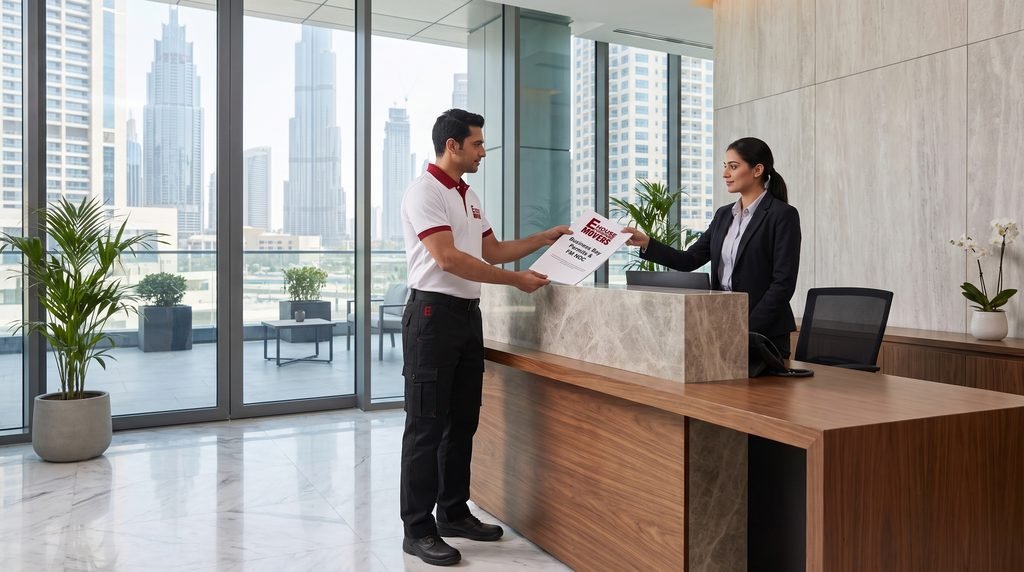
JLT does not have one publicly stated after-hours moving window for every tower. Permitted removal hours and access slots require confirmation for the specific property.
There is, however, a quantified community rule that directly affects scheduling. DMCC’s published Master Community Violations and Fines schedule lists an AED 500 fine for bulk deliveries or removals outside permitted hours. It also lists AED 1,000 for failing to obtain permission for a bulk delivery or removal 48 hours in advance.
The published schedule lists:
- AED 500 for not using designated delivery or removal access ways.
- AED 1,000 as well as rectification costs when movement of goods damages the Master Community.
- AED 1,000, along with the cost of repairing any damage caused by inadequate protection during bulk removals.
- AED 500 for failing to dispose of packing and crating materials correctly.
- AED 500 for using visitor parking for trade vehicles collecting or delivering goods.
Vehicle access also varies by location. DMCC’s JLT vehicle-access guidance states that cluster parking uses controlled entry systems, while access to parking inside individual tower basements falls under the relevant owners’ association management.
Plan the JLT/DMCC office move around tower access first
A successful office move in JLT/DMCC starts with building access, not the moving truck. Each tower can apply different FM procedures, service-lift arrangements, loading controls, security checks, and permitted removal hours. That makes the exact cluster, tower, floor, and unit essential planning information.
DMCC rules add another layer. Bulk removals can require prior permission, while address amendments, operational fitness certificates, Concordia approvals, and tenancy handover requirements may apply depending on the premises and relocation scope. DMCC also lists penalties for removals outside permitted hours and for failing to obtain required bulk-move permission in advance.
Treat access confirmation as the first booking step. Before accepting an office moving quotation, send the mover the origin tower, destination tower, approved move window, service-lift details, loading point, and FM contact.
Then get those arrangements confirmed in writing. That single step removes most of the uncertainty around a JLT/DMCC office relocation and gives the moving team a clear operational plan before vehicles and crews reach either tower.
Frequently Asked Questions
DMCC’s published schedule references permission for bulk deliveries or removals 48 hours in advance, while individual tower FM teams can set additional requirements.
No. Tower access varies by building management, so Almas Tower, One JLT, Gold Tower, Silver Tower, and other JLT properties require separate FM confirmation.
Yes, where the relevant tower permits it, but the approved moving window, service-lift booking, loading access, and security clearance must be confirmed first.
Sarmast Baloch is a distinguished content strategist and industry writer with multiple years of specialized expertise in the self storage and residential relocation sector. His work reflects a deep command of moving logistics, storage optimization, and consumer-facing relocation strategies, consistently delivering authoritative and insight-driven content that bridges the gap between industry knowledge and everyday decision-making. Over the years, Sarmast has built a strong reputation for crafting meticulously researched, data-informed narratives that empower homeowners, renters, and businesses to approach relocation with clarity and confidence. His editorial contributions span a broad spectrum of moving and storage subjects, from cost analysis and vendor evaluation to long-distance logistics and space management solutions. A trusted voice in the moving and storage landscape, Sarmast brings a rare combination of analytical rigor and accessible storytelling to every piece he produces, making him an invaluable authority at eHouseMovers.com.
Idris is a logistics specialist with a focus on residential relocation and supply chain efficiency. With extensive experience in the moving industry, he specializes in transit safety, specialized packing techniques for high-value goods, and fleet management. He is dedicated to streamlining the moving process, ensuring that every relocation is handled with strategic planning and maximum care.