



Commercial vehicle schedules in Umm Al Quwain fail for one repeatable reason: route plans ignore restricted road timings until the last hour. That gap creates missed gate slots, idle trucks, overtime exposure, and preventable disputes over delays and penalties.
This playbook translates Restricted Road Timings for Commercial Vehicles in Umm Al Quwain into a booking-to-delivery timeline that dispatch teams can execute and audit.
What benefits come from reading this playbook?
This playbook reduces failed delivery attempts by aligning booking data, route selection, and gate access with the restricted road timings for commercial vehicles in Umm Al Quwain. It also improves dispute readiness by standardizing time stamps, GPS evidence, and proof-of-delivery packs.
What are the restricted road timings for commercial vehicles in Umm Al Quwain on the main highways?
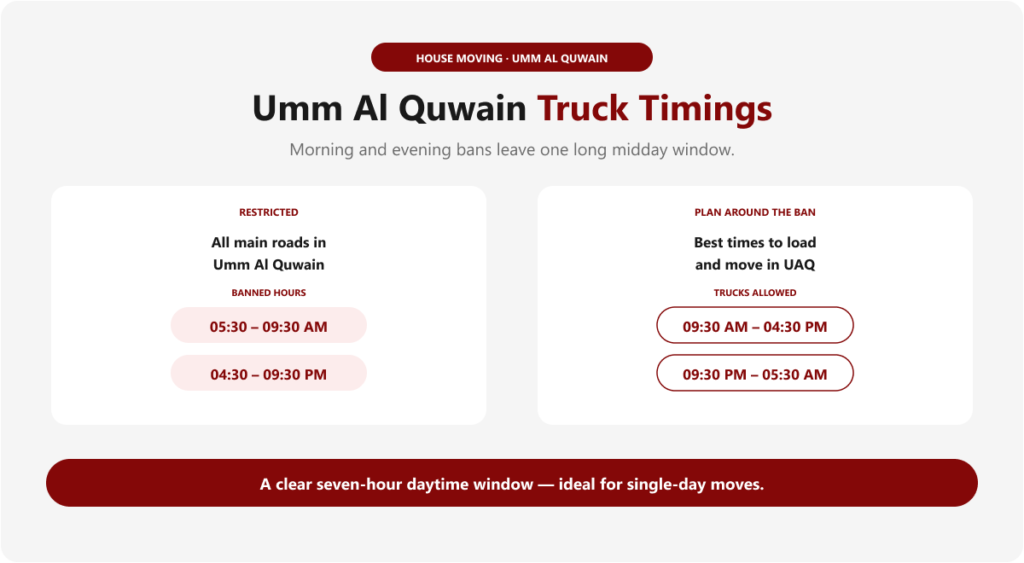
Umm Al Quwain restricts heavy vehicles and lorries on E11 and E311 routes heading to Umm Al Quwain during rush hours: 05:30 to 09:30 and 16:30 to 21:30, effective from October 1, 2018.
Which highways matter most for route plans into Umm Al Quwain?
E11 and E311 form the primary highway approaches into Umm Al Quwain for traffic coming from the Sharjah and Ras Al Khaimah corridors. The restriction targets “heavy vehicles and lorries” on these routes during peak commuter windows.
What penalties appear in widely reported enforcement notes?
A commonly reported enforcement outcome includes a fine of AED 1,000 and 4 black points for violations.
What upstream restriction changes can shift a compliant UAQ plan into a late arrival?
Truck movement timing controls on Dubai’s Sheikh Mohammed bin Zayed Road (E311) restrict movement during 06:30 to 08:30, 13:00 to 15:00, and 17:30 to 20:00, with an effective date stated as April 28, 2024.
A route that originates in Dubai or crosses Dubai E311 during these windows adds queue time, detours, or staging waits.
Main highway timingsb for commercial vehicles in Umm Al Quwain
| Corridor into UAQ | Restricted window 1 | Restricted window 2 | Scope stated in coverage | Enforcement note in coverage |
|---|---|---|---|---|
| E11 towards Umm Al Quwain | 05:30 to 09:30 | 16:30 to 21:30 | Heavy vehicles and lorries | AED 1,000 and 4 black points |
| E311 towards Umm Al Quwain | 05:30 to 09:30 | 16:30 to 21:30 | Heavy vehicles and lorries | AED 1,000 and 4 black points |
Why do restricted road timings exist in the first place?
Restricted road timings matter because they change the feasible delivery windows for industrial, retail, and project logistics, especially when gate access slots already compress the schedule. The constraint becomes larger when upstream corridors add their own truck restrictions.
What data supports the “peak-hour risk” framing?
UAE road risk data shows measurable fatalities and injuries, with major violations driving a large share. One MOI open-data summary, reported by Khaleej Times, cites 384 road deaths in 2024, versus 352 in 2023 and 343 in 2022.
Additional coverage reports that Dubai recorded 158 of those 2024 fatalities.
What data supports congestion as a schedule risk factor?
Congestion adds measurable delay cost and schedule variance, even outside restricted windows. INRIX city scorecard pages provide “hours lost in congestion” metrics (city-level).
Overall, motorists across the UAE lost between 8 and 35 hours, with Abu Dhabi and Umm Al Quwain losing 19 and 14 hours, respectively. Abu Dhabi and Umm Al Quwain spent 5 and 7 % less time in traffic in 2024 than the previous year. In Al Ain and Fujairah, motorists spent 9 and 8 hours in 2024.
Which commercial vehicle operations face the highest exposure in Umm Al Quwain?
Exposure concentrates in time-critical delivery operations that arrive near 05:30 to 09:30 and 16:30 to 21:30 on E11, and E311 approaches into Umm Al Quwain.
Which delivery profiles show the highest “window collision” rate?
- Retail and distribution: Pallet replenishment, spare parts routes, multi-drop schedules
- Construction logistics: Concrete, blocks, steel, MEP material drops
- Industrial supply and service: Plant maintenance equipment, tools, compressors
- Commercial relocations: Office moves, warehouse transfers, fit-out logistics
Which operational attributes increase timing risk?
- Gate slot dependency: Entry requires prior approval at a fixed time
- Security screening: ID checks and vehicle checks consume minutes
- Handling constraints: Dock doors and forklifts create queues
- Multi-party coordination: Tenant admin, property management, and security approvals
What is the “booking to delivery” timeline that prevents timing breaches?
The timeline prevents breaches by locking restriction windows into booking intake, then using staged release and evidence packs to maintain compliance through execution. The sequence below uses operational checkpoints tied to time horizons.
Timeline overview
| Stage | Time horizon | Core objective | Output record |
|---|---|---|---|
| Booking intake | T minus 72 to 48 hours | Feasibility of slot plus corridor | Booking record and access profile |
| Dispatch planning | T minus 24 hours | Corridor locked and buffer math defined | Route plan and time plan |
| Dispatch release | T minus 4 to 2 hours | Live feasibility validated | Release timestamp and brief log |
| Approach and staging | Day-of | Restricted window avoided | GPS evidence and staging log |
| Gate entry and unload | Day-of | Handover executed and recorded | POD plus time stamps |
| QA and audit trail | Post-delivery | Dispute readiness and KPI closure | Evidence pack and KPI report |
What happens at booking, 48 to 72 hours before departure?
Booking succeeds when it captures road window constraints, gate controls, and documentation requirements in one intake record. This step reduces reattempt probability.
Which booking fields improve compliance and on-time delivery?
A booking record includes entities and attribute values:
- Destination entity: Umm Al Quwain site name, zone name, gate number
- Highway approach: E11 approach, E311 approach, alternate corridor reference
- Restricted windows: 05:30 to 09:30 and 16:30 to 21:30 for E11 and E311 heading to UAQ
- Vehicle profile: Vehicle type, axle count, gross weight band, load type
- Gate constraints: ID checks, access permits, security escort, and unloading bay assignment
- Unload process: Forklift availability, dock door assignment, pallet count, unloading time target
- Proof set: Delivery note format, time stamp requirement, photo rules, signature rules
Which numbers belong in a booking record for schedule stability?
A booking record that includes quantified durations supports stable ETAs:
- Load time: 45 minutes, 90 minutes, 150 minutes
- Gate processing: 10 minutes, 20 minutes, 40 minutes
- Unload time: 30 minutes per pallet batch, 60 minutes per dock cycle
- Staging buffer: 30 minutes, 60 minutes, 90 minutes
A booking record with explicit numbers supports predictable departure windows and compliant highway entry windows.
What happens at planning, 24 hours before departure?
The 24-hour stage locks the route corridor and selects the arrival window that avoids restricted timing conflicts on E11 and E311 toward Umm Al Quwain.
Planning works best when it targets “arrive outside restricted windows” rather than “depart early.” UAQ restriction windows in the widely cited note are:
- 05:30 to 09:30
- 16:30 to 21:30
How do upstream truck restrictions affect UAQ delivery feasibility?
Upstream restrictions shift feasible departure times for trips crossing Dubai corridors. A common upstream constraint is Dubai’s E311 timing controls. Dubai RTA published truck movement restrictions on Sheikh Mohammed bin Zayed Road (E311) as:
- 06:30 to 08:30
- 13:00 to 15:00
- 17:30 to 20:00
What corridor restrictions influence Sharjah-connected routes?
Dubai RTA also published an evening peak truck ban on Emirates Road (E611) towards Sharjah from 17:30 to 20:00, effective January 2025. This corridor can appear in northbound routing options depending on the origin.
What planning artifacts close the 24-hour gap?
- Route plan screenshot or export
- Buffer math list with minutes
- Gate slot confirmation log
- Delivery order and packing list
- Handling method note: dock, forklift, tail-lift
- Evidence pack index prepared before departure
What happens at dispatch release, 2 to 4 hours before departure?
Dispatch release works when it verifies the time window math using live conditions, then issues a controlled signal that preserves the planned approach into Umm Al Quwain. This step converts a plan into executed compliance.
Which live checks prevent last-minute timing violations?
- Live corridor speed status and incident alerts
- Gate contact confirmation
- Vehicle readiness and load securement confirmation
- Driver brief: restricted windows, alternate staging points, proof tasks
Which numeric decision rule reduces ambiguity?
A simple rule uses two buffers: a staging buffer plus a gate buffer. Example framework:
- Staging buffer: 45 minutes
- Gate buffer: 20 minutes
- Total buffer: 65 minutes
A departure that projects arrival inside a restricted window triggers staging or rerouting, not a direct approach.
Trigger rule
Predicted arrival inside 05:30 to 09:30 or 16:30 to 21:30 on E11/E311 towards UAQ → staging event recorded → revised arrival time logged.
What happens on the approach to Umm Al Quwain?
Approach success depends on entering E11 or E311 heading to Umm Al Quwain outside restricted rush windows and maintaining route evidence continuity.
How does a dispatcher treat E11 and E311 restrictions operationally?
E11 and E311 operate as controlled corridors from 05:30 to 09:30 and 16:30 to 21:30 for heavy vehicles heading to UAQ. A dispatcher uses one of three outcomes:
- Direct approach: Arrival outside restricted windows
- Staging hold: Staging until permitted entry
- Reroute: Alternate route selection that preserves compliance and arrival commitments
Which route evidence elements reduce disputes?
- GPS breadcrumb export for the trip segment
- Time-stamped gate arrival photo if site rules allow photos
- Vehicle telematics log showing stop durations and time stamps
- Communication log entries: slot confirmations and changes
What happens at gate entry and unloading?
Gate entry succeeds when documents match the booking record and time stamps prove compliant arrival and controlled unloading. This phase often determines whether a delivery becomes a claim.
Which gate checks appear most often in industrial and commercial sites?
- ID verification and visitor log registration
- Vehicle inspection and load documentation
- Slot validation against booking confirmation
- Safety PPE confirmation, where applicable
- Dock or bay assignment
Which unloading controls reduce dwell time?
- Pre-assigned handling equipment availability
- Standardized pallet labeling and count matching
- Defined unloading sequence tied to delivery note lines
- Sign off process that captures time, name, stamp, and signature
How does a cost model quantify timing restriction risk?
Cost escalation tracks idle time, reattempt events, and compliance incidents as line item costs that rise with missed windows. A cost model helps procurement and operations align on the service level and documentation level.
Which cost drivers show the strongest correlation with missed windows?
- Driver idle time and vehicle idle time
- Yard staging time that exceeds the planned buffer
- Gate rejection and reattempt mileage
- Over time, exposure when arrival shifts into evening windows
- Administrative time spent resolving disputes and issuing revised delivery notes
Which KPIs quantify performance and compliance at the same time?
Use a KPI set with numeric definitions:
- On-time delivery rate: Delivered within slot tolerance
- First attempt success rate: Deliveries completed without reattempt
- Average gate dwell time: Minutes from gate arrival to bay entry
- Average staging time: Minutes spent waiting outside restricted windows
- Violation rate: Number of restriction-related fines per 1,000 trips
- Evidence completeness rate: % of deliveries with full proof pack
Why does logistics performance data matter?
UAE logistics and freight markets show measurable growth and scale, and performance controls protect margins. A UAE freight and logistics market report indicates freight transport share and growth figures across functions and end users. Macro economic sources also highlight transport and storage growth as an economic contributor.
What documentation creates a dispute-ready evidence pack?
A dispute-ready evidence pack contains time-stamped route proof, slot proof, gate proof, and delivery proof in a single indexed bundle. This pack supports claims defense and client reporting.
What goes into a standard evidence pack index?
- Booking confirmation and slot details
- Vehicle and driver identification records
- Route plan and planned highway approach
- Dispatch release timestamp and driver brief record
- GPS log export for the trip
- Gate arrival timestamp record
- Unloading start and end timestamps
- Proof of delivery and signed delivery note
- Exception log: delays, incidents, access changes
- Communication log: client and site contacts
Which evidence items tie directly to restricted windows?
Time stamps near 05:30 to 09:30 and 16:30 to 21:30 on E11 and E311 heading to UAQ carry the highest scrutiny risk. A clear record of staging outside the window protects the compliance narrative.
What are the most common myths about restricted road timings in Umm Al Quwain?
Myths increase violations and reschedules because they replace time window facts with assumptions. Use fact-based corrections.
Myth 1: Only city center roads have restrictions
E11 and E311 heading to Umm Al Quwain have a published rush hour restriction for heavy vehicles and lorries.
Myth 2: A late evening arrival avoids all enforcement risk
The restricted window extends to 21:30 in the cited UAQ restriction note.
Myth 3: Upstream corridors do not affect UAQ arrivals
Dubai E311 has separate truck movement timing controls that constrain departure planning for trips that pass through that corridor.
Myth 4: Proof of delivery alone resolves timing disputes
Dispute resolution relies on route evidence and time stamps, not only delivery signatures. A proof pack structure strengthens dispute readiness.
| Myth | Reality (fact anchor) | Operational impact |
|---|---|---|
| “Restrictions apply only inside city streets.” | E11 and E311 towards UAQ are referenced in restriction coverage. | Corridor entry conflicts rise. |
| “Evening arrival avoids restrictions.” | Evening window runs to 21:30 in cited coverage. | Late slot planning fails. |
| “Upstream roads do not matter.” | Dubai E311 has separate truck timing restrictions. | Departure time planning becomes inaccurate. |
What is the decision framework for outsourcing transport under UAQ timing constraints?
Outsourcing decisions improve when procurement evaluates time window capability, documentation capability, and evidence custody capability.
Which procurement questions predict delivery performance?
- Confirm restricted window knowledge for E11 and E311 toward UAQ
- Provide a documented staging process for restricted windows
- Provide a route evidence export format and a sample
- Provide gate dwell time KPI reporting
- Provide exception handling logs and escalation contacts
- Provide compliance incident reporting frequency
- Provide evidence retention duration and access rights
Which SLA metrics align with timing restrictions?
- First attempt success rate target
- Maximum gate dwell time threshold
- Evidence completeness target
- Incident response time target
- Escalation path with named roles
What audit-trail data supports continuous improvement?
Dubai RTA reports measurable compliance and traffic-flow effects after expanding truck movement restrictions. RTA reported compliance improvements of 7.7% on Emirates Road and 5% on Sheikh Mohammed bin Zayed Road (June 2025 vs November 2024), plus average speed increases of 26 km/h on Emirates Road and 19 km/h on Sheikh Mohammed bin Zayed Road after implementation, in its published results summary. These metrics demonstrate why compliance tracking and evidence capture matter operationally.
Conclusion: Reduce Reschedules With a Documented Timing Playbook
Restricted road timings in Umm Al Quwain are not a last-minute constraint. They are a planning input that shapes booking accuracy, route feasibility, gate access, and proof quality. This playbook converts the E11 and E311 rush-hour windows into a measurable workflow: capture constraints at booking, lock corridor and buffers at T minus 24, validate with live checks at release, then close delivery with a dispute-ready evidence pack. The same structure also absorbs upstream constraints such as Dubai E311 truck movement windows, which often shift northbound ETAs. The operational outcome is simple: fewer missed slots, less idle time, cleaner handovers, and stronger audit trails when delays or penalties are questioned.
FAQs
E11 and E311 towards UAQ are reported to be restricted for heavy vehicles from 05:30–09:30 and 16:30–21:30.
E11 and E311 are the primary approach corridors referenced for UAQ timing restrictions.
Heavy vehicles and lorries entering UAQ during peak commuter windows face the highest exposure.
Coverage links violations to AED 1,000 and 4 black points.
Plan arrival outside restricted windows and use staging buffers with documented timestamps.
Gate slots, security checks, and unloading queues often push entry into restricted windows.
Dubai E311 restriction windows can delay northbound departures and shift UAQ arrival timing.
Booking slot proof, route plan, GPS log, gate timestamps, unloading timestamps, POD, and an exception log.
On-time rate, first-attempt success, gate dwell time, staging time, violation rate, and evidence completeness.
Confirm they document UAQ timing windows, staging controls, and GPS-based proof for every job.
Sarmast Baloch is a distinguished content strategist and industry writer with multiple years of specialized expertise in the self storage and residential relocation sector. His work reflects a deep command of moving logistics, storage optimization, and consumer-facing relocation strategies, consistently delivering authoritative and insight-driven content that bridges the gap between industry knowledge and everyday decision-making. Over the years, Sarmast has built a strong reputation for crafting meticulously researched, data-informed narratives that empower homeowners, renters, and businesses to approach relocation with clarity and confidence. His editorial contributions span a broad spectrum of moving and storage subjects, from cost analysis and vendor evaluation to long-distance logistics and space management solutions. A trusted voice in the moving and storage landscape, Sarmast brings a rare combination of analytical rigor and accessible storytelling to every piece he produces, making him an invaluable authority at eHouseMovers.com.
Idris is a logistics specialist with a focus on residential relocation and supply chain efficiency. With extensive experience in the moving industry, he specializes in transit safety, specialized packing techniques for high-value goods, and fleet management. He is dedicated to streamlining the moving process, ensuring that every relocation is handled with strategic planning and maximum care.