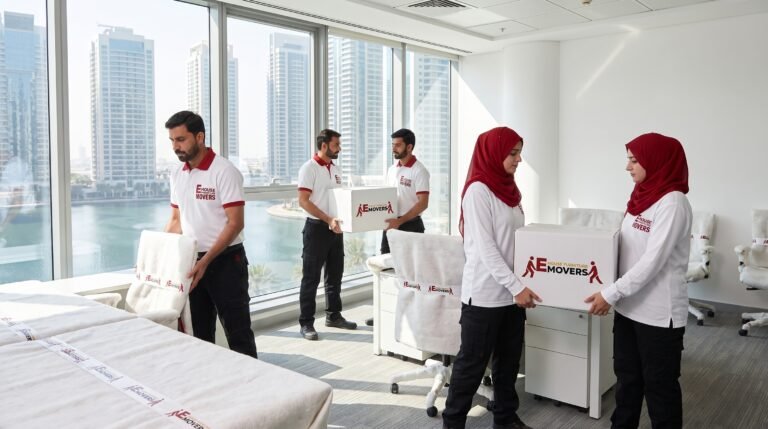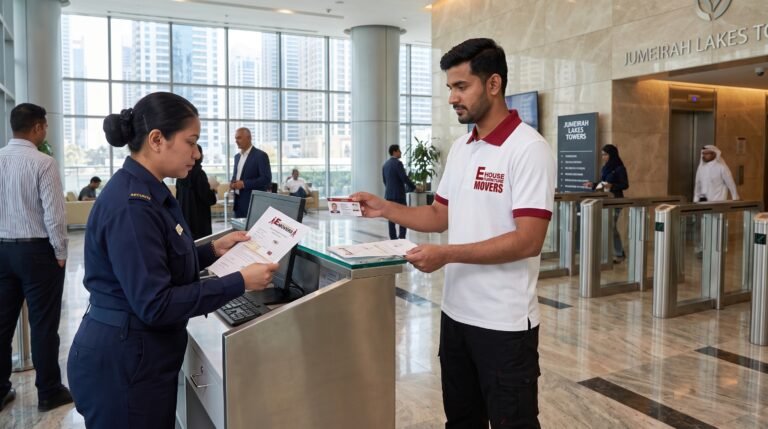


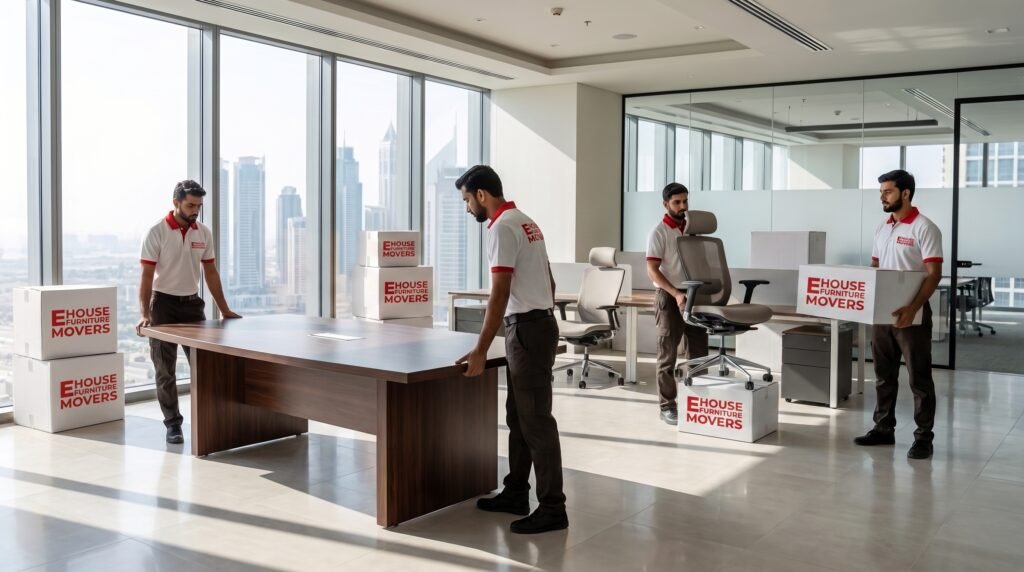
Office furniture relocation is the specialized process of transporting, disassembling, and reassembling office desks, chairs, boardroom tables, filing cabinets, and modular workstations from one location to another while maintaining furniture integrity, preserving warranty coverage, ensuring proper installation, and coordinating with broader office relocation projects.
Office furniture movers in Dubai face unique challenges that distinguish them from standard household furniture moving companies. Unlike home relocations where furniture moves infrequently, commercial office spaces are continuously reconfigured, expanded, downsized, or relocated. Each transition requires specialized expertise in handling expensive commercial-grade furniture systems, understanding complex modular assembly procedures, protecting valuable assets, and maintaining workspace functionality during transitions.
Why office furniture moving requires specialized expertise:
Standard household furniture moving companies treat furniture as generic cargo—move items quickly with minimal care. Office furniture moving demands precision and specialized knowledge. Commercial-grade desks, ergonomic office chairs, and modular workstations manufactured to Dubai fit-out standards represent substantial organizational assets requiring protection. Improper handling damages finishes, breaks assembly connections, voids manufacturer warranties, and creates safety hazards for office workers post-installation.
The scale of the opportunity for furniture movers in Dubai:
Dubai’s business landscape is characterized by continuous workspace evolution. Companies regularly:
- Expand office capacity requiring new furniture acquisition and relocation
- Downsize and consolidate operations reducing furniture footprint
- Reorganize workspace layouts adopting open-plan, hybrid, or activity-based working
- Relocate to new premises within Dubai Emirates
- Upgrade aging furniture systems to modern ergonomic standards
Each scenario creates demand for expert office furniture movers who understand desks, chairs, boardroom tables, and modular workstations—not as individual items, but as interconnected workspace systems requiring coordinated disassembly, transport, and reassembly.
This comprehensive guide addresses the complete office furniture relocation process: understanding furniture types and their moving requirements, disassembly and reassembly procedures, cost factors affecting pricing (AED 80-150 per workstation desk is typical), coordination with furniture manufacturers (Hettich, Häfele modular systems common in Dubai fit-out standards), and integration with broader office moving projects.
For organizations planning broader office relocations, understanding how to choose office movers in Dubai using comprehensive vendor evaluation criteria ensures selected movers have furniture expertise alongside general relocation capabilities. Similarly, complete office moving pricing guides help budget for furniture relocation as a cost component within total project expenses, while office relocation timelines enable proper scheduling of furniture moves within project workflows.
What Is Office Furniture and Why Does It Require Specialized Moving?
Defining Office Furniture: Categories, Materials, and Complexity
Office furniture encompasses desks, chairs, tables, cabinets, and modular workstations manufactured to commercial standards, designed for business environments, featuring specialized assembly, and representing significant organizational assets requiring professional handling.
Office furniture differs fundamentally from residential furniture in purpose, construction, durability, and assembly complexity.
Purpose distinction:
- Residential furniture is designed for personal use in homes, with moderate usage expectations
- Office furniture is engineered for intensive daily business use, supporting productivity, ergonomics, and professional environments
Construction standards: Office furniture is manufactured to commercial durability standards exceeding residential expectations. Commercial desks withstand constant use, paper handling, equipment placement, and frequent repositioning. Office chairs support continuous sitting throughout workdays for years. These durability demands require superior materials, engineering, and manufacturing processes.
Assembly complexity: Residential furniture typically features simple assembly (four legs + tabletop). Commercial office furniture, particularly modular systems, involves complex assembly procedures, precision alignment, cable management integration, and specialized fastening systems requiring technical expertise.
Asset value: Office furniture represents substantial organizational capital. A single modular workstation desk costs AED 2,500-5,000. A complete boardroom table for 12-20 seaters ranges AED 8,000-20,000. A quality ergonomic office chair costs AED 1,500-3,500. Large offices may have furniture assets worth millions of AED, making proper handling essential for protecting investment value.
Primary Office Furniture Categories
Desks and workstations:
Standard workstation desks are the foundation of office furniture systems:
- Single-user desks: AED 80-150 when moved professionally (complete disassembly, transport, reassembly)
- Width: 1,200-1,600mm (4-5.2 feet)
- Depth: 600-800mm (2-2.6 feet)
- Height: Adjustable (680-1,160mm for seated work, standing work support)
- Materials: MDF with laminate finish, particle board, or premium plywood
- Assembly: Leg systems with fasteners, cable management trays, modular components
- Special requirements: Cable passage management, ergonomic positioning, monitor arm integration
Modular workstations (Hettich/Häfele systems common in Dubai):
- Components: Multiple desk units connected via frame systems
- Configurations: Benching systems supporting 4-10 user workstations per bench
- Assembly complexity: Precision-aligned frame systems, cable management infrastructure, partition integration
- Moving cost: AED 150-300 per unit (increased complexity from single desks)
- Häfele modular systems: European engineering standard adopted by Dubai fit-out specialists
- Special considerations: Manufacturer specifications must be followed for reassembly warranty validity
Office chairs:
Ergonomic office chairs represent essential equipment:
- Task chairs: Basic adjustable chairs, AED 800-1,500
- Executive chairs: Premium ergonomic design, AED 2,000-4,000
- Specialist chairs: Gaming-style, contoured, specialized ergonomic, AED 1,500-3,500
- Components: Base, pneumatic cylinder, backrest, seat cushion, armrests, casters
- Moving considerations: Chairs are relatively simple to move but require careful handling to prevent caster damage and mechanism failure
- Reassembly: Typically plug-and-play assembly (base + seat connection)
Boardroom and meeting tables:
Meeting tables serve critical collaboration functions:
- Small conference tables (4-6 seater): AED 2,000-5,000
- Medium boardroom tables (8-12 seater): AED 5,000-12,000
- Large boardroom tables (12-20 seater): AED 8,000-20,000+
- Materials: Solid wood, engineered wood, glass tops, combination finishes
- Assembly: Typically one-piece construction (minimal disassembly) with pedestal or leg systems
- Weight: Large boardroom tables weigh 200-500kg requiring specialized transport equipment
- Cable management: Modern boardroom tables integrate power, data, and video conferencing cabling requiring careful preservation during moving
Filing cabinets and storage:
Commercial filing systems:
- Vertical filing cabinets: 4-6 drawer configurations, AED 1,200-3,000
- Lateral filing: 2-4 drawer systems, AED 1,500-3,500
- Mobile filing: Wheeled carts and portable systems, AED 800-2,000
- Special requirements: Weight distribution, drawer mechanism preservation, caster functionality
- Content management: Deciding what documents to relocate vs. dispose of before moving
Why Office Furniture Requires Specialized Moving
Warranty preservation:
Manufacturer warranties typically require proper disassembly and reassembly procedures. Improper moving voids warranties—leaving organizations liable for repairs. Professional furniture movers understand manufacturer specifications ensuring warranty validity post-relocation. Hettich and Häfele systems have specific assembly protocols that must be followed to maintain coverage.
Damage prevention:
Professional furniture movers understand:
- Finishes: How to protect laminate, veneer, and painted surfaces from scratches and impact damage
- Assembly connections: Proper disconnection preventing stripped screws, broken fasteners, or joint damage
- Hardware: Careful handling of hinges, casters, and mechanical components preventing damage
- Padding and protection: Strategic wrapping preventing nicks, dings, and cosmetic damage
Amateur moving often damages finishes, breaks assembly points, or causes mechanical failures reducing furniture value and functionality.
Workspace continuity:
Professional furniture moving ensures:
- Rapid deployment: Desks, chairs, and tables are reassembled and operational upon arrival, enabling immediate workspace functionality
- Proper configuration: Furniture is positioned according to workspace design specifications, ergonomic standards, and cable management requirements
- Cable integration: Electrical outlets, data connections, and video conferencing systems are properly reconnected during reassembly
- Safety: Properly assembled and positioned furniture prevents tipping hazards, unstable configurations, and ergonomic problems
Furniture Disassembly: The Critical First Step in Professional Furniture Moving
Understanding Why Disassembly Is Necessary
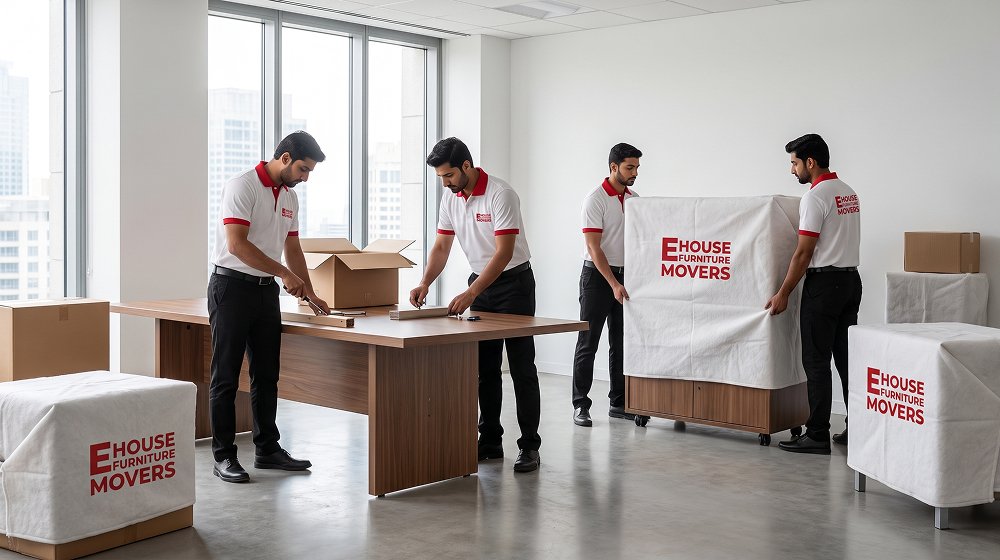
Furniture disassembly breaks office furniture into transportable components, reducing overall moving volume, protecting finishes from damage, and enabling professional reassembly at the destination.
Not all office furniture requires disassembly. Large one-piece items (boardroom tables, solid wood cabinets) often move as single units. However, modular workstations, desk systems with legs, and multi-component furniture benefit significantly from disassembly.
Disassembly benefits:
Volume reduction: Disassembled furniture occupies 40-60% less transport volume than assembled pieces. This reduces vehicle requirements and transportation costs.
Damage prevention: Disassembly removes fragile components (legs, extending surfaces) from potential impact damage. Legs, drawers, and protruding elements are the most damage-prone parts of assembled furniture.
Assembly precision: Disassembly allows movers to separate components, document assembly procedures, and reassemble with manufacturer-specified precision. This is essential for modular systems where precise alignment affects functionality.
Special handling: Some components (glass tops, specialty finishes) benefit from individual protection and handling separate from framework.
Professional Disassembly Procedure
Day 1-2 Before Moving: Assessment and Planning
Step 1: Document existing configuration.
Before disassembly begins, professional movers photograph and document:
- Current workspace layout and furniture arrangement
- Cable connections and power/data routing
- Assembly configuration (leg attachment points, panel arrangements)
- Special features (monitor arm positions, keyboard trays, adjustable components)
- Damage or wear requiring attention
This documentation enables reassembly matching the original configuration.
Step 2: Identify disassembly requirements.
Movers assess each piece:
- Which components should be disassembled (vs. moved intact)
- Fastening methods (screws, bolts, clips, dowels)
- Hardware preservation requirements (collect fasteners, document placement)
- Specialized tools required (hex keys, screwdrivers, cable disconnection tools)
- Manufacturer specifications (Hettich/Häfele assembly guides)
Step 3: Prepare a disassembly workspace.
A dedicated staging area is established for disassembly:
- Flat work surface for component placement
- Organization system for fasteners (labeled containers, photography of placement)
- Protective covering preventing damage
- Climate-controlled environment (if furniture contains sensitive materials)
Moving Day: Supervised Disassembly
Step 1: Disconnect electronic components.
Before any disassembly:
- Power down all connected equipment (monitors, task lights, devices)
- Photograph and label all cable connections (power, data, video)
- Disconnect cables carefully, coiling and labeling each
- Store cables separately, organized by destination furniture piece
Step 2: Remove shelves, drawers, and removable components.
- Withdraw drawers fully, noting position and operation
- Remove shelves from cabinet systems
- Disconnect extending surfaces (pull-out desk surfaces, adjustable shelves)
- Place components on protective padding
Step 3: Detach legs and base systems.
Using appropriate tools:
- Disconnect pedestal bases or leg assemblies
- Remove fasteners (bolts, screws, clips), placing in labeled containers
- Photograph fastener locations for reassembly reference
- Disconnect cable management trays or undercarriage components
Step 4: Detach work surfaces if removable.
For modular systems:
- Disconnect work surface from base frame
- Handle edges carefully (laminate edges can chip)
- Protect surface finish with padding
- Note any special fastening systems requiring manufacturer documentation
Step 5: Organize and label components.
As disassembly progresses:
- Group components by furniture piece
- Label each component clearly (e.g., “Desk-001 Top”, “Desk-001 Legs”, “Desk-001 Hardware”)
- Create hardware organization containers (drawer, box, bag for each furniture piece’s fasteners)
- Photograph each furniture piece’s components in organized arrangement
- Create written checklist confirming all components are accounted for
Transport: Protecting Furniture During Movement
Vehicle Selection for Office Furniture
Professional furniture moving requires vehicles with:
Adequate cargo space: Fully enclosed cargo areas preventing weather exposure and providing security
Cargo protection: Interior padding, cargo rails, or securing systems preventing container movement during transport
Climate control: Optional for sensitive finishes or materials (high-humidity environments affecting veneers or particle board)
Lifting equipment: Dollies, moving blankets, and padding for protecting finishes
Organization: Organized loading preventing furniture piece mixing and enabling systematic unloading
Loading Procedures: Systematic Organization

Systematic loading prevents damage and enables rapid unloading:
Step 1: Protect all components.
- Wrap exposed surfaces (tops, finished edges) with moving blankets
- Use cardboard edge protection for sharp corners
- Pad all protruding hardware (hinges, casters)
- Protect glass surfaces (tabletops) with special glass padding
Step 2: Load strategically.
- Place heaviest components (tabletops, bases) first, lowest in vehicle
- Layer lighter components above (cushions, backs, accessories)
- Group components by destination room/area enabling sequential unloading
- Separate delicate items requiring special handling
Step 3: Secure cargo.
- Use cargo straps preventing shifting during transport
- Create barriers preventing piece-to-piece contact
- Leave access routes for unloading systematic access
- Ensure driver has clear vision (cargo doesn’t block mirrors/windows)
Professional Reassembly: Completing the Relocation
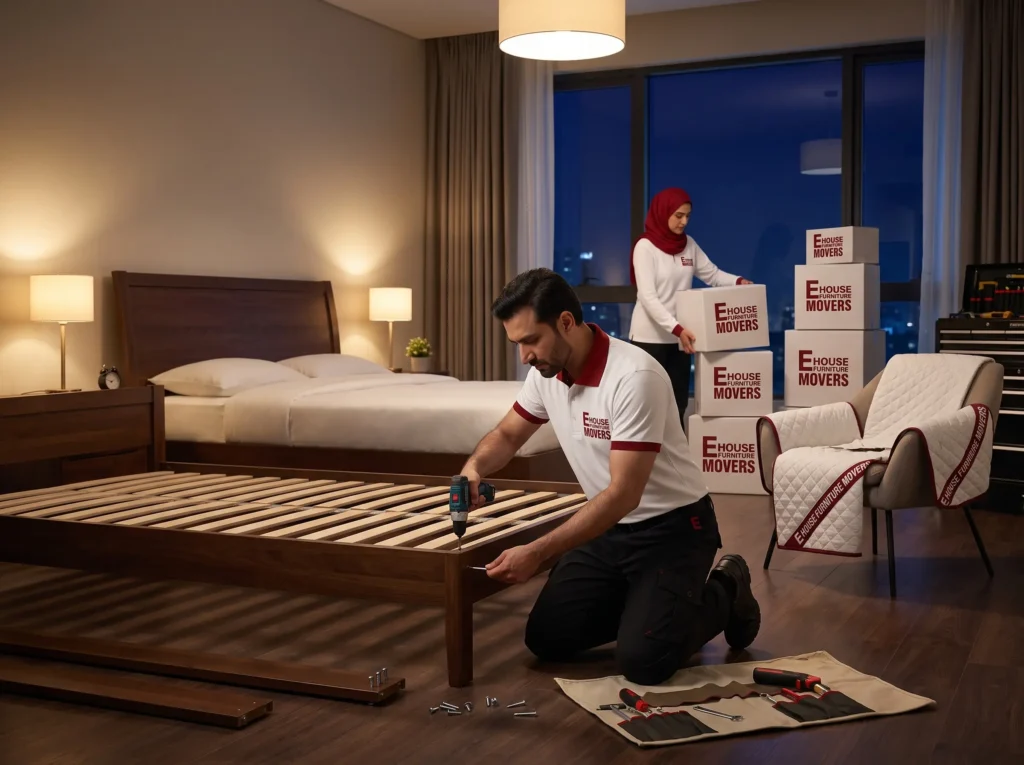
Pre-Reassembly Preparation at Destination
Before any reassembly begins:
Step 1: Position base components.
- Place desk bases/pedestals in exact positions per workspace design
- Ensure level placement on stable flooring
- Align bases in rows or clusters per layout specifications
- Position all bases before adding tops (enables accurate alignment)
Step 2: Prepare work surfaces.
- Unwrap and inspect work surfaces for transport damage
- Clean surface to remove dust/padding residue
- Position near assembly location (within reach of assembly team)
Step 3: Organize fasteners and tools.
- Retrieve labeled fastener containers
- Lay out hex keys, screwdrivers, and specialized tools
- Arrange assembly documentation and photographs
- Have manufacturer specification guides available
Step-by-Step Reassembly Procedure
Step 1: Attach work surfaces to bases.
- Position work surface over base frame
- Align with fastening points (ensure perfect alignment)
- Insert fasteners (bolts, screws, or clip systems)
- Tighten progressively (not completely at first), checking alignment
- Final-tighten fasteners once alignment is confirmed
Step 2: Attach supporting components.
- Install cable management trays under work surface
- Attach shelves or storage compartments
- Install monitor arms or task lighting
- Connect adjustable components (pneumatic supports, extending surfaces)
Step 3: Reinstall drawers and removable components.
- Insert drawers into proper positions
- Ensure smooth operation (drawer slides function correctly)
- Install shelves securely
- Attach any removable accessories
Step 4: Reconnect electronic components.
- Reconnect power cables to proper outlets
- Connect data cables (network, USB, peripherals)
- Reconnect video conferencing or display systems
- Test all connections for proper operation
Step 5: Final positioning and leveling.
- Confirm work surface is level (use spirit level)
- Adjust feet/pedestals for proper height and stability
- Confirm all connections are secure
- Verify ergonomic positioning (chair height relative to desk)
Step 6: Quality verification.
- Test all drawer operation
- Verify all connections function
- Confirm stability and safety
- Document completion with photographs
Boardroom Tables and Large Furniture: Special Handling Procedures
Understanding Boardroom Table Characteristics
Boardroom tables for 12-20 seaters represent expensive, complex pieces requiring specialized moving attention.
Typical specifications:
- Weight: 200-500kg for large tables
- Length: 3,000-6,000mm (10-20 feet)
- Materials: Solid wood, engineered wood, glass tops, specialty finishes
- Assembly: Often one-piece construction with minimal disassembly
- Integrated systems: Power outlets, data connections, video conferencing cables built into perimeter
- Cost: AED 8,000-20,000+ (substantial asset)
Specialized Moving Procedures for Boardroom Tables
Transportation requirements:
- Specialized vehicles: Tables longer than 3 meters require vehicles or flatbeds accommodating full length
- Horizontal transport: Large tables should be transported horizontally (tabletop flat), not vertical
- Multi-person handling: Tables this size require 3-4 trained movers for safe handling
- Protective equipment: Custom crating or heavy padding protecting expensive finishes
Cable management:
Modern boardroom tables integrate power, data, and video conferencing:
- Documentation: Photograph and label all cable connections before moving
- Disconnection: Carefully disconnect integrated cables
- Routing: Plan cable routing at destination before reassembly
- Reconnection: Verify all systems function post-installation
Surface protection:
- Top protection: Specialized glass or finish protection if tabletop is valuable material
- Edge protection: Careful handling of table edges (laminate can chip, veneer can crack)
- Chemical protection: Avoid cleaning products that damage finishes during moving process
Modular Workstations: Hettich and Häfele Systems in Dubai Fit-Out Standards
Understanding Modular Workstation Systems
Modular workstations are interconnected furniture systems combining desks, partitions, storage, and accessories configured for multiple users in benching arrangements or cellular offices.
Dubai fit-out standards increasingly feature modular systems, particularly Hettich and Häfele brands, for their quality, flexibility, and professional appearance.
Why modular systems require specialized moving:
System integration: Components are designed to connect precisely. Improper disassembly/reassembly misaligns connections, creating gaps, unstable structures, or non-functional systems.
Warranty requirements: Manufacturer warranties specify assembly procedures. Hettich and Häfele have documented assembly protocols. Non-compliance voids warranty coverage.
Complexity: Modern modular systems integrate:
- Precision-aligned frame systems
- Cable management infrastructure (power distribution, data routing)
- Panel partitions and sound dampening
- Integrated lighting and climate control
- Specialized fastening systems
Asset value: Modular workstations represent significant investments. AED 4,000-8,000 per workstation is typical, so a 10-person benching system represents AED 40,000-80,000 in furniture assets.
Hettich and Häfele System Specifications
Hettich modular systems:
European engineering standard widely used in Dubai professional fit-outs:
- Frame precision: Modular frames connect with 1mm tolerance requirements
- Cable management: Built-in cable trays and management systems requiring careful reassembly
- Fastening: Proprietary fastening systems (not standard screws/bolts)
- Assembly documentation: Detailed assembly guides provided by Hettich
- Disassembly complexity: Requires trained technicians familiar with Hettich systems
Häfele components:
German-engineered systems featuring:
- Precision hinges and moving parts: Specialized hinges and sliding mechanisms
- Cable integration: Complex cable routing through modular components
- Surface options: Multiple finish options requiring careful handling
- Adjustment systems: Many Häfele systems feature adjustable components (height, width, depth)
Professional Relocation of Modular Systems
Pre-moving assessment:
Professional movers should:
- Obtain manufacturer assembly documentation
- Photograph entire system before disassembly (multiple angles)
- Create system map showing component relationships
- Document cable routing and connections
- Verify original assembly specifications (unusual configurations requiring special procedures)
Systematic disassembly:
- Disconnect and label all cables
- Remove partitions (often stored flat to reduce volume)
- Detach individual workstation units from main frame
- Remove specialized components (task lighting, monitor arms, accessories)
- Organize fasteners in labeled containers
Transport:
- Modular components are lighter individually but more voluminous than assembled
- Organized loading enables sequential reassembly
- Protect all connections and surfaces
Reassembly:
- Reconstructed main frame first (precision alignment critical)
- Installed individual workstations connected to frame
- Reconnected all partitions and accessories
- Reinstalled cable management and integrated systems
- Final testing of all functionality
Pricing and Cost Factors: AED 80-150 Per Workstation Desk and Beyond
Cost Component Breakdown for Office Furniture Moving
Professional office furniture moving costs vary based on furniture type, complexity, moving distance, and service level required.
Workstation desk moving (AED 80-150 per unit):
This price range reflects complete professional service:
- Labor (disassembly): AED 25-40 per desk (15-20 minutes per unit)
- Transport: AED 25-40 per desk (space allocation in vehicle)
- Labor (reassembly): AED 25-40 per desk (15-20 minutes per unit)
- Protective materials: AED 5-10 per desk (padding, wrapping)
- Quality verification: AED 5-20 per desk (testing, positioning, final checks)
Total cost per workstation: AED 80-150
Factors affecting pricing within range:
- Location proximity: In-Dubai moves cost less (AED 80-100) vs. inter-emirate moves (AED 120-150)
- Complexity: Simple desk-only moves (lower end) vs. integrated systems with cable management (higher end)
- Volume: 50+ units receiving economy of scale (potentially AED 60-80 per unit); small quantities (1-5 units) approaching AED 150+
- Condition: Damaged furniture requiring restoration increases cost AED 20-50 per unit
Broader Furniture Relocation Costs
Office chair moving: AED 20-40 per chair
- Simple disassembly/reassembly
- Minimal volume
- Lower labor intensity
Boardroom tables (12-20 seater): AED 800-2,000 per table
- Specialized transport equipment
- Cable management expertise
- Protection for expensive finishes
- Multi-person handling requirement
Filing cabinets: AED 50-100 per unit
- Weight-related handling challenges
- Drawer mechanism verification
- Positioning and leveling
Modular workstations (Hettich/Häfele): AED 150-300 per unit
- Increased complexity from standard desks
- Precision reassembly requirements
- Possible manufacturer-specified technician involvement
- Cable management integration
Total Project Cost Example
Medium office relocation: 15-person office moving to new space
- 15 workstation desks: 15 × AED 100 = AED 1,500
- 15 office chairs: 15 × AED 30 = AED 450
- 1 boardroom table (12-seater): AED 1,200
- 6 filing cabinets: 6 × AED 75 = AED 450
- General labor/coordination: AED 500
- Total furniture moving cost: AED 4,100
This represents the furniture component of broader office relocation budgets. The complete office moving pricing guide provides context for total project budgeting when furniture moving combines with general office equipment relocation.
Summary and Key Takeaways
Office furniture moving in Dubai requires specialized expertise distinct from household furniture relocation. Professional office furniture movers understand:
- Furniture types and characteristics (desks, chairs, boardroom tables, modular workstations)
- Disassembly procedures protecting finishes and preserving assembly precision
- Manufacturer specifications (Hettich, Häfele systems requiring documented protocols)
- Cost factors (AED 80-150 per workstation desk is typical pricing)
- Cable management ensuring electronic integration post-installation
- Workspace coordination positioning furniture per design specifications
FAQ: Common Questions About Office Furniture Moving
A: Organize desks and clear surrounding areas. Document cable connections and take photographs. Gather manufacturer assembly guides (especially for Hettich/Häfele systems). Remove personal items. Confirm moving crew arrival time.
A: Yes, if professional movers follow manufacturer specifications. Hettich and Häfele systems have documented assembly procedures. Choose movers familiar with your furniture brand. Request written confirmation that assembly followed manufacturer specifications.
A: 15-person office: 2-3 days (disassembly day 1, transport day 2, reassembly day 3). Larger offices may require 4-5 days. Timeline depends on furniture complexity and moving distance.
A: Large boardroom tables often move intact due to one-piece construction. However, integrated cables should be carefully disconnected before moving. Professional movers determine disassembly requirements based on table specifications and transport distance.
A: Positioning furniture per workspace design specifications, disassembly/reassembly of all components, cable reconnection and testing, leveling and stability verification, quality checks confirming all functionality, completion documentation.
A: Cables are photographed and labeled before disconnection. During transport, cables are organized separately. Upon reassembly, cables are reconnected to the same connection points. IT personnel verify power and data connectivity before the workspace goes live.
Sarmast Baloch is a distinguished content strategist and industry writer with multiple years of specialized expertise in the self storage and residential relocation sector. His work reflects a deep command of moving logistics, storage optimization, and consumer-facing relocation strategies, consistently delivering authoritative and insight-driven content that bridges the gap between industry knowledge and everyday decision-making. Over the years, Sarmast has built a strong reputation for crafting meticulously researched, data-informed narratives that empower homeowners, renters, and businesses to approach relocation with clarity and confidence. His editorial contributions span a broad spectrum of moving and storage subjects, from cost analysis and vendor evaluation to long-distance logistics and space management solutions. A trusted voice in the moving and storage landscape, Sarmast brings a rare combination of analytical rigor and accessible storytelling to every piece he produces, making him an invaluable authority at eHouseMovers.com.