

A modular workstation is not a desk with legs. It is a system of panels, connector bolts, cable trays and hinge fittings engineered to come apart and go back together on a schedule, and taking one apart the wrong way turns a two-hour job into a half-day repair.
Most Dubai fit-outs run on two European hardware families: Hettich, which supplies the cam locks, hinges and drawer runners inside desking and storage units, and Hafele, which anchors partition connectors, leg levellers and cable management across open-plan systems. Office workstation movers in Dubai price disassembly and reassembly at AED 80 to 150 per desk depending on which hardware family is involved and how the panels are configured.
The sections below cover what each hardware system requires at teardown, what a cubicle reassembly actually involves step by step, and what changes when a floor converts from open-plan to private offices during the same move.
What Does Workstation Disassembly Actually Involve?
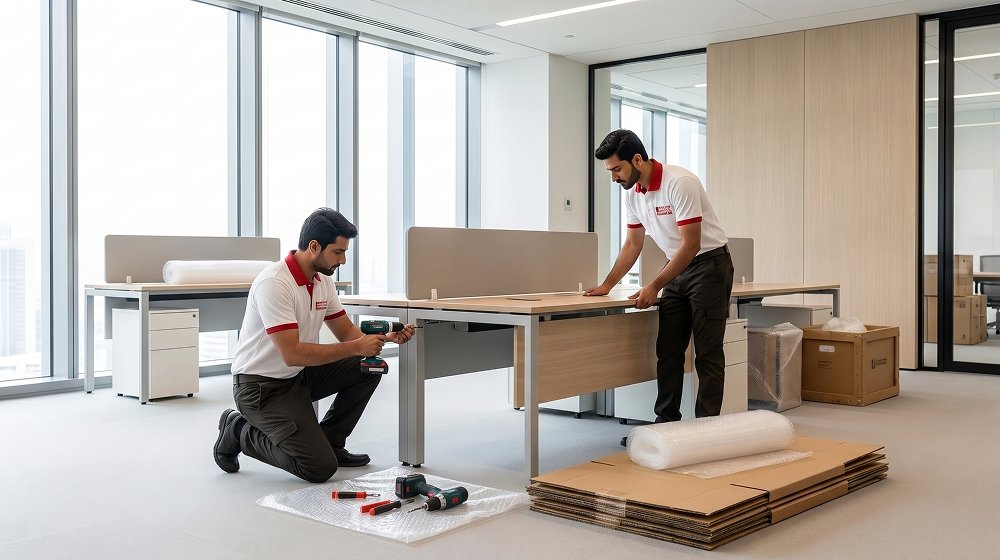
Workstation disassembly is the controlled removal of panels, connectors and cabling in a sequence that lets the same unit rebuild identically at the destination. It is not furniture removal. A standard desk unbolts from the floor and goes on a truck. A modular workstation is a connected system: panels lock into shared frames, cable trays run continuously between bays, and privacy screens hang on brackets shared with the neighbouring desk.
Three failure points account for most reassembly problems on Dubai sites:
- Mixed hardware batches. A cluster fitted out in phases sometimes mixes Hettich and Hafele connectors on adjacent desks; swapping a bolt from the wrong family strips the thread on the first turn
- Unlabelled small parts. Cam locks, minifix housings and levelling feet look identical across desks but are sized to a specific panel thickness; a mover who bags hardware by desk number avoids a rebuild delay, one who doesn’t creates it
- Cable tray continuity. Where trays run desk to desk, disconnecting the wrong bracket collapses the tray under its own cable weight during transport
What Do Hettich Fittings Require at Teardown?
Hettich hardware anchors the moving parts of a workstation: drawer runners, cabinet hinges and the cam-and-bolt connectors that join desk panels to their frames. Each carries its own removal sequence.
| Component | Function | Disassembly Note |
|---|---|---|
| Cam lock connectors | Join panel to frame at a fixed torque | Back out the cam a quarter turn before pulling the bolt, or the housing cracks |
| Sensys and Intermat hinges | Soft-close cabinet and overhead storage doors | Detach the hinge arm from the cup before removing the door, not after |
| Quadro and Actro runners | Drawer glide systems under load | Release the rear latch first; forcing the drawer out front-first bends the runner rail |
| Levelling feet | Desk height and floor compensation | Mark the height setting before unscrewing, since retensioning blind adds 5 to 10 minutes per leg at reassembly |
None of these steps are difficult individually. What makes Hettich-fitted desks slower to move is volume: a 40-desk cluster carries roughly 160 cam connectors and 80 sets of levelling feet, and a rushed crew that skips the height marking step adds noticeable time back at the destination.
What Do Hafele Fittings Require at Teardown?
Hafele hardware anchors the structure of the partition system itself: the connector housings joining panel to panel, the cable management channels running through the frame, and the glass-panel clamps used on higher-spec screens.
- Panel-to-panel connectors use a locking cam similar in principle to Hettich’s but sized differently; the two are not interchangeable, and forcing a Hafele bolt into a Hettich housing strips both
- Cable channels run inside the frame rather than in a surface tray on higher-end Hafele systems, so the frame itself has to open before the cable can be freed, adding a step a standard desk teardown doesn’t have
- Glass partition clamps carry a torque spec tight enough that over-loosening cracks the glass edge; a crew trained on laminate panels alone sometimes over-torques the first clamp on a glass-fronted office
Hafele Middle East has supplied fittings on projects including the Burj Khalifa and Emirates Palace since establishing its Dubai office in 1997, and its current UAE catalogue, viewable on hafele.ae, lists the specific connector and hinge ranges most commonly found in Business Bay and DIFC fit-outs. Matching the disassembly crew’s hardware knowledge to the actual brand on site, rather than treating all partition systems as generic, is the difference between a clean rebuild and a repair job.
How Much Does Workstation Disassembly Cost Per Desk?
Workstation disassembly and reassembly runs AED 80 to 150 per desk, with the range set by hardware complexity rather than desk count alone.
| Workstation Type | AED Per Desk | What Drives the Price |
|---|---|---|
| Standard laminate desk, Hettich cam connectors | 80–100 | Simple bolt-and-cam disassembly, no cable channel work |
| Modular cluster with shared cable trays | 100–120 | Tray continuity across desks adds handling time |
| Hafele partition system, laminate panels | 110–130 | Frame-integrated cable channels, panel-to-panel connectors |
| Glass-fronted partition or executive cubicle | 130–150 | Torque-sensitive clamps, higher breakage risk, slower handling |
A 40-desk floor at the standard end of the range costs roughly AED 3,200 to 4,000 for disassembly and reassembly combined; the same floor on glass-fronted Hafele partitions runs closer to AED 5,200 to 6,000. The gap is hardware, not labour hours: glass and frame-integrated cabling simply take longer to do correctly.
How Does Cubicle Reassembly Work Step by Step?
Cubicle reassembly follows the disassembly sequence in reverse, with one addition: every hardware bag gets matched to its desk number before the first panel goes up, not during.
- Frame placement first. The base frame or leg set positions and levels before any panel attaches, using the height marks recorded at teardown
- Panel-to-frame connection second. Cam locks or Hafele connectors join panels to the frame at the same torque recorded on the way out
- Cable routing third. Trays or frame channels reconnect before the desktop surface goes on, since access disappears once the surface is fixed
- Desktop and accessories last. Surface, drawer units and screens attach only after the frame and cabling are confirmed sound
A crew that skips the labelling step at teardown loses this sequence entirely, since a hardware bag with no desk number forces a trial-and-error rebuild that can add 15 to 20 minutes per desk on a large floor.
What Changes When Open-Plan Converts to Private Offices?
An open-plan to private-office conversion adds new partitions on top of standard disassembly, which is a different job from simply moving the same layout to a new address.
- New partition frames install where none existed, which means new Hafele or Hettich connector sets rather than reused hardware, since salvaged fittings are rarely rated for a different panel configuration
- Door sets and glazed partitions for private offices carry their own hinge and lock hardware, typically Hettich Intermat or Hafele Dialock systems, which adds a specialist step beyond standard desk teardown
- Electrical and data points often need repositioning to match the new room boundaries, which is a fit-out task that runs alongside the furniture move rather than as part of it
A conversion project is priced separately from straight relocation because the new partition hardware is purchased, not reused; the AED 80 to 150 per-desk range above covers disassembly and reassembly of existing workstations, not new partition construction.
How Does Workstation Work Fit Into a Larger Office Move?
Workstation disassembly runs as its own workstream inside a larger move, timed against whichever execution model the floor uses. On a single-weekend move, it happens Friday evening at origin and Saturday at destination. On a phased project, it sits inside the business-services wave, after the IT core is live and before department heads verify their teams’ desks; the full wave sequence is covered in Phased Office Moves in Dubai.
Desk count is one of the inputs that sets the overall project timeline, since a 40-desk cluster with glass partitions takes longer to strip and rebuild than the same desk count in standard laminate.
Conclusion
A modular workstation is a system, not a piece of furniture, and it moves like one. Hettich hardware governs the moving parts, Hafele governs the partition structure, and neither forgives a mismatched bolt or an unlabelled bag of hardware. AED 80 to 150 per desk buys a rebuild that goes back together the way it came apart. The 15 minutes a crew spends marking height settings and bagging hardware by desk number is the difference between that and a repair bill.
Frequently Asked Questions
AED 80 to 150 per desk, depending on hardware. Standard laminate desks with Hettich cam connectors sit at the lower end; glass-fronted Hafele partitions sit at the top.
Hettich supplies the moving parts, cam locks, hinges and drawer runners, while Hafele anchors the partition structure, panel connectors, cable channels and glass clamps. The two hardware families are not interchangeable.
Not without hardware-specific training. Mixing a Hettich bolt into a Hafele housing, or the reverse, strips the connector on the first turn, which is why hardware identification happens before teardown starts, not during it.
A correctly labelled standard desk reassembles in roughly the same time as disassembly, about 15 to 25 minutes. An unlabelled hardware bag can add 15 to 20 minutes of trial and error per desk on a large floor.
Yes, because new partition hardware is purchased rather than reused. The per-desk disassembly and reassembly range covers existing workstations only, not new partition construction.
Inside the business-services wave, after the IT core infrastructure is live at the destination and before department heads verify their teams’ desks are functional.
Sarmast Baloch is a distinguished content strategist and industry writer with multiple years of specialized expertise in the self storage and residential relocation sector. His work reflects a deep command of moving logistics, storage optimization, and consumer-facing relocation strategies, consistently delivering authoritative and insight-driven content that bridges the gap between industry knowledge and everyday decision-making. Over the years, Sarmast has built a strong reputation for crafting meticulously researched, data-informed narratives that empower homeowners, renters, and businesses to approach relocation with clarity and confidence. His editorial contributions span a broad spectrum of moving and storage subjects, from cost analysis and vendor evaluation to long-distance logistics and space management solutions. A trusted voice in the moving and storage landscape, Sarmast brings a rare combination of analytical rigor and accessible storytelling to every piece he produces, making him an invaluable authority at eHouseMovers.com.
Idris is a logistics specialist with a focus on residential relocation and supply chain efficiency. With extensive experience in the moving industry, he specializes in transit safety, specialized packing techniques for high-value goods, and fleet management. He is dedicated to streamlining the moving process, ensuring that every relocation is handled with strategic planning and maximum care.