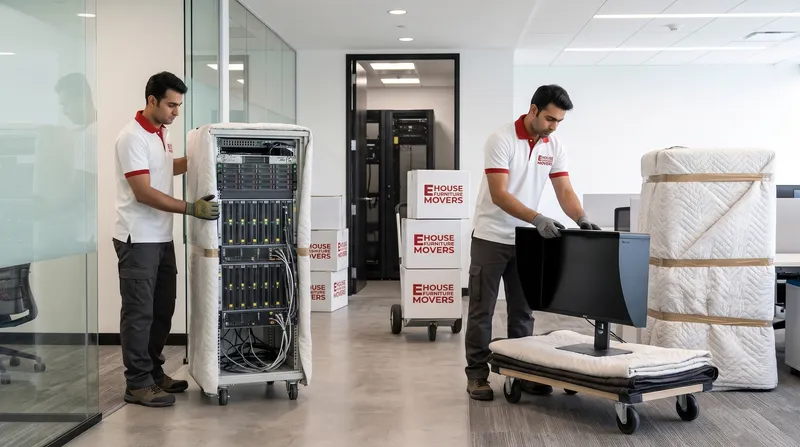
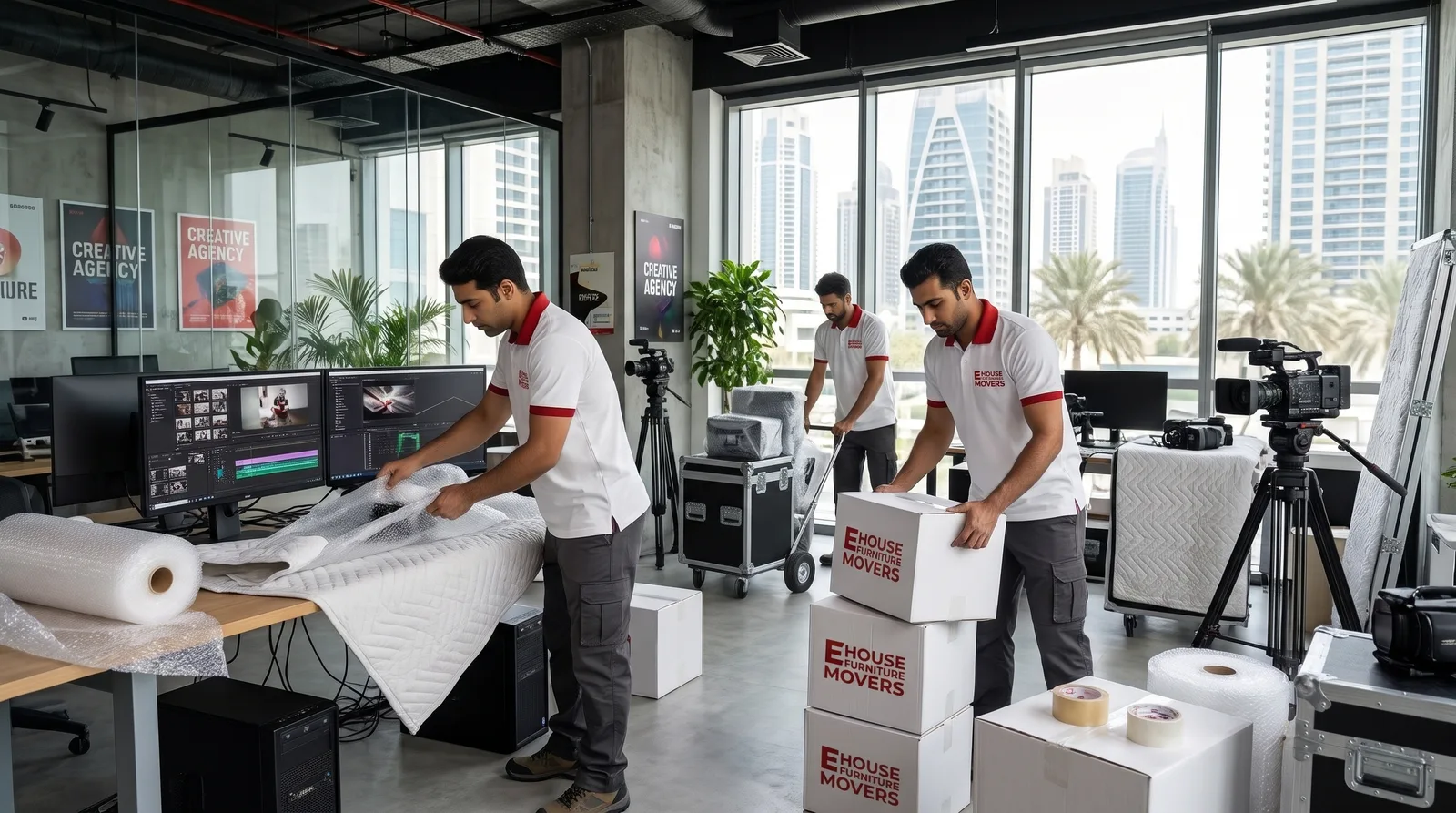
Moving a media, creative, or advertising agency in Dubai is complicated when client deadlines cannot wait. One damaged camera, missing project drive, or disconnected edit suite can delay campaign production and client approvals. That makes professional media agency office movers in Dubai essential for protecting fragile equipment and maintaining business operations.
This guide covers studio equipment handling, edit-suite transfers, colour-calibrated monitors, server protection, free-zone approvals, and strategies to minimize downtime during live campaigns.
Why Agency Moves Risk Fragile Creative Gear
Agency inventories include equipment that looks ordinary until its working connections disappear. A workstation may contain client-approved colour profiles. A server may hold shared media that six editors access. A brand prototype may have no replacement before a product launch.
What creates the highest relocation risk?
Four areas deserve separate controls:
- Physical damage: Lens mounts, sensor surfaces, monitor panels, microphone capsules and lighting connectors need fitted protection.
- Missing dependencies: Fonts, plug-ins, media paths, dongles and network credentials may not travel with an edit-suite computer.
- Data exposure: Unreleased campaigns and audience databases require controlled custody. The UAE Government identifies Federal Decree-Law No. 45 of 2021 as the country's personal-data protection framework.
- Schedule interruption: A late storage reconnection can block an export even when every crate reaches the new office.
Assign each high-value item an asset ID, serial number, condition photograph, custodian and receiving-room code. Record accessories separately. For creative office relocation, acceptance means a successful functional check, not a signed delivery slip alone.
Edit Suite, Studio & Camera Equipment Handling
Edit suite, studio, and camera equipment relocation requires careful packing, secure transport, and precise technical reconnection. Protecting production files, maintaining shared storage connections, and testing equipment after delivery help prevent disruptions to creative projects.
How do you move an edit suite without breaking projects?
Make a validated project copy before disconnecting its workstation. Adobe documents Premiere's Project Manager > Collect Files and Copy to New Location option. Include the required sequences, linked footage and relevant previews, then open the copy on another machine. Check fonts, plug-ins, audio outputs and render settings separately.
Shared editors need more than an internet connection. Adobe's 2026 storage guidance specifies 1 Gbps Ethernet for HD workflows and 10 Gbps for 4K shared-network workflows. Its Productions guidance sets 1 Gbps per workstation as a minimum and recommends 10 Gbps or faster for larger productions. Keep media caches on local drives and preserve Windows drive letters or macOS volume names.
Before dispatch, label switch ports, storage connections, audio interfaces and power supplies. Move one complete edit station first. Restore a real project and test playback before the remaining editing desks leave.
How should studio, camera and brand assets be packed?
Separate cameras, lenses, lights and audio gear according to their failure points. Nikon recommends sturdy protective packaging and removing memory cards and batteries when shipping cameras for service. Apply model-specific transport instructions and applicable battery rules to your move.
The equipment handling table defines what movers protect and what your technical team verifies.
Equipment | Packing and custody control | Acceptance test |
Camera bodies and lenses | Fitted padded cases; capped mounts; separate accessory log | Autofocus, sensor inspection, test footage |
Studio lights and modifiers | Protect glass, yokes, stands and control modules separately | Power, dimming, mounting and colour settings |
Edit workstations | Label cables and expansion hardware; stabilize internal components | Open project, audio interface, export |
Colour-reference monitors | Original fitted packaging where possible; upright panel protection | Pixel inspection, calibration profile, reference image |
NAS drives and servers | Antistatic protection, drive-slot records, sealed custody | Array health, shares, user permissions, restore test |
Client artwork and brand props | Flat rigid sleeves or dedicated crates; numbered seals | Artwork version, surface condition, item count |
For bare drives, Seagate advises antistatic packaging and individual cushioning. It warns against loose packing peanuts and newspaper in its shipping instructions. Keep confidential drives under an assigned custodian rather than in untracked mixed cartons.
Colour-Calibrated Monitor & Server Care
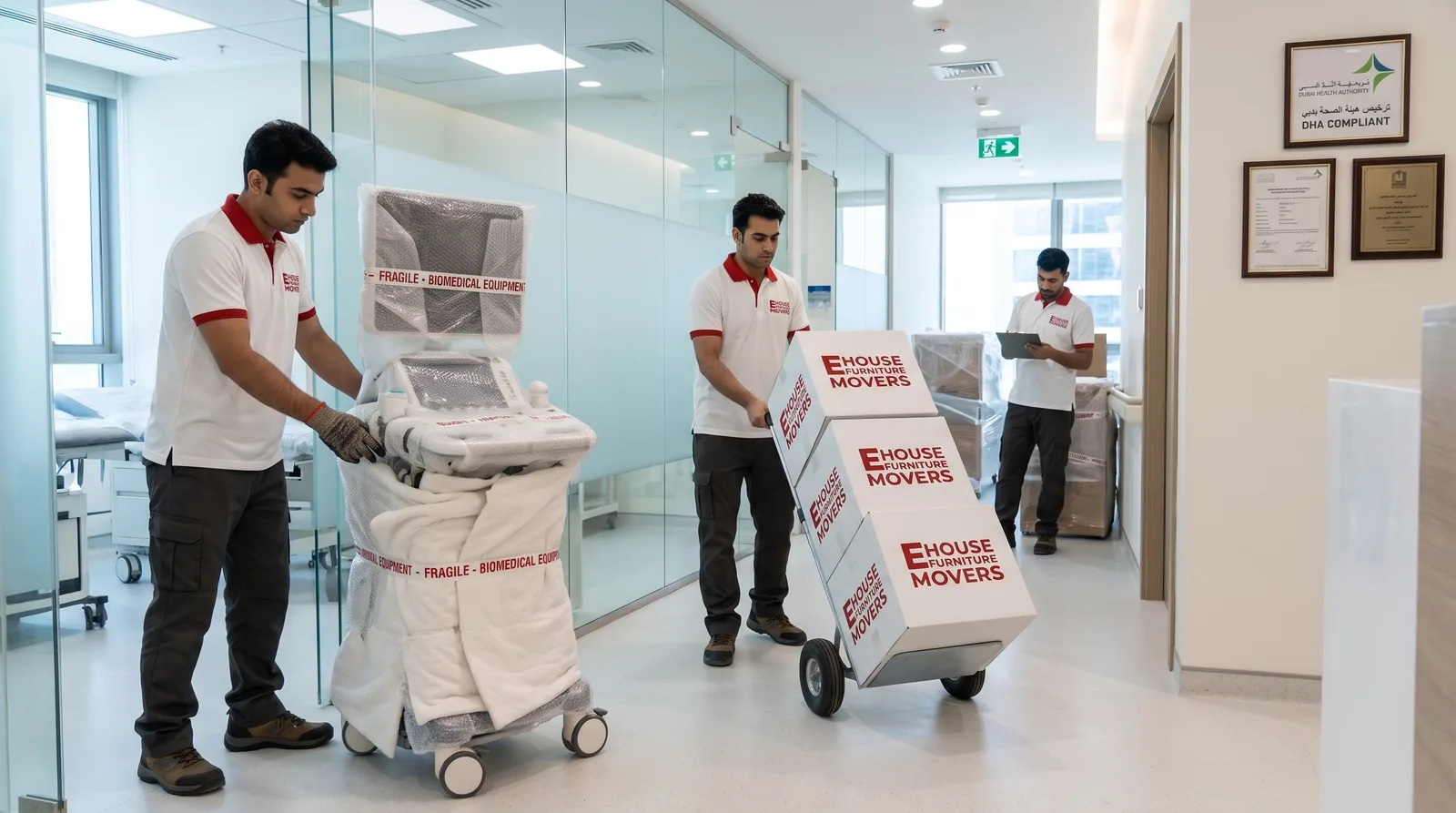
Colour-calibrated monitors and servers require careful handling during media agency office relocation in Dubai to protect display accuracy and stored production data. Proper packing, controlled transport, and post-move calibration checks help maintain colour consistency and equipment performance.
What happens to calibrated displays after transport?
A monitor can power on yet fail a colour-critical approval check. New room lighting, reflections, changed signal chains and saved settings affect the viewing environment. Verify the display's target before approving artwork or footage.
EIZO recommends recalibrating graphics monitors every 200 to 300 operating hours, approximately monthly under ordinary use. Its example illustrates a 5,000 K white point and 100 cd/m² brightness drifting to 4,500 K and 90 cd/m² over time. These are illustrative measurements, not guaranteed changes after moving.
Record each display's colour space, brightness, white point, gamma, measurement profile and last calibration date. Reconnect the original video signal route. Then measure the screen and review a previously approved reference image under controlled lighting.
How do you protect servers and campaign archives?
Shut storage down cleanly, label every rack connection and document drive locations where the hardware requires it. Test recovery before dispatch. A green backup indicator alone cannot prove that archived footage opens.
The Australian Cyber Security Centre recommends the 3-2-1 backup approach:
- 3 copies
- 2 media types
- 1 offsite copy
Keep recovery credentials separate from packed devices. Check share permissions, project databases and remote access after reconnection.
For confidential creative assets, record who collected, transported and received each drive. Personal-data handling must reflect applicable law and client contracts; not every campaign file contains regulated personal data.
Media City / d3 Free-Zone Access
Dubai Media City, Dubai Internet City and Dubai Design District (d3) fall within Dubai Development Authority's regulatory jurisdiction for TECOM districts. Their property managers still control practical access to buildings; goods lifts and loading areas.
d3's April 2025 figures, published by TECOM Group, show over 1,100 businesses and 20,000 creative professionals. Those numbers help identify the district's creative-business concentration; they do not establish permit fees or loading availability.
Which approvals apply to an agency relocation?
Media, creative, and advertising agency relocation in Dubai may require a company address amendment, building access permission, and a studio fit-out permit, depending on the relocation scope. Dubai Development Authority (DDA) regulates applicable licensing changes and fit-out approvals within TECOM business districts.
- Company address: According to the Dubai Development Authority (DDA), changing a company's registered address costs AED 520, including an AED 500 service fee and AED 20 in Knowledge and Innovation Dirham charges. The process typically takes one working day, and an authorized representative submits the application through the axs portal.
- Studio fit-out: DDA lists AED 0.90 per square foot, with an AED 200 minimum, AED 10,000 maximum and AED 20 transaction charges. It gives 2 working days as the estimated permit service time and 6 months as permit validity. The contractor applies with required documents, including building-owner consent and drawings.
These examples show DDA area-based permit charges only, excluding construction, removals and other approvals:
Proposed fit-out area | DDA area fee | With AED 20 charges |
800 sq. ft. | AED 720 | AED 740 |
1,500 sq. ft. | AED 1,350 | AED 1,370 |
3,000 sq. ft. | AED 2,700 | AED 2,720 |
An agency installing acoustic partitions or new electrical routes needs a fit-out scope review. Do not assume replacing loose furniture requires the same permit. For permitted work, DDA's completion service lists a Dubai Civil Defence completion certificate among its documents and estimates 2 working days for completion-certificate service.
Agency-specific compliance checklist
Media, creative, and advertising agency office relocation in Dubai requires careful coordination of licensing, building access, fit-out permissions, and equipment security. Use this checklist to verify regulatory compliance and obtain the necessary approvals before moving.
- Confirm licence address and authorized applicant through DDA or your actual licensing authority.
- Obtain building-management approval for vehicles, goods lifts, after-hours access and protective coverings.
- Check landlord consent and fit-out drawings before modifying acoustic walls, electrical systems or server-room services.
- Confirm fire-safety clearances and applicable completion certificates for permitted works.
- Keep serial-number manifests, signed drive custody logs and client confidentiality controls.
- Obtain written access slots for both Media City/Internet City or d3 premises before booking movers.
Minimal-Downtime for Live Campaigns
Minimizing downtime during media and advertising agency office relocation in Dubai requires staged equipment transfers and uninterrupted access to campaign files. A planned relocation schedule keeps editing workstations, shared storage, and essential production systems operational during live client campaigns.
How do agencies move without interrupting live work?
Use a staged cutover with a working fallback edit station. A creative office relocation schedule must follow delivery dates, not merely vehicle availability. Define two internal targets: recovery time objective (RTO), the longest acceptable outage, and recovery point objective (RPO), the maximum acceptable data-loss interval.
For example, your team might choose a two-hour RTO and 15-minute RPO for a campaign being finalized. These are illustrative planning targets, not industry guarantees. Your storage and backup design must demonstrate whether they are achievable.
Follow this five-step production cutover:
- Freeze critical changes: Finish urgent exports and list client approvals still open.
- Verify recovery: Restore a recent project and confirm required fonts, media and credentials.
- Move noncritical equipment: Transfer spare displays, unused props and archived production cases first.
- Activate the destination: Test internet, shared storage, one edit suite, calibrated reference display and client-review access.
- Release the old setup: Decommission the final active station only after a timed test export succeeds.
Keep Your Creative Agency Running Beyond Moving Day
A successful media, creative, and advertising agency office relocation in Dubai goes beyond delivering equipment to a new address. Your edit suites must reopen projects, calibrated monitors must pass accuracy checks, and production teams must regain access to campaign files without unnecessary delays.
Whether you're relocating within Dubai Media City, Internet City, or d3, choose specialist media agency office movers who understand fragile gear, technical reconnection, and building-access requirements. Insist on a detailed moving plan, documented equipment protection, and post-move testing before approving the handover.
Ready to relocate your creative agency?
Request a detailed AED quotation and equipment-specific relocation plan today. Confirm the moving schedule, technical responsibilities, and downtime limits before booking. Your next client deadline deserves a working studio, not a room full of unopened equipment cases.
Frequently Asked Questions
Not for every physical move. DDA address amendments, fit-out approvals and building-access permissions address different activities.
Your campaign deadlines determine the tolerance. Test the chosen RTO and RPO before moving live storage.
No. Prioritize specialist supervision for cameras, reference displays, servers and engineered studio rigs.
The final AED quote depends on equipment quantities, packing cases, technicians, access windows and installation work. DDA fees are separate.
Planning a move?
Get a written, fixed-price quote from our team, usually within 20 minutes.