


Clinic & Medical Centre Relocation
Clinic Relocation in Dubai for Medical Centres
We handle clinic relocation in Dubai for GP clinics, dental practices, specialist centres, physiotherapy clinics, diagnostic labs and the head offices of healthcare groups. Treatment rooms, medical equipment, medicine fridges and patient files are moved as separate parts of the job, each with its own packing and handover steps.
For a clinic, the furniture is the easy part. The real risk is the gap between closing the old site and seeing patients at the new one. Your new premises cannot open until the DHA has inspected them and issued the licence for the new address, so every day of delay is a day with no appointments. As office movers in Dubai, we plan clinic moves backwards from your inspection date, so rooms are set up and equipment is in place before the inspector arrives.
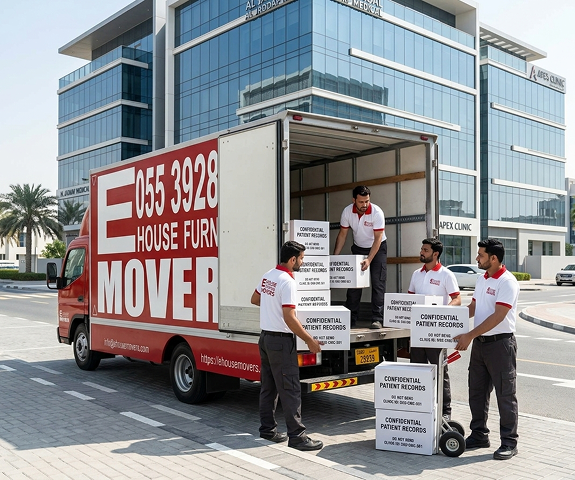
Request a Free Quote
We plan the move backwards from your inspection date
Tell us how many treatment rooms you have, what equipment needs to move and your target inspection date. We arrange a site survey and send a fixed written quote with a move plan built around that date.
What We Move for Clinics
A clinic holds equipment that is heavy, delicate, or both — and the order the rooms move in matters as much as the packing.
Examination Couches & Treatment Chairs
Couches, treatment chairs and procedure tables, moved room by room and placed into their marked positions on your new floor plan rather than stacked in a corridor for your team to sort out.
Dental Chairs & Units
Moved after your dental engineer has disconnected the water, air and suction lines. We lift the chair and unit with the right equipment and set it down where the engineer needs it for reconnection.
Diagnostic Equipment
Ultrasound machines, ECG machines and patient monitors. Packed to the manufacturer’s instructions where the supplier has given them, and carried rather than trolleyed wherever the casing says so.
Lab Equipment
Centrifuges, analysers, microscopes and incubators. Analysers are the single heaviest thing in most clinics after the dental chair, and they are surveyed against lift limits before a date is agreed.
Medicine & Vaccine Fridges
Moved empty and upright. The stock itself should travel separately in validated cool boxes — see the FAQ below, because this is the part of a clinic move that goes wrong most often.
Autoclaves & Sterilisation Equipment
Drained and moved once your team has run them down. Sterilisers are heavy for their size and they do not take being laid on their side.
Lockable Medicine Cabinets & Pharmacy Shelving
Cabinets travel locked and empty, with the keys staying with your team at all times rather than taped to the unit.
Patient Record Files & Archive Boxes
Into lockable crates with numbered seals, on a signed inventory. The whole of section 5 is about this, because it is the part of a clinic that cannot be replaced.
Reception, Waiting Room & Consultation Furniture
Reception desks, waiting room seating and consultation room furniture. The straightforward part of the job, and the part that gets moved last.
Computers, Printers & the Practice Server
Workstations and printers move with the furniture. If your clinic management system runs on its own server or a small rack, that is a separate process with its own labelling and port map — see our server and IT equipment relocation.
X-ray, OPG and CBCT machines are a special case, and we do not take them down. They should be de-installed and reinstalled by the supplier or a licensed engineer. Once they are disconnected and packed to the manufacturer’s instructions, we move them to the new site and place them in the prepared room — and the same engineer should reinstall and test them there.
How We Protect Patient Records
Patient files are the one part of a clinic that cannot be replaced.
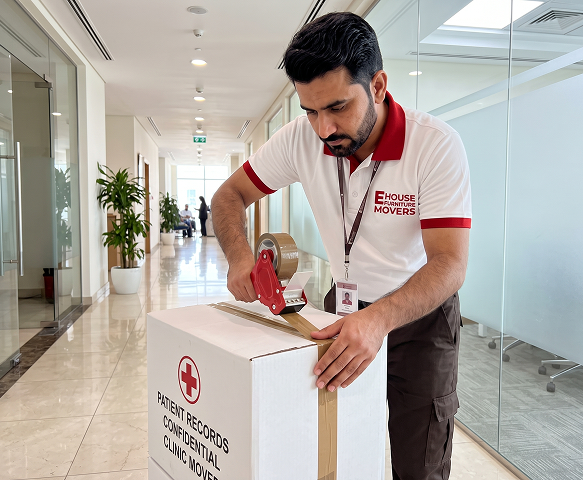
UAE health data law requires clinics to keep patient health data for at least 25 years after a patient’s last treatment, so even an old archive has to be moved safely or stored properly.
This is the same chain of custody process we use for confidential documents moving at law firms, where it is set out in full. If you have old records you no longer need, check the retention rules with your medical director first, then arrange certified destruction before the move rather than paying to transport paper you are about to shred.
-
Sealed, Numbered Crates
Files go into lockable crates. Each crate is closed with a tamper-evident seal that carries its own number, so a crate that has been opened cannot be passed off as one that has not.
-
An Inventory You Keep
Your practice manager decides which shelves or file ranges go into each crate. We record the crate number, the seal number and the contents on a sheet, and you keep a copy of it.
-
Signed Handover at Both Ends
Crates are counted and signed out at the old clinic, then counted and signed in at the new one. Your nominated person checks each seal before a crate is opened.
-
Files Stay with the Crew
Crates travel in a locked truck straight to the new clinic. They are never left in a lobby, a car park or a loading bay — which is where records actually go missing, not in transit.
Our crew does not open folders or sort papers at any point. Files are packed by shelf, drawer or file range exactly as your team instructs, and each crate is sealed as soon as it is full.
Licences and Approvals Your Clinic Handles
Moving a clinic changes its licence. These approvals are your clinic’s responsibility — we do not apply for them, but we build the move plan around them.
DHA Change of Facility Location
You apply through the DHA Sheryan portal. The DHA reviews the application, gives initial approval, inspects the new premises and then issues the licence for the new address. Under the DHA Health Facility Guidelines, moving to a new building follows a process similar to opening a new facility, so the new site must meet current design requirements.
FANR Licence for X-Ray Equipment
If you use X-ray, OPG or CBCT units, the new room must meet FANR radiation safety requirements, and your FANR licence will need updating for the new location. Your radiation safety officer can confirm the steps.
Trade Licence Address
Update your registered address with Dubai Economy and Tourism, or with your free zone authority. It is the step most often left until somebody notices the old address on a prescription pad.
Clinics in Dubai Healthcare City are licensed by the Dubai Healthcare City Authority rather than the DHA, so their steps are different. We ask for your target inspection date at the start and set the main move a few days before it, so the rooms are ready and your team has time to prepare. Your old clinic keeps seeing patients until the last possible day — the new site cannot open before the licence is issued anyway, so there is nothing to gain by closing early.
Our Process for Moving a Clinic
Eight stages, built backwards from your inspection date rather than forwards from the day you hand back the keys.
Site Survey
We walk both sites with your practice manager, list the equipment, count record files and check lifts, doors and loading access.
Move Plan
Dates are fixed around your DHA inspection and around your equipment suppliers’ visits, not around our schedule.
Record Packing
Lockable crates arrive a few days early. Closed archives are packed and sealed first, while the clinic keeps running.
Equipment Disconnection
Your engineers and suppliers disconnect the devices, and your team moves medicines into cool boxes.
Moving Day
Rooms move one at a time: treatment rooms, lab and pharmacy area first, then reception and admin.
Setup to Your Floor Plan
Couches, chairs and equipment go into their marked positions in each room, ready for the inspector rather than ready for unpacking.
Reconnection & Checks
Suppliers reconnect and test the equipment. Record crates are checked against the inventory with your nominated person present.
Old Site Cleared
We empty the old clinic so it can be handed back to the landlord, packing waste included.
Timing the Move Around Patient Appointments
Every other office move is scheduled around a lease date. A clinic move is scheduled around an inspection and an appointment book.
Every closed day is a day with no appointments
Most clinics move from Friday evening through the weekend, or during a short planned closure. Ask your reception team to block appointments for the move days and the inspection day, and give patients the new address well in advance — the address change is the thing patients notice, not the closure.
A multi-department centre cannot move in one go
Larger clinics move in stages. Admin and archives go first, then non-clinical rooms, then treatment rooms and equipment last. That keeps the old clinic working for as long as possible, which matters more here than on any other kind of move.
What Affects the Cost
We give a fixed written quote after the site survey, and it does not move afterwards. Six things set the number.
-
Treatment Rooms & Equipment
The number of treatment rooms and the pieces of medical equipment in them — counted at the survey, not estimated over the phone.
-
Heavy Items
Dental chairs, lab analysers and safes, and what the floor and lift limits allow at both buildings.
-
Patient Files & Archive Boxes
How many crates of records, and whether any of the archive goes to storage instead of to the new clinic.
-
Access at Both Buildings
Lift size and loading bay rules. Access is usually the single biggest swing on a clinic move.
-
One Weekend or Staged
A single-weekend move and a staged move are priced differently, and multi-department centres usually want the staged one.
-
Crates & Storage
Crate rental, and any storage for records or equipment between the two sites if the fit-out runs late.
Frequently Asked Questions
Can you move our dental chairs?
Yes. Your dental engineer disconnects the water, air and suction lines first. We then move the chair and unit with lifting equipment and place it where the engineer needs it for reconnection.
Do you move X-ray and CBCT machines?
Yes, once the supplier or a licensed engineer has taken them down and packed them. The same engineer should reinstall and test them at the new site. Your FANR licence also needs updating for the new room.
Will your crew see our patient records?
No. Files are packed by shelf, drawer or file range as your team instructs. Our crew does not open folders, and each crate is sealed as soon as it is full.
How do you move our medicine and vaccine fridges?
We move the fridges empty and upright. The stock should travel in validated cool boxes with temperature loggers, handled by your team or a pharmaceutical courier, so your records show the temperature stayed in range.
Do you get the DHA licence for our new address?
No. Your clinic applies for the change of location through Sheryan. We plan our move dates around your approval and inspection.
Can you store our equipment if the new clinic is not ready?
Yes. If the fit-out runs late, equipment and sealed record crates can go into storage and be delivered when the new site is ready.
Plan Your Clinic Move
1date
your DHA inspection — everything else is planned backwards from it
Tell us how many treatment rooms you have, what equipment needs to move and your target inspection date. We will arrange a survey and send a fixed quote with a move plan built around that date. Call or WhatsApp +971 55 392 8484.